Biochar: the Black 'Magic' of Terra Preta
How a high-surface-area carbon lattice may drive soil microbial communities across a threshold into a self-stabilizing, high-fertility state, and why terra preta is grown rather than manufactured
Abstract
Amazonian dark earth (terra preta) is more fertile, more biologically active, and more persistent than the weathered tropical soils it overlies, holding fertility for centuries after abandonment. This paper advances a single mechanistic hypothesis and the established science motivating it: that a durable, high-surface-area pyrogenic carbon lattice acts as a multifunctional shared substrate which, supplied together with comprehensive mineral resources and a microbial inoculum, lets ordinary soil self-organize under selection into a qualitatively different state of ecological organization, its endpoint shaped by founding conditions and local biota, not fixed. The argument has four parts. First, the carbon lattice supplies habitable space, ion-exchange capacity, nutrient and water reservoirs, and, once conditioned, the predicted retention of community signals, through pore-size classes and surface chemistries that mature on different timescales. Second, the predicted rise in microbial density and proximity switches on a community economy governed by quorum sensing and metabolic division of labor; across an evolutionary clock, the Black Queen dynamic of adaptive gene loss compounds that economy, deepening interdependence, and deepening stability only where the shared pool is reliably replenished. Third, the positive feedbacks of that economy are the formal prerequisite for an alternative stable state, and soil microbial communities are increasingly inferred to occupy alternative stable states, the rigorous form of an ecological “escape velocity,” a tipping point into a self-reinforcing basin. Fourth, fungi integrate the system, mobilizing minerals, trading reciprocally with hosts, and priming immunity, with the acquisitive and structural functions rising with mycelial density and the immune and signaling functions riding on its presence. On this account, persistence is itself two coupled mechanisms of unlike kind: a kinetically stable carbon scaffold that endures passively, and an actively self-reinforcing community that holds fertility only while fed, the scaffold a durable home for the living engine, which supplies what the scaffold cannot. The same organization predicts a distinctive efficiency profile in two parts of unequal standing: retention, the largely abiotic holding of water and nutrients against loss, which is claimed with confidence; and acquisition and recycling, the biological mobilization and re-use of what is held, which is the hypothesis. Together they describe fertility that is banked once and then renews itself, held not only against loss but in forms that remain biologically accessible rather than passing into pools the crop cannot reach. A minimal two-loop model of the mechanism, run with parameters from the literature cited, produces the bistability and hysteresis the claim requires against the maintenance input at doses of about two percent by weight and above, with the bistability residing in the efficiency economy and the density the lattice permits rather than in storage; a fuller model of the same mechanism does not, and the difference between them reduces to a single derived condition on four quantities, the community’s maximum growth rate and death rate, the efficiency of its sparse uncooperative state, and the nutrient status of degraded soil against the community’s half-saturation, each measurable and none yet measured for a soil of this kind, so the prediction is stated as conditional and the measurement that decides it is named. What both models share is a slow relaxation, a founded community outlasting a collapsed one by decades at zero input, which requires no second basin. Each component is independently established across five disciplines; the links between them are this paper’s hypotheses, and their convergence on one architecture is what makes those hypotheses worth testing, though convergence is not assembly in soil. What would convert it into a discovery is measurement rather than endurance: at matched input, whether a conditioned lattice banks phosphorus into labile rather than occluded pools, holds nitrogen against leaching and volatilization, and turns both over faster per unit of labile stock, read within one to three seasons, with the engineered up-transition and its hysteresis as the longer test behind it.
1. Introduction: terra preta as a grown soil
Amazonian dark earth has long carried a reputation bordering on the magical: a black soil that turns barren tropical ground productive and holds it that way for generations. This paper argues that the “magic” resolves into mechanism, and that among the dynamics that deepen that mechanism is a named evolutionary one, the Black Queen. The reputation is earned; the explanation is ordinary science.
The central puzzle of terra preta is not that it is fertile. Many soils are fertile while inputs continue. The puzzle is that terra preta remained fertile, biologically rich, and structurally distinct for centuries to millennia after deliberate inputs ceased, sitting in the middle of a landscape of strongly weathered, nutrient-poor Ferralsols and Acrisols that do not behave that way. A soil that holds a high-function state without ongoing maintenance is behaving, on its face and subject to the distinction Section 4 draws between endurance and active persistence, less like a fertilized field and more like a system that has settled into a different equilibrium.
The hypothesis advanced here is that this difference is produced, and then maintained, by a physical object: a stable, high-surface-area carbon lattice derived from pyrolyzed biomass. Supplied alongside a complete mineral profile (macronutrients and a comprehensive complement of trace elements) and a microbial inoculum, the lattice does one specific and consequential thing. It adds an enormous quantity of structured habitat and reactive surface. That addition lifts microbial density and, more importantly, microbial proximity, to the point where the community is no longer limited by space, by the diffusion of shared resources, or by the loss of metabolic partners. Past a threshold, with resources in surplus so that nothing is rate-limiting, the system does not simply hold more of the same life. It crosses into a different regime of ecological organization that can both assemble and remain assembled, and it is that self-stabilizing, higher-function state that this paper identifies with terra preta.
The claim of this paper can be stated as a single proposition: the conditioned carbon lattice is the keystone variable of the terra preta syndrome. One material, charcoal of sufficient quantity, matured to high exchange capacity, loaded with a complete mineral profile, and inoculated, is the controlling input from which the remaining properties of the soil follow, rather than a list of independently supplied traits that must each be installed. Those properties resolve into two dividends on two clocks. The first is immediate and physical: porosity and tilth, water retention, and the resistance to leaching that a high-surface-area, high-exchange substrate confers the moment a conditioned lattice enters the ground, requiring no biology and no further maturation. The second is slower and biological: fertility that is banked once and then renews itself, held in forms that stay biologically accessible, the suppression of disease, and the organized microbial complexity that emerge as ordinary soil physics and biology operate on that substrate over time. The strong form of the proposition is that this second dividend is genuinely emergent, the outcome of feedbacks running on a suitable substrate rather than a set of separately engineered functions, and that it is therefore reproducible in principle by conditioning carbon to the same specification, which reframes the common view that terra preta cannot be deliberately replicated as a tractable problem of substrate conditioning rather than an irreducible mystery. The proposition is bounded in one respect the body develops: the biological dividend is reliably emergent under adequate inoculation and sufficient time, not instantaneous and not indifferent to founding conditions, because priority effects in community assembly mean the same substrate can be colonized along more than one trajectory.
Three points of precision are worth stating at the outset, because they distinguish a defensible claim from an overstated one.
First, the transition is best described as a tipping point into an alternative basin of attraction, not as a literal escape to an unbounded state. The community does not run away; it settles into a higher, self-reinforcing equilibrium that resists small perturbations. This framing, developed in Section 4, is what makes the persistence of terra preta a feature of the mechanism rather than a coincidence.
Second, the carbon lattice is proposed as an unusually efficient and durable route to high-surface-area structured habitat, not as the only possible route. Chernozems and deep compost-built soils reach high density and complexity with little pyrogenic carbon. Pyrolytic char is distinguished by the durability of its physical structure and by the breadth of functions its surface supports simultaneously, not by being uniquely necessary. Within the Amazonian comparison, however, the lattice is the keystone difference. Terra preta differs from its neighbors in mineral nutrients and in biology as well, but those can be added to ordinary soils that then lose them again; what the dark earth additionally has, and what makes its added fertility persist, is the durable carbon lattice that holds and organizes those minerals and that biology in place. Keystone here denotes the element whose removal would collapse the persistent result: necessary within a required package of lattice, minerals and inoculum, not sufficient alone, and not the only element present.
Third, the claim is mechanistically grounded but not yet demonstrated as a controlled regime shift in real soil. The synthesis that follows shows that every component the mechanism requires is independently well established. The integrated outcome, an engineered up-transition into a self-stabilizing high-fertility state, remains the open experiment, and the paper is explicit about where that boundary lies.
One further point of orientation belongs here because it bears on what this paper claims as its own. The reframing of terra preta persistence as an attractor in soil state space, testable by resistance, hysteresis, and assembly dependence rather than inferred from composition, has been stated independently by Wilkins (2026), whose commentary reaches the frame from the temporal pattern of the biochar record and treats black carbon as necessary infrastructure within a broader feedback system. This paper converges on that frame from the mechanism side and claims no priority on it. Where the two part is the constructive question. Wilkins treats reproducible founding of a self-sustaining state through compositional manipulation, including engineered consortia, as the framework’s refutation criterion, while allowing that consortia embedded in equivalent long-term feedback structures might sustain; this paper specifies that feedback structure, the conditioned lattice and the economy it houses, argues that it can be supplied deliberately as one supra-threshold input, and designs the experiment that decides between the two bets. Attractor reasoning has earlier precedent in soil science as well, in the attractors of agricultural soil degradation (Kuzyakov and Zamanian, 2019) and in the trajectory and attractor analyses invoked as a heuristic for anthropogenic dark earths (Dotterweich and Schreg, 2019), and the proposal that dark earth persists through the activity of its own biota is older still (Woods and McCann, 1999); what this paper adds is the mechanism, the two-class material specification, and a discriminator read from the form and turnover of the nutrient bank rather than from endurance, not the vocabulary.
2. The carbon lattice as a multifunctional shared substrate
The starting observation is quantitative. Pyrolytic char can present a very large specific surface area, with reported values across the literature spanning roughly twenty to several hundred square meters per gram for plant-derived chars, and higher still for activated carbons. The soils into which such char is most relevant are, by contrast, low-surface-area materials. Sand is effectively near zero; silt is on the order of one square meter per gram; and kaolinite, the non-swelling one-to-one clay that dominates the strongly weathered tropical soils of the Amazonian comparison, sits at roughly ten to thirty square meters per gram. The implication needs its arithmetic stated rather than gestured at. At a realistic application of one to three percent by weight, a char of two hundred square meters per gram contributes roughly two to six square meters per gram of soil, which transforms a quartz sand sitting near zero, lifts a genuinely low-clay soil severalfold at best, and adds only a fractional gain to the kaolinitic ground of the Amazonian comparison, whose baseline of ten to thirty square meters per gram exceeds the contribution. The bulk average, however, is the wrong lens for what follows, because an amended soil is not a diluted powder with a raised mean; it is ordinary ground studded with discrete particles, each carrying its full surface and porosity into its own neighborhood, so the operative quantity is what a root or a colony encounters at a particle, not the average across the blend.
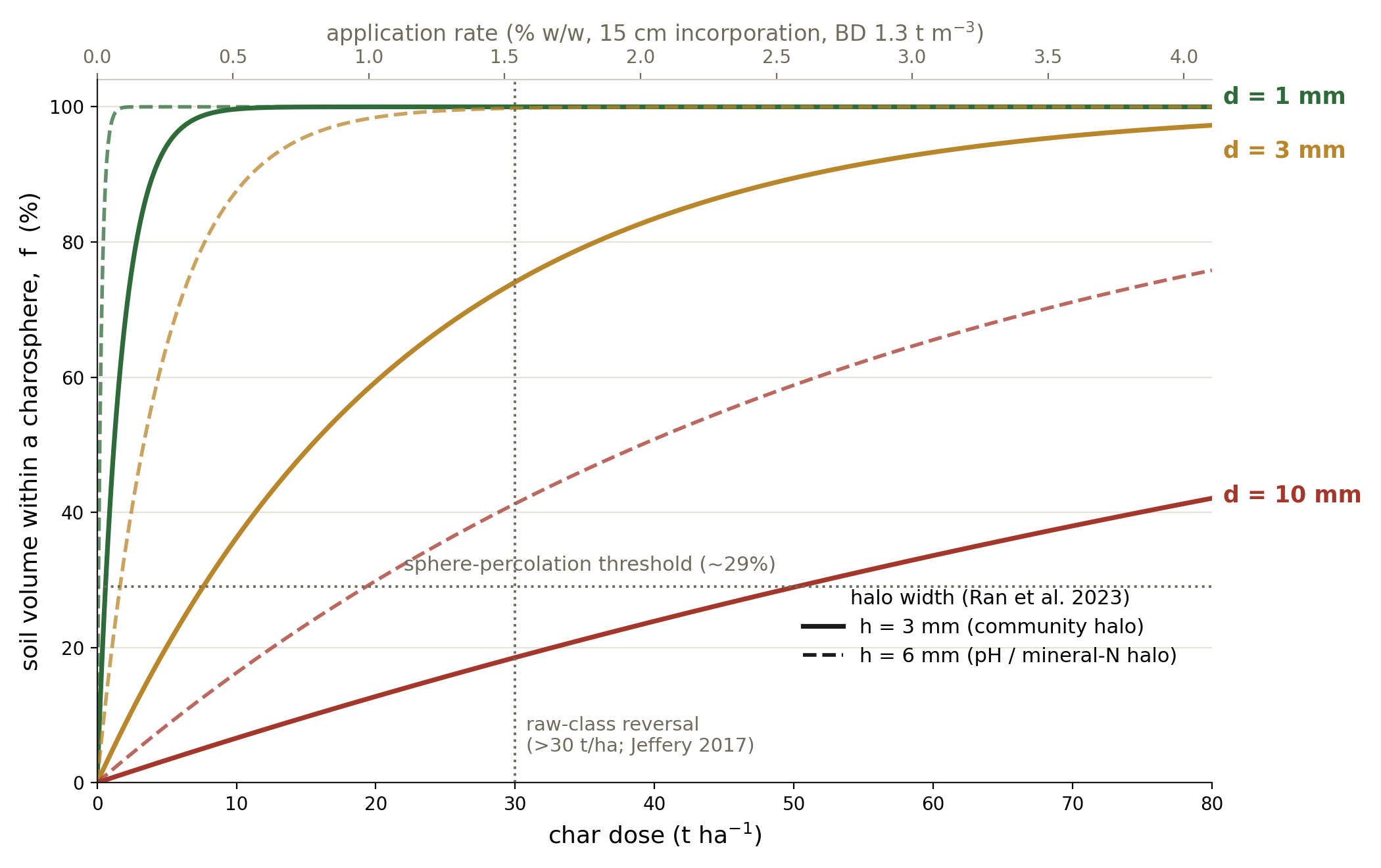
That lens invites its own arithmetic, and stating it commits the paper to whichever answer the numbers return. The conversion comes first, because percentages by weight conceal it: at a bulk density of 1.3 tonnes per cubic meter incorporated to fifteen centimeters, one to three percent by weight is roughly twenty to sixty tonnes of char per hectare, a range whose upper half sits at and beyond the thirty-tonne reversal the raw-class record shows in temperate trials (Jeffery et al., 2017). The dose window this mechanism requires is therefore one the raw class is known to exit badly, and the two-class distinction of Section 8 carries load at the argument’s hinge and not only in its defense; the meta-analytic record likewise finds no short-term yield gain above ten tonnes per hectare (Ye et al., 2020), a raw-class result the distinction predicts and against which the window here must be read. A recent paddy gradient, reported so far as a preprint, walks the window itself, a single season at zero, one, two and three percent by weight of raw manure-straw char, and finds the response peaking at two percent, the one-percent arm indistinguishable from control on structure, and a decline at three percent its authors attribute to pH overshoot and pore occlusion (Lin and Zhuang, 2025); the peak falls inside this window, somewhat above the temperate reversal, and the decline is the raw-class exit already noted, but that study’s “threshold” is the maximum of a one-season response, offered without geometry or persistence, and is not a founding threshold, which the dose ladder of Section 10 is built to locate, one answer to the “critical amount of biochar necessary” left open when the program was framed (Lehmann, 2009). How much of the soil that window actually places within a particle’s reach is then a computable quantity rather than a gesture. Around a char particle the affected zone is the charosphere, and its measured extent is on the order of three millimeters for shifts in microbial community composition and six millimeters for pH and mineral nitrogen (Ran et al., 2023), while planar-optode imaging of pH halos returns smaller radii, roughly one to one and a half millimeters, set mainly by the char’s electrical conductivity (Chen et al., 2021), so the halo width is bracketed rather than known, and the charosphere’s functional geometry has been called for without yet being defined (Yu et al., 2019). The coverage figures that follow are computed at the three-millimeter community halo, the upper end of that bracket; at the optode radius of a millimeter and a half the same doses return roughly ninety, twenty, and seven percent, so it is the finer grind that keeps the conclusion inside the bracket. For particles of radius a dispersed at random with an active halo of width h, the fraction of soil volume lying within some particle’s halo follows from Poisson placement as f = 1 − exp[−φ((a + h)/a)³], where φ is the volumetric fraction of char, the overlap of neighboring halos handled by the form rather than ignored. The arithmetic rewards fineness overwhelmingly (Figure 1). At one percent by weight, roughly three percent by volume for typical envelope densities, millimeter-scale particles place essentially the entire soil volume inside a community halo, three-millimeter granules somewhat over half, and centimeter-scale chips little more than a tenth: the same mass, spanning nearly an order of magnitude of coverage on grind alone. Grind is therefore a first-class variable of the mechanism, on equal footing with dose, and one the meta-analytic yield record this paper reads in Section 8 does not report, though direct trials confirm the premise, finer char raising microbial biomass at fixed mass (Chen et al., 2017; Zhao et al., 2020) and particle size registering in the field from millimeters to centimeters (Gao et al., 2024), as the liming tradition has known for its own consumable particle for a century (Jones and Mallarino, 2018). Two bounds attach to the numbers rather than to the logic. The halo widths available were measured across the boundary of a char layer rather than around dispersed particles, and a halo’s width may itself vary with particle size, so these are the best current inputs rather than settled constants, and pair-correlation imaging of amended ground is the direct check. And the calculation contains no threshold: coverage rises smoothly with dose and with fineness, exactly as Section 3’s rule requires of diffusion geometry. Where the halo fraction passes roughly twenty-nine percent, the value at which randomly placed overlapping spheres first connect (Rintoul and Torquato, 1997; a polydisperse grind shifts it: Dhar, 1997), the halos additionally merge into a system-spanning network; that crossing is recorded here as a geometric remark and not as a mechanism, because connectivity of the medium is not the feedback of Section 4, but the arms of Section 10 should know which side of it they stand on.
The important refinement is that “surface area,” as measured by gas adsorption, is not equivalent to habitable space for a microorganism. Gas-adsorption surface area is dominated by micropores far too small for cells to occupy. The fraction that is open and accessible is considerably smaller than the total, and the pores that actually house microbes are micron-scale macropores, broadly in the range of a few to roughly twenty micrometers, consistent with cell dimensions of one to five micrometers and with fungal hyphal colonization of larger pores, and the one carrier study that varied pore size across many chars found rhizobial survival peaking at macropores near ten to fourteen micrometers (Vanek et al., 2016). A char surface-area figure therefore overstates colonizable habitat, often by several-fold.
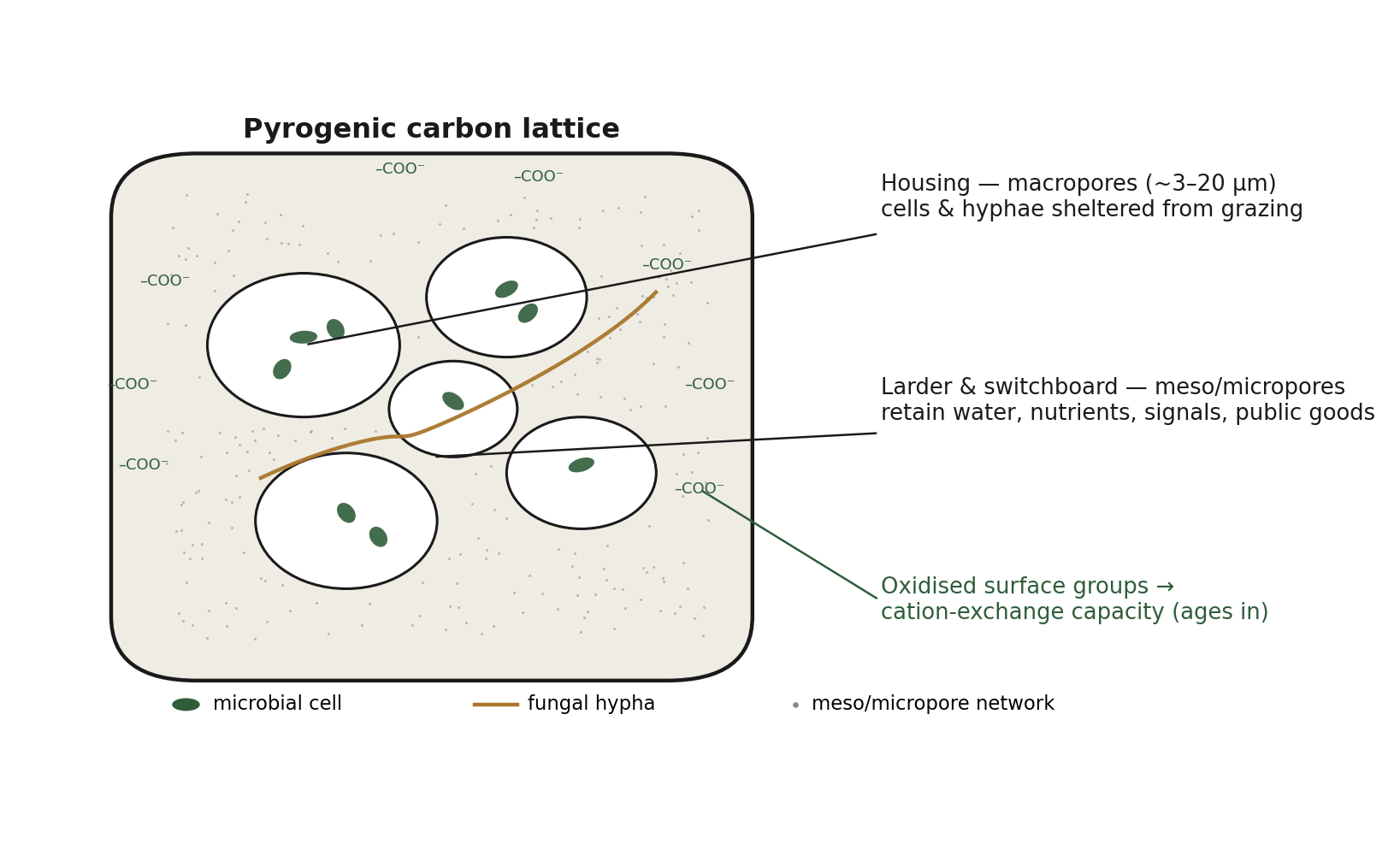
This distinction does not weaken the thesis; it sharpens it into a two-channel model in which the same material does different jobs through different pore-size classes (Figure 2):
Housing. The micron-scale macropores are where cells and hyphae can live, and the honest field record on raw char says how far that goes: direct measurement finds interior colonization of field-aged char very sparse after three years in the ground, with microbial activity concentrating in the charosphere, the halo of soil around the particle, rather than on or in the char itself, pore-space biomass contributing only a minor fraction, and no quantitative evidence of cells held inside pores at densities above the surrounding soil (Lehmann et al., 2011; Quilliam et al., 2013; Pingree et al., 2022). Whether that occupancy also shelters them from grazing protozoa is frequently asserted in the biochar literature and rarely tested, and the one direct test of the proposition found no evidence that biochar protected microbial biomass or activity from grazers, in part because soil grazers span a size range that overlaps the pores in question (Pingree et al., 2022). The housing channel is therefore claimed here as colonizable space, documented as capacity rather than as standing occupancy, and not as a demonstrated refuge; call it the real estate claim, since what is asserted is the property rather than the tenancy. The economy this paper builds does not require an address inside the pore; it requires density and proximity, and the same measurements relocate rather than remove them, since the particle neighborhood is exactly where activity concentrates. For the conditioned class the question changes once more, because occupancy is not left to field colonization at all, the community arriving in residence, and whether it persists in and on the lattice is a question cross-sectional imaging of recovered particles answers directly. Whether structured habitat converts potential density into standing density under grazing pressure is an open question, and Section 10 measures microbial density directly rather than assuming it.
Larder and switchboard. The finer mesoporous and microporous surface, the bulk of the gas-adsorption area, does two jobs this paper must separate, because the published record treats them differently. The larder is established: that surface adsorbs and retains water, dissolved organic matter, gases, and mineral nutrients, holding them against the leaching flux instead of allowing them to wash away. The switchboard, the retention of the community’s diffusible signals and public goods, cannot be claimed the same way, because for fresh char the direct evidence runs the other way. Char sorbs acyl-homoserine lactone signals strongly, and the alkaline surface it carries destroys them, base-catalyzed lactonolysis opening the lactone ring (Yates et al., 2002); measured directly, chars disrupt rather than retain microbial communication, with the severity set by production conditions (Masiello et al., 2013), and the two channels of that disruption, sorption and pH-driven hydrolysis, have since been modeled quantitatively as functions of char pH and surface area (Gao et al., 2016b). A fresh char surface is therefore, for a diffusible signal that reaches its wall, a sink and, at native alkalinity, an incinerator. That char can nonetheless raise quorum-regulated behavior in other settings, by aggregating cells in culture (Yan et al., 2022) or by stimulating signal secretion and electron exchange in digesters (Li et al., 2025), does not contradict the point, because those gains arrive through density and conduction rather than through what the wall does to the molecule, and the claim here is about the wall. A third destructive channel, persistent free radicals on the char surface, degrades signal in soil in a feedstock-dependent way (Cheng et al., 2024), and coating and loading do not obviously quench it, so the assay below measures it as a separate term rather than assuming conditioning removes it.
The two-class distinction of Section 8 predicts where that verdict ends, and the prediction follows from machinery this paper already carries rather than from any new mechanism. The AHL affinity of char rides its bare hydrophobic surface, and conditioning buries exactly that surface: nutrient loading occupies sorption sites, and the organic coating that composting deposits (Hagemann et al., 2017) overlays the sorbing face, so the sorptive channel should saturate as conditioning proceeds. The hydrolytic channel is driven by reserve alkalinity, and conditioning, which spends and binds that reserve by specification (Section 8), should slow lactonolysis in proportion to the acid-neutralizing capacity it removes. Where Section 8 carries a reserve deliberately, for strongly acid ground, the prediction does not fail but changes form: a carbonate-buffered reserve is self-gating and holds the pore wall near neutral to slightly alkaline, where base-catalyzed lactonolysis runs orders of magnitude slower than at the pH of nine to ten a raw char surface presents (Yates et al., 2002), so the conditioned wall is predicted to be slower by the pH difference rather than inert, and the acid-soil case is the assay’s own first test rather than its exception. The conditioned class is therefore predicted, not asserted, to retain free signal where its raw parent destroys it, the effect tracking measured acid-neutralizing capacity and coating rather than provenance. The site classes keep the larder and the switchboard from trading against each other: the nutrient larder rides ion-exchange sites and coating chemistry, the signal sink rides bare hydrophobic carbon, and because those are different surface populations, passivating the second does not empty the first, a partition the assay below reads rather than assumes. The test is a bench comparison in the style of Section 10’s internal controls: raw char, an acid-neutralized raw control, and a loaded and coated char prepared by published co-composting (Kammann et al., 2015; Hagemann et al., 2017), read for AHL sorption isotherms, extending the raw-char isotherms already measured (Sheng et al., 2022), hydrolysis rates, radical-mediated degradation, and free-signal recovery, with a bioreporter on the pore water as the biological check. If the conditioned material destroys or sequesters signal like its raw parent, the switchboard is deleted from the specification rather than reframed, and the pore-scale extension of Section 3 is withdrawn with it; if retention tracks conditioning, the six-axis specification has earned a seventh discriminating function without a seventh axis.
The second channel is the physical basis for the community economy described in Section 3, and the coupling of the two channels through one piece of material is the heart of the “multifunctional substrate” idea.
A further and frequently misstated point concerns cation exchange capacity (CEC), the soil’s capacity to hold exchangeable nutrient cations. CEC does not scale with bare surface area. It arises from oxygen-bearing functional groups (carboxyl, phenolic, and hydroxyl groups) on the carbon surface. Because high pyrolysis temperature develops surface area and porosity while removing those functional groups, surface area and fresh CEC tend to anti-correlate across temperature, with CEC peaking at relatively low pyrolysis temperatures. This appears at first to be a problem for any “more surface, more function” claim, but two considerations resolve it and, in doing so, strengthen the maturation thesis.
The first consideration is that habitat, surface area, and CEC are set by three different variables, and are therefore partly independent design levers rather than a single slider. Macroporous habitat derives largely from the preserved cellular architecture of the feedstock; gas-adsorption surface area derives from high-temperature carbonization; CEC derives from low-temperature and, importantly, aged surface chemistry. Because application rate is a free additional lever, there is no obligatory trade of CEC against surface area at the system level: a higher dose of a lower-temperature, higher-CEC char can supply both habitat and exchange capacity, at the cost of more material rather than a loss of function.
The second consideration is temporal, and it is the more interesting one. The physical channel (surface area and pore structure) is fixed at the moment of pyrolysis, whereas much of the surface chemistry (and therefore much of the CEC and a large part of the biological function) develops over time as the char weathers and its surface oxidizes, building carboxyl and carbonyl groups and negative charge. The housing is ready on day one; the ion-exchange economy and the associated biological function ripen over months to years. That ripening is documented on the archetype and on the raw material alike: the aged black carbon of the dark earths carries a surface charge and an exchange capacity per unit of carbon far above the adjacent soils’ (Liang et al., 2006), and the oxidation that builds it proceeds by abiotic as well as biotic routes and tracks climate along a chronosequence (Cheng et al., 2006, 2008), which is also why Section 10 must carry ripening in its null. Different functions thus come online on different clocks. This asynchronous maturation is not a complication to be explained away. It is the mechanistic reason that terra preta is something grown rather than mixed: if every function switched on at once at the moment of application, there would be nothing to wait for, and the empirical observation that dark earth develops over time would have no basis.
A consequence of this exchange and sorption capacity is the inhibition of nutrient leaching, and it matters most in exactly the setting where terra preta arose. In a high-rainfall tropical landscape over kaolinitic, low-charge soils, soluble nutrients from rain and irrigation are flushed below the root zone before they can be taken up; the charged and sorptive lattice intercepts and holds those cations and dissolved organic compounds against that flux, so that fertility added to the soil stays in the soil rather than draining away. This anti-leaching role is one more retention function of the same surface, measured on the archetype, where an archaeological anthrosol leached applied nutrients measurably less than the adjacent Ferralsol (Lehmann et al., 2003), and a simple leaching column is among the most direct tests of it (Section 10).
The retention principle extends to water, through a buffer that operates on two levels. The first is physical: the pore structure adsorbs and holds water, raising the soil’s water-holding capacity, most noticeably in coarse, low-clay soils. The second is biological: the dense community the lattice supports secretes extracellular polysaccharides and mucilage and builds the aggregate structure that together retain moisture and slow drying, so that a larger and more active biomass becomes, in effect, a second water reservoir built upon the first. The buffer against drought is therefore doubled, once by the physical cavities and again by the biology those cavities house. The water held in the biological term is held in the secreted matrix and the improved structure, not stored inside the cells themselves, whose volume is a negligible fraction of soil water; the mechanism is matrix and aggregation, not cellular storage.
These retention properties carry a corollary that is easy to miss and consequential for how the lattice should be prepared and tested. A fresh, uncharged char is not yet any of these things: its exchange sites and sorptive surfaces are empty, so on entering a soil it first draws nutrients and water out of solution and holds them, behaving for a time as a net sink that demands from its surroundings rather than a source that contributes to them. Only once those sites are loaded, the surface aged, and the biology established does the same material become a net contributor, releasing and cycling what it holds. This transition from sink to source is the practical face of the asynchronous maturation described above, and it is why the manner and the timing of preparation, and not the bare presence of char, determine whether the lattice helps or harms in its first seasons. It is also the most likely reason that short trials of fresh, uninoculated char report such inconsistent results, a point developed in Section 8, where this paper addresses the wider biochar literature.
The honest boundary of this section is that what is well established is the existence of large total surface area, the macropore limitation on habitable fraction, the dimensional suitability of those macropores for cells and hyphae, the retention of nutrients and water by the finer porosity, the demonstrated sorption and hydrolysis of quorum signals by fresh char, the resistance of that retention to leaching, and the initial net-sink behavior of a fresh, uncharged lattice. What is inferred, and addressed in Section 4, is that these properties together drive a discrete change in community organization.
3. The efficiency economy: density, division of labor, and reductive interdependence
If the carbon lattice raises density and proximity, the question becomes what changes when a microbial community becomes dense and tightly packed. The microbial-ecology literature answers this with several named, well-supported mechanisms that, taken together, describe a self-reinforcing economy.
Density-gated collective behavior
Quorum sensing is the canonical case of a microbial community switching behavior at a density threshold. Cells secrete signaling molecules whose concentration rises with population density; above a threshold concentration, the population activates collective functions such as biofilm formation, coordinated metabolism, and resource utilization (Miller and Bassler, 2001; Waters and Bassler, 2005). The claim that “past a certain density the system enters a new behavioral mode” is therefore not speculative; it is a central paradigm of bacterial sociobiology. One calibration is warranted: the sharpness of the threshold is contested, and single-cell studies indicate the switch can be graded rather than a hard cutoff. The defensible phrasing is “a threshold-like transition into a new regime,” which is sufficient for the present argument.
Confinement lowers the density required. Beyond classical density sensing, the same signaling systems respond to physical containment. Diffusion sensing was proposed as the alternative reading of quorum signals, an individual cell probing whether its secretions stay put (Redfield, 2002), the two readings were unified as efficiency sensing, cells integrating density, mass transfer, and spatial clustering in one measurement (Hense et al., 2007), and the confinement prediction has since been demonstrated directly, as few as one to three confined cells switching on quorum programs because their signals do not diffuse away (Boedicker et al., 2009; Carnes et al., 2009). Interpreted in the context of a porous carbon lattice, a cell within a small pore behaves as though it is in a dense crowd. The structured habitat does not merely hold more cells; it lowers the effective density required to trigger collective behavior. This is a direct mechanistic link between pore space and the community economy.
One boundary condition disciplines the transfer, and Section 2’s two-class correction sets it. Boedicker’s microdroplet works because its wall returns what it receives, a confining boundary that neither consumes nor destroys the signal, whereas a fresh char pore wall sorbs the signal and, at native alkalinity, hydrolyzes it, the inverse boundary. The confinement gain is therefore claimed only for the conditioned class, whose loaded, coated, acid-spent walls approach the non-consuming case, and it is claimed as a prediction the bench assay of Section 2 prices; for raw char the pore is a signal sink, and the confinement argument is withdrawn for that class rather than defended.
Division of labor
Distributing a long metabolic pathway across specialists reduces the per-cell burden relative to a single organism carrying the entire pathway, and modeling predicts that this can raise community productivity and allow more species to coexist on the same resources. The crucial and frequently omitted result is that division of labor is not automatically more efficient. Splitting a pathway across cells imposes a transport cost, because intermediates must move between populations, and a rigorous analysis shows that a two-strain consortium produces less biomass than an equivalent single organism of the same metabolic capacity unless specialization raises per-pathway efficiency enough to overcome that transport penalty (Tsoi et al., 2018).
Proximity, residence time, and the threshold
The Tsoi et al. (2018) result just stated sets this subsection’s baseline. The model is well mixed by construction and carries no spatial coordinate, so what it establishes is that the penalty exists and that rate parameters govern it. The extension that follows is this paper’s own and is stated separately for that reason.
The exchanged intermediate is a molecule that must physically cross the distance between the cell that releases it and the cell that consumes it, so the fraction arriving depends on that separation. For an absorbing target of radius a, the probability that a molecule released at distance r is captured falls off as a/r (Berg and Purcell, 1977). The relevant distances are known and they are small. Measured interaction ranges in directly imaged cross-feeding pairs are a few micrometers, reported as 3.2 micrometers for one auxotroph and 12.1 for another (Dal Co et al., 2020), and mean inter-cell distance in real soil has been measured at 12.5 micrometers (Raynaud and Nunan, 2014), varying with depth and with the water films that connect one cell to the next (Bickel and Or, 2023). Proximity at this scale is not a metaphor for community closeness. It is a measurable quantity operating over the same range as the exchange it governs, and it has now been treated explicitly as an ecological and evolutionary variable in its own right (Huang et al., 2026). It also carries a cost side the flywheel must price: clustered neighbors drain the limited pool a leaky partner releases, so that proximity past a point starves rather than feeds (Ramesh et al., 2025), and conduction can substitute for contact, cells exchanging electrons through char without touching (Chen et al., 2014), a route the lattice adds rather than the one the flywheel prices.
This is the point at which the two principal claims of this paper converge: proximity supplied by the carbon lattice is the variable that flips division of labor from a net cost into a net gain. The real estate claim and the efficiency claim are not two assertions but one mechanism.
One consequence of the physics must be stated plainly, because it bounds what can be claimed. The decay of captured fraction with separation is smooth and monotonic. Diffusion geometry alone produces no critical distance and no collapse, so any threshold in this system arrives from somewhere other than the geometry of diffusion.
What happens to the fraction that is not captured is where the two halves of this paper’s retention argument meet. Section 2 described the lattice intercepting nutrients against the leaching flux, and this section has described intermediates lost between exchanging partners. These are ordinarily treated as separate problems. They are one problem observed at two scales, and the variable that joins them is residence time in solution. Every transit between one cell and the next is an interval during which a nutrient atom is dissolved, mobile, and exposed to the downward flux through a profile whose bottom is open. A soil biome has no floor. What passes below the rooting zone is not relocated but lost, and no biological process recovers it. Shorter separations mean fewer and briefer intervals in solution per cycle, so the same atom passes between organisms more times before it is exposed long enough to escape. Tight internal cycling and low leaching are not two virtues of the same soil. They are one quantity measured in two places.
The ratio this describes is not itself novel. The competition between biological uptake and advective removal is a Damköhler number, the competition between advection and diffusion is a Péclet number, the dependence of ecosystem retention on the rate of biological accumulation is the older observation of Vitousek and Reiners (1975), and pore-scale Damköhler and Péclet treatments already set the distance over which a signal or substrate can be exchanged under flow (Jung and Meile, 2020). What is proposed here is the identification of inter-cell separation as a term in that ratio, and therefore the claim that a substrate shortening separation acts on system-scale nutrient retention and not only on local metabolic efficiency.
Stated this way, the lattice acts on the same ratio twice, shortening separation by concentrating cells and hyphae within pore space and sorbing the solute during the interval when it is dissolved regardless. The honest calibration is that the second of these is far better evidenced than the first, since sorption reducing nutrient loss is measured and reproducible, whereas the claim that pore occupancy raises local density above bulk soil rests on pore-size matching and inference rather than direct measurement, as Section 2 states.
The proximity gain should be priced rather than gestured at, and the arithmetic is short. Mean separation scales as the inverse cube root of cell density, so a rise in standing biomass of a quarter, the raw-char figure of the meta-analyses, shortens mean spacing by about seven percent, and a rise of one hundred and twenty-five percent, the dark-earth figure, by about twenty-four percent; against a measured mean inter-cell distance of twelve and a half micrometers and directly imaged exchange ranges of three to twelve micrometers, the larger figure moves mean spacing from roughly twelve and a half to nine and a half micrometers, inside the upper exchange range and not below the lower one. At the fine grind Section 2 recommends, where nearly the whole soil volume lies within a halo, that bulk gain is the whole of the density gain; at coarser grinds the charosphere occupies a fraction f of the soil volume and a fraction q of the biomass, and the local density factor is q over f, its cube root the spacing reduction, so clustering rather than bulk enrichment carries the argument there. Two further routes act beside density and are named as predictions. Connected water films, not bulk distance, set the range over which cells actually exchange (Bickel and Or, 2023), and the water the lattice holds keeps films connected through drying that would otherwise break them; and conduction through the char lets cells exchange electrons without contact at all (Chen et al., 2014). Standing density and its partition between charosphere and bulk are measured directly in Section 10 by a sorption-corrected assay, with pore-scale imaging as the check on the partition, and the proximity term is claimed at the size those measurements return.
The threshold, then, is not in the diffusion but in the feedback. Retention raises density, density shortens mean separation, shorter separation raises the captured fraction, and the captured fraction raises retention again. A smooth response curve becomes a threshold when a loop of this kind pushes on it with sufficient gain, which is the condition Section 4 develops and which Kéfi, Holmgren and Scheffer (2016) state as necessary but not sufficient. That loops of this kind genuinely produce thresholds in cooperative microbial systems is documented rather than hoped for, since obligate cross-feeding generates bistability through an Allee effect, a threshold in inoculum density below which the consortium does not sustain itself, in a nutrient-explicit model of a well-mixed chemostat rather than a spatial system (Vet, Gelens and Gonze, 2020); in this paper’s terms the char dose is the lever on that density, through retention and housing, and the link from dose to density is the hypothesis rather than the theorem, and signaling connectivity in a bacterial community crosses a percolation threshold, with wild-type Bacillus subtilis measured just beneath the transition (Larkin et al., 2018).
Those results establish that the mechanism is real in systems of this kind. They do not establish it here. This paper asserts that a conditioned lattice, supplied at sufficient dose with complete minerals and an inoculum, drives the same loop across the same kind of threshold in soil, and it does not derive that assertion from the cited work. It is the central claim of the paper and it is offered to be measured rather than treated as shown. The sub-threshold arm of Section 10 exists for exactly this reason, so that the smooth dose response a system without a threshold would produce can be distinguished from the discontinuity claimed here.
The claim carries an operating envelope, and the paper states both walls with their class labels attached. Proximity past a point delivers competitors as readily as partners, a bound on density itself rather than on the lattice, whose rigid pores hold the air path open as packing tightens. Sorption past a point converts retention into occlusion, and that wall belongs to unsaturated surface: it is the signature pathology of the unconditioned class, and it returns for conditioned material only where dose outruns loading, which is the phosphorus knife-edge of Section 10. The reversal the field record shows, yield declining beyond thirty tonnes per hectare in temperate trials (Jeffery et al., 2017), is a record of the raw class, and it bounds that class.
A candidate mechanism for that bound follows from the signal chemistry of Section 2 and the coverage arithmetic of Figure 1, and it is registered as a candidate rather than a claim. Each raw particle is a signal sink, so the summed sink strength of an application scales with dose and fineness exactly as coverage does, and past the dose where sink capacity rivals the community’s signal production the amendment begins to silence the economy it was meant to house, a bulk-dose signal budget computable from the measured sorption and hydrolysis rates (Masiello et al., 2013; Gao et al., 2016b) and one that liming and occlusion accounts do not predict. The budget belongs to the raw class alone, the conditioned class having spent the chemistry that drives it, which makes it one more contrast the two-class assay of Section 2 prices.
Whether the conditioned class has any interior optimum at all is a different question, and classification has already moved partway toward it. The World Reference Base recognizes a pretic horizon, introduced in its 2014 edition and carried into the fourth, a diagnostic horizon defined by the dark-earth signature of pyrogenic carbon, organic carbon, extractable phosphorus, and exchangeable calcium and magnesium, and it classifies soils holding twenty percent or more artefacts by volume within the upper metre as Technosols (IUSS Working Group WRB, 2022), which is the discipline conceding that char-built ground is a nameable soil rather than an amendment overdose. Read functionally, the lattice already meets the substrate description better than the mineral fractions do, exchange capacity, surface, water holding, and habitable terrain in one particle, so the limiting case is stated here as a hypothesis: a growing medium constructed entirely on conditioned char, its minerals and community delivered with the particle and its energy supplied as mulch, an engineered biochar loam with no mineral soil at all. Plants are already grown in char-dominant media, so the question is not whether they grow in char but whether such ground self-organizes and holds as the full soil economy of this paper, which no field trial has tested. Nor does the constructed horizon forfeit the downward mining of Section 5, since a biochar loam is a topsoil, not a planet: laid over native ground, the fungal reach extends out of the char and into the subsoil and hardpan beneath, mining the mineral bank in place, and only where the medium is isolated from the earth entirely does mineral delivery carry the whole load, which the conditioned class already provides.
The Black Queen dynamic: a second, evolutionary clock
The mechanisms above act on physiological time and need no genetic change, since densely packed cells simply perform them. A further dynamic acts on a different kind of clock, an evolutionary one that changes gene content, and rather than competing with the proximity economy it compounds upon it. The Black Queen Hypothesis (Morris, Lenski and Zinser, 2012) holds that loss of a costly but leaky function is favored at the individual level and proceeds until production of that public good is just sufficient for the community, at which point further loss is checked by its cost. An organism gains by not spending resources to make what its neighbors already supply, which drives genome streamlining and produces obligate interdependence. Because this requires mutation and selection across generations, it is not what establishes the high-function state within a single brew cycle or a single season; it enters the system from two directions instead. First, the organisms that inoculate a soil are already auxotrophic and cross-dependent, because the shedding of biosynthetic genes is favored and pervasive in nature, common across both free-living and symbiotic bacteria, and the difficulty of culturing most soil microbes in isolation is a direct reflection of that dependence (D’Souza et al., 2014). The proximity economy therefore draws on a deep, ready-made web of interdependence from the first day, and the lattice supplies the dense, structured habitat in which those inherited dependencies can finally express themselves. Second, continued gene loss proceeds within the established community, and although it is fast when counted in generations, with auxotrophs evolving in fewer than two thousand generations under favorable conditions (D’Souza and Kost, 2016), it is paced in real time by the fact that most soil cells grow slowly, so it unfolds over the soil’s maturation and its long life rather than within a season. As it proceeds, public goods are reliably supplied, selection on the now-redundant private copies relaxes, interdependence tightens, and the basin of attraction deepens. The dynamic does not establish the high-function state on its own; it makes a state already established by proximity progressively more entrenched and harder to dislodge as time passes. A modeled extension indicates that this process can be generative as well as reductive, with relaxed selection on redundant genes permitting the exploration of new functions, so that the economy compounds rather than merely plateaus (Takeuchi et al., 2024). Two ceilings bound the dynamic. In simulation, loss of function accumulating in bulk soil can tip a community into a tragedy of the commons in which the shared good is no longer replenished (Finn et al., 2022), and spatial structure can hinder the dynamic as readily as help it (Wang et al., 2021); gene loss therefore compounds only where the shared pool is replenished, which is precisely the argument for the conditioned lattice. Wet-laboratory support that loss of function establishes dependencies and improves community function comes from soil-derived consortia (Billet et al., 2019). The honest boundary is that this second clock, and especially its generative form, is an evolutionary argument and in part a modeled one; it is offered as a compounding reinforcement of the homeostatic valley over the soil’s maturation and life, not as the proximate engine of the transition, which remains the proximity economy described above.
Multiplicative rather than additive
The proximity terms are not independent perks to be summed, and by this point the section has assembled two feedback loops, not one. The first is biological: density enables specialization, specialization lowers per-capita cost, and lower cost supports higher density and tighter coupling. The second is physical, derived above: retention holds nutrients in place, held nutrients support density, density shortens the separations over which capture must win, and efficient capture returns what would leach into retention. The two loops are distinct circuits sharing one hub, standing density, so each turn of either wheel speeds the other, the physical loop supplying and holding what the biological loop spends and refines, and coupled circuits sharing a hub compound rather than add, which is the precise sense of multiplicative. This is the flywheel, and it turns on ecological time; beneath it the Black Queen clock turns across generations, so a state established by the fast loops is deepened by the slow one, and the system is reinforced on two timescales at once. Section 4 shows that such positive feedback is precisely the formal requirement for the regime shift the paper proposes, and Section 5 returns to the same two-circuit structure as a measurable prediction.
The boundary of this section is that all of the above is established as mechanism, supported by theory and by laboratory and synthetic-community experiments. What it does not by itself demonstrate is that a real soil crosses into a discrete, higher-order community state. It shows that every gear the flywheel requires is real.
4. Crossing the threshold: critical transitions and alternative stable states
The intuitive notion of an ecological “escape velocity,” a hump the community must clear before a higher-order organization becomes self-sustaining, has a rigorous and long-standing form in ecology: the critical transition across a tipping point into an alternative stable state.
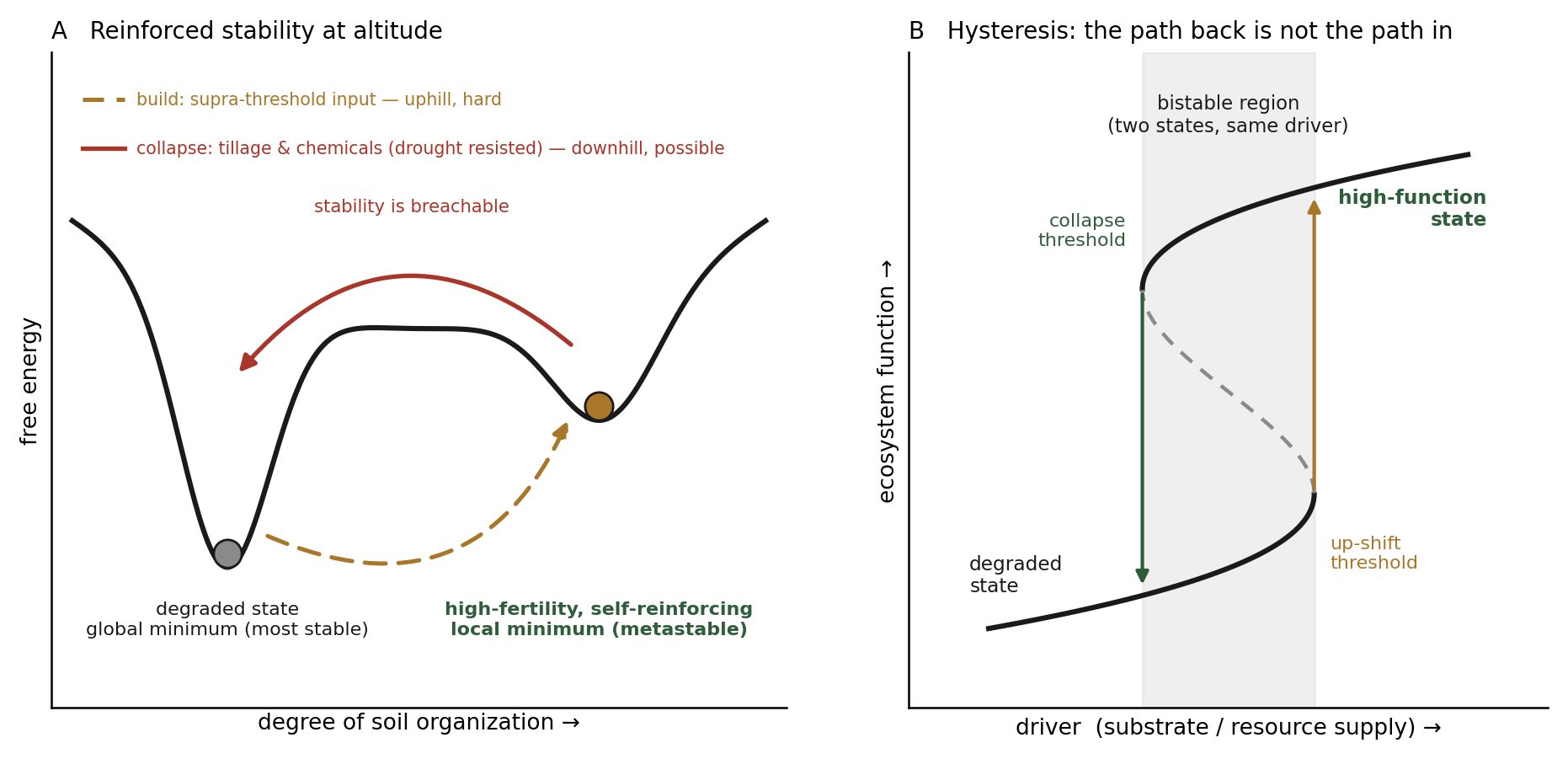
The theory holds that an ecosystem can persist in two or more stable states under identical external conditions; when a disturbance pushes it past a critical threshold, the response is nonlinear and disproportionately rapid, and the system shifts into an alternative state (Holling, 1973; May, 1977; Scheffer et al., 2001; Beisner et al., 2003). The “remains assembled” half of the intuition corresponds to hysteresis: once a tipping point is crossed, restoring the driver to its former value does not restore the former state, so a small change in conditions can produce an enduring change to a state with different characteristics. The familiar ball-and-cup image is apt (Figure 3A): drawn as a landscape, the degraded state sits in the deeper valley and the high-function state in a shallower one at higher altitude, held there by the feedbacks of Section 3, a metastable minimum in the language of self-organizing systems used here by analogy only (Prigogine and Nicolis, 1977), and the fold of the response curve against its driver is where the hysteresis lives (Figure 3B). An “escape velocity” is the push required to move the ball over a ridge into a neighboring valley, not a runaway to infinity; once in the new valley, perturbations roll back toward it, which is the rigorous form of the homeostasis the hypothesis emphasizes.
Two features make this framework more than an analogy for the present argument.
First, positive feedback is a necessary but not sufficient condition for the emergence of alternative stable states at the community scale, since whether a positive feedback opens a second basin depends on its form and strength and not merely on its presence (Kéfi, Holmgren and Scheffer, 2016). The efficiency economy of Section 3 and the multifunctional surface of Section 2 are therefore not separate conveniences; in this framework they are the self-reinforcing loops without which a second basin cannot exist.
Second, a growing body of evidence locates the relevant transitions in microbial communities specifically, and increasingly in soil, not only in lakes and forests. Energy-landscape analysis of more than fifteen hundred agroecosystem soil samples infers that prokaryotic and fungal community structure occupies several alternative stable states separated by tipping points, with the states differing in their association with crop disease (Fujita et al., 2025). The one field trial to have traced community architecture under biochar on a highly weathered tropical Oxisol found the community, after one year, more organized rather than merely more abundant: more nodes, more links and more negative pairwise associations, which the authors read as heightened competition and niche partitioning, together with more putative keystone taxa, and from which they infer, from the structure of the network rather than from any perturbation applied, a higher resistance to environmental change (Yu et al., 2018). The effect was largest in the low-fertility Oxisol and small in the fertile Mollisol run alongside it, which is the ordering the mechanism of this paper predicts and the reason its demonstration is aimed at poor ground. In controlled microbial communities the transitions have been driven and observed directly: a transient perturbation, including a temporary shift in pH, can induce a lasting switch between alternative stable states that persists after the perturbation is removed (Amor, Ratzke and Gore, 2020). Soil functional transitions show the same signature under moisture stress, where mild perturbation allows return to the reference state while intense perturbation pushes the community out of its stability basin into an alternative functional state that persists after the perturbation has ceased (Todman et al., 2018). That persistence after the cause is removed is the field-scale form of the self-stabilizing regime the hypothesis posits. The soil demonstrations to date indicate that such states exist and that transitions between them occur; experimentally tracing a full hysteresis loop in soil, rather than inferring the tipping points, remains the harder and still-open measurement.
The most directly relevant home for the argument is restoration ecology. For degraded systems with alternative stable states, the recovery trajectory is not the mirror image of the collapse trajectory, and feedbacks make restoration difficult; degraded systems become trapped in their state, so that reversing the original driver is insufficient to restore function (Suding and Hobbs, 2009), and the same authors warn that threshold concepts have been adopted in restoration faster than the evidence for them has been evaluated, a warning this paper takes as the standard Section 10 must meet. Stated in the field’s own terms, this is the present argument: a depleted soil is not merely low on inputs but is held in a low-fertility basin by its own feedbacks, and cannot be coaxed out by incremental amendment. The rigorous justification for comprehensive, simultaneous intervention (carbon lattice, complete minerals, and inoculum delivered together as one supra-threshold input) is exactly this: half-measures relax back, whereas a threshold-crossing input can reorganize the system into the higher basin where it then holds. The clearest way to state what that intervention must be, kept as an analogy and not as evidence, is that an ecological community of this kind behaves like an engine rather than a pile of ingredients. Its parts, the durable carbon habitat, the complete mineral charge, and the living inoculum, must reach a minimum working complexity together before the self-reinforcing feedback will run at all, just as an internal-combustion engine below a minimum of compression, fuel, air, and ignition acting in concert will not carry itself, and only above that minimum does the flywheel take over. The analogy holds past the start. An engine at cold start does not run smoothly; it warms into coordination, each cylinder firing into the momentum of the others, lubricant distributing, temperature rising, the subsystems priming one another, until the whole runs on a momentum of its own, and that momentum is hysteresis in the mechanic’s language, an engine that keeps running under conditions that could never have started it. The assembled soil community is proposed to behave the same way, the parts required in the right amounts and in the right places, the feedbacks then driving the whole into a smooth-running economy no part achieves alone. Whether the biological start is truly all-or-nothing, or a steep climb between two branches, is a property the analogy assumes rather than establishes, and it is exactly what the hysteresis contrast in Section 10 is built to distinguish. Incremental amendment is the engine cranked with no fuel in the line; the supra-threshold, all-at-once input is what allows it to catch. The same image, applied to the field record for biochar, returns in Section 8.
The synthesis that unifies the paper is that the carbon lattice is the durable abiotic anchor of the stabilizing feedback. Alternative stable states are typically driven by biotic-abiotic feedbacks. The lattice persists (Section 7), and while it persists it holds the water, nutrients, habitat, and, in the conditioned class, the signals (Section 2) that sustain the dense, interdependent, efficient community (Section 3), which in turn maintains the aggregation and organo-mineral integration that keep the system in the high-fertility valley. The roles here are distinct and should not be merged: the recalcitrant carbon is the durable anchor whose persistence keeps the stabilizing feedback supplied and therefore keeps the basin from eroding over time, but the basin itself, and its hysteresis, are produced by the self-reinforcing biology the substrate supports, not by the inert carbon. The carbon makes the state durable; the living feedback makes it an attractor. The nearest published framing is the materials-science one, in which anthropogenic carbon-reinforced soil is treated as a self-organized living engineered material whose stimulated microbiome is the key (Yang, Fu and Antonietti, 2023) and artificial black soils are manufactured to function within weeks (Yang et al., 2024); that line supplies self-organization without bistability, and it is the manufacture pole against which the claim that the state is grown is set.
These are two kinds of persistence, and conflating them obscures the claim. The carbon’s durability is passive and kinetic, in the way an allotrope is: diamond sits above graphite in energy, graphite being carbon’s stable ground state at surface conditions, yet diamond persists indefinitely because reverting would mean dismantling an ordered covalent network, a barrier so high the rate is negligible. Pyrogenic carbon is locked the same way, its recalcitrance rising with the order and condensation of its aromatic domains, which are turbostratic, nearer disordered graphite than cubic diamond, so the principle is borrowed and not the literal form. But a diamond does nothing to stay a diamond; it is trapped, not maintained, whereas the high-fertility function is active persistence, held by a living community that constructs the niche favoring it and is sustained only while energy flows through it, the kind of self-perpetuating feedback that differential persistence selects for at the level of whole systems (Lenton et al., 2021). Terra preta couples the two: a diamond-like scaffold that persists passively and gives the engine a durable home, housing a flame-like community that supplies the fertility the scaffold alone cannot. This layering is why one soil shows both kinds of endurance at once, persisting for centuries and resisting drought through the inert scaffold, yet falling to tillage and biocides, which dismantle the living community and displace rather than destroy the carbon.
The persistence of terra preta for centuries after abandonment is consistent with this picture, but it is not by itself evidence of a living attractor, because recalcitrant carbon and passive cation exchange would endure for centuries with no self-reinforcing biology at all; endurance is therefore over-determined. Nor is persistence under harvest available as the discriminator, because no dark earth is farmed at modern export intensity without import, and where dark earth is cultivated it depletes (M. J. Schmidt et al., 2023; Lima et al., 2002), which is what mass balance requires of any soil. What distinguishes a self-stabilizing biological state from a durable but inert reserve is not that the soil lasts, nor even that it holds, but the form in which it holds: an inert reserve loses nitrogen to leaching and volatilization and loses phosphorus into iron- and aluminum-bound occlusion, whereas the state proposed here banks the same elements against those losses and in pools that remain biologically accessible, so that an atom is used several times over before it leaves the field. That signature, the form and turnover of the bank rather than its endurance, is the discriminating test taken up in Sections 8 and 10. The alternative stable state is accordingly claimed for the biological and structural organization that produces that form, the community, the aggregate architecture, the fungal network and the disease suppression, and not for the nutrient stock itself, which obeys mass balance in every account; the efficiency of the banking is the consequence of the organization, not an exemption from accounting.
Three boundaries must be stated honestly. An abrupt response alone does not prove bistability, because abrupt responses can also follow abrupt changes in external conditions; demonstrating an alternative stable state requires showing hysteresis, two states under the same conditions. The documented soil transitions are predominantly downward, into degraded states that are hard to restore, and the clearest of them shows the signature directly, a drought-driven shift whose transformed community persisted after the soil was returned to its former moisture (Cordero et al., 2023), the driver restored and the state not following; the deliberate up-transition into a high-fertility self-stabilizing basin is strongly plausible by the symmetry of the theory and is supported by the existence of dark earths as a built high-fertility endpoint, but it has not been demonstrated as a controlled experiment. And a real feedback is necessary but not sufficient; the loops must be strong enough to fold the system’s response curve and open a second basin, and showing that they are that strong is the work that remains. The condition has been stated in general form for positive interactions in ecosystems: facilitation opens a second stable state only above a threshold strength, and several facilitations each too weak to fold the system alone can sum to cross it together (Kéfi, Holmgren and Scheffer, 2016), which is why the mechanism here is stated as a set of coupled loops rather than as any one of them, and why the demonstration must be able to say how much of the set was present.
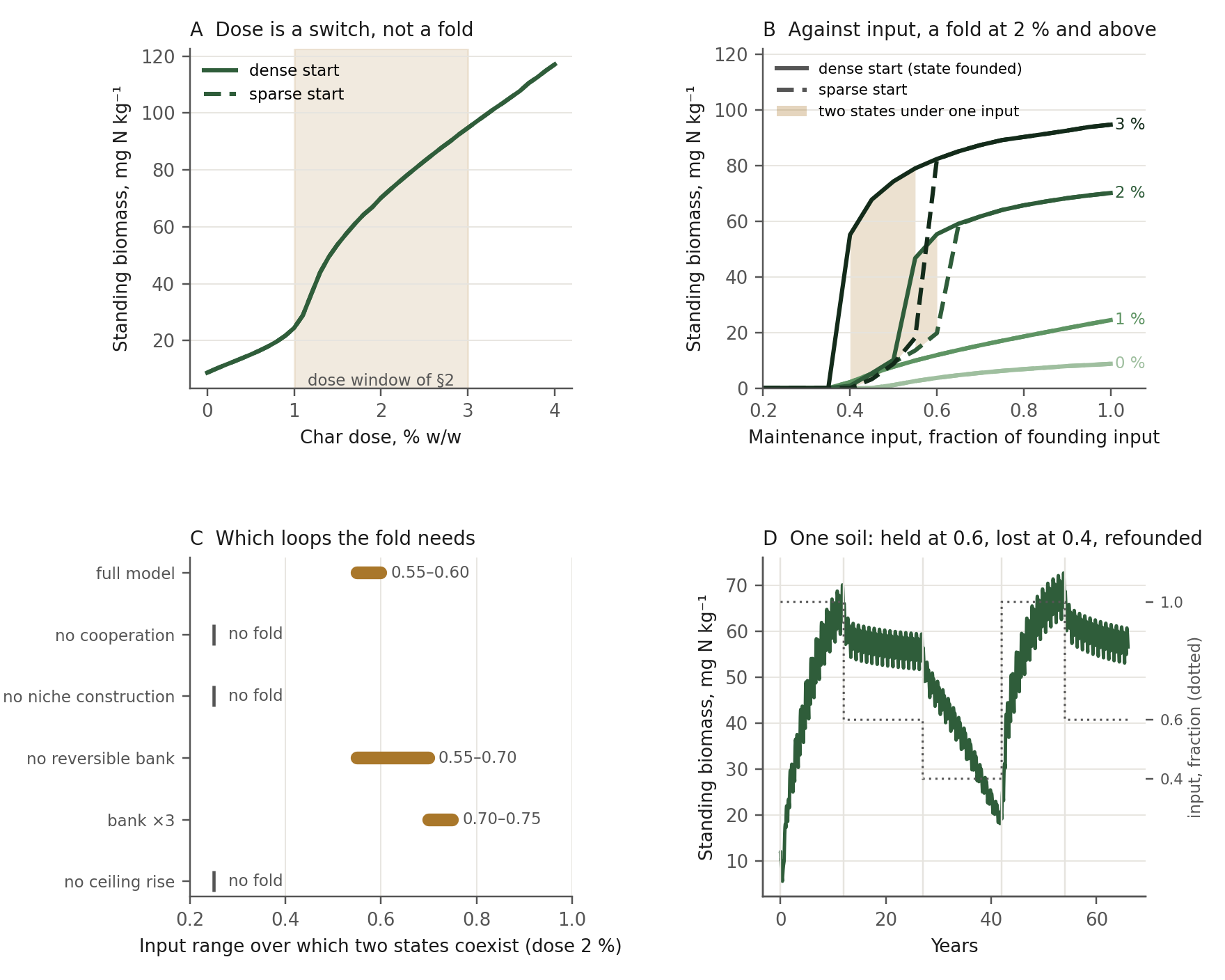
That work has a desk stage as well as a field stage, and the desk stage has been run, because it can kill the claim cheaply. The two loops of Section 3 were written as a small model whose parameters were taken from the literature this paper cites (Figure 5; Table 2; the code is deposited with the preprint): a nitrogen-like nutrient arriving in three fertilizer pulses a year over a background of mineralization, a pore water that drains at the seasonal rate a high-rainfall profile imposes, a lattice whose capacity grows with dose and which captures a pulse and re-releases it over weeks, a crop taking its share from solution, and a microbial biomass that dies, returns most of its nutrient to solution and the rest to a necromass pool that mineralizes over years. The biological loop enters as the efficiency economy of Section 3 in its simplest form, a multiplier on growth that rises from the uncooperative baseline toward full division of labor as density passes the threshold the spacing arithmetic sets, the Allee-structured cross-feeding of Vet, Gelens and Gonze (2020) reduced to one parameter, and as the community’s construction of its own ceiling, the aggregation and water holding that let a denser community stand; the physical loop enters as the bank and as the rise in the density ceiling the lattice supplies. Four results follow, stated at the strength the model can carry.
First, against dose the transition is a switch and not a fold: standing biomass rises steeply between about one and one and a half percent by weight for the central parameters, but a sparse start and a dense start arrive at the same state, so there is no hysteresis with respect to dose, which is in any case irreversible. Second, against the reversible driver Section 10 adopts, the maintenance input, a fold opens at doses of about two percent and above. A state founded at full input holds when the input is cut to fifty-five percent, while the same input cannot found the state from the degraded condition until it is restored to sixty-five percent; at three percent the founded state holds to forty percent and founds at sixty, and at one percent and at zero there is no fold at all. The state therefore holds on roughly half the input it took to build, and not on none, which is the claim of Section 8 in the model’s own terms. Third, the fold requires the biological loop and the lattice’s habitat effect, and not the lattice’s storage. Remove the cooperation multiplier, or the community’s raising of its own ceiling, or the rise of the ceiling with dose, and the fold disappears; remove the reversible bank and the fold remains, somewhat wider; triple the bank and the fold narrows and moves to higher input, because a larger held pool loses more to slow fixation. Fourth, the bank acts on where a nutrient goes rather than on whether the state holds, and only through synchrony: with constant crop demand a reversible bank without fixation leaves the crop’s share of supply essentially unchanged at steady state, since what it captures it later releases into the same competition between roots and drainage, and with the slow fixation term it lowers the share by about what fixation takes, whereas with a hundred-day crop season following each application it raises the crop’s share by a couple of points, and a bank three times larger with the same slow fixation lowers it while the same bank without fixation raises it further. Both walls named above appear unforced, the occlusion ceiling past which storage becomes a sink and the supply floor, below roughly a third of the founding input, beneath which no state holds, the floor being the direction the simulation record already pointed, cooperation in cross-feeding networks failing under fluctuating supply (Oña and Kost, 2022) while public-goods cooperation rises with resource supply (Brockhurst et al., 2008). One further behavior is a warning for the field. Just below the fold, at half the founding input, the founded state persists for twenty to forty years before it collapses, the slow relaxation that critical-transition theory predicts near a saddle (Scheffer et al., 2009); a soil that has held for decades is not thereby shown to be on the stable side, and the early-warning readouts of Section 10 exist for exactly this reason.
What the model does and does not show is stated as plainly. It shows that the mechanism as this paper states it, with parameters inside the ranges the cited literature supports, produces a bistable state with hysteresis against the driver the trial can reverse, inside the dose window Section 2 computes, and that the bistability lives in the efficiency economy and the density the lattice permits rather than in storage, which is the two-term decomposition of Section 9 recovered from the dynamics rather than assumed by them. It does not show that soil does this. Three of its parameters, the density at which cooperation pays, the strength with which a community raises its own ceiling, and the efficiency of the uncooperative state, are order-of-magnitude estimates from the spacing arithmetic and the meta-analytic biomass gains, and the fold depends on the first two in a way the field can check. Across a grid of the cooperation threshold from 30 to 80 milligrams of nitrogen per kilogram and of the ceiling term from 0.5 to 1.5, the fold at two percent is present wherever the density the dose permits reaches the density at which cooperation pays and absent where it does not: at a threshold of 30 it is present at every ceiling strength tested and sits at 0.30 to 0.45 of the founding input; at 45 it requires a ceiling term of at least 1; at 60 it requires 1.5 and sits at 0.80 to 0.85; at 80 no founded state forms at two percent at all, and the grid is deposited with the code. The claim is therefore conditional on a ratio, the cooperation threshold against the ceiling the lattice supplies, and both are measurable in the first season. A fuller version of the same model, carrying phosphorus and potassium as separate currencies, a fungal layer, aggregate structure and a necromass pool, and run with the same cooperation switch at the same steepness, does not reproduce the fold at any dose tested or at any steepness of the switch, and tracing the difference between the two models locates the condition more exactly than the grid did. A collapsed community stays collapsed only where its growth when sparse and uncooperative falls short of its death; in the model’s terms, only where the nutrient limitation of the degraded soil lies below the ratio of the death rate to the product of the maximum growth rate and the uncooperative efficiency. The small model places its degraded soil inside that boundary by a few parts in a hundred, which is why its fold is present and why it is fragile; the fuller model, whose degraded soil holds more of its nutrient in solution and in a necromass that mineralizes back, places it outside, and raising the community’s nutrient half-saturation until the limitation crosses the boundary brings the fold back where the derivation says it should. The fold is therefore decided by four quantities rather than by the two the grid varied: the growth and death rates of the community, the efficiency penalty on the sparse state, and the nutrient status of degraded soil relative to the community’s half-saturation. Table 1 names all four. None has been measured for a soil of this kind. What survives the fuller model without any such condition is the slow relaxation: a founded community at zero input takes some seventy years to decay where a collapsed one takes forty, which is the inertia Section 8 attributes to dark earth and which requires no second basin to exist. The model carries no water, disease or spatial terms, and the efficiency economy of Section 3 enters it as a single density-gated multiplier rather than as the proximity mechanism that section describes, so the boundary it locates is the boundary of that stand-in and not of the mechanism itself. It is the cheapest honest test the claim admits: the smaller model was permitted to fail and did not, the larger was permitted to fail and did, and the difference between them is a measurement. The field trial is where it can be made.
5. The fungal layer: integration, mineral mobilization, reciprocal exchange, and immune priming
Among the components of the proposed system the fungal network has the widest reach, and the right approach is to state its role at full strength and then to state, with equal clarity, where the evidence for that role ends. The functions resolve into five of differing evidentiary weight: the network integrates the system, mobilizes its minerals, runs a reciprocal market with its plant partners, primes plant immunity, and carries signals. The first four are well supported. The fifth is supported in part and carries one widely publicized overstatement that must be set aside.
Integrate the system (well supported). The fungal network is the closest thing the soil has to an integrating organ. Mycorrhizal and saprotrophic fungi govern large parts of the soil economy at once: they regulate nutrient cycling, shape microbial diversity, suppress soil-borne pathogens, and bind mineral particles and organic matter into the aggregates that give soil its structure, while their necromass and the carbon they receive from plants enter the stable organic-matter pool. The integrating role is measurable at the level of the whole system rather than merely inferred. In manipulative experiments with assembled plant communities, the below-ground diversity of arbuscular mycorrhizal fungi determined plant diversity, ecosystem variability, and productivity, the diversity, stability, and yield of the entire community shifting as the fungal community was altered (van der Heijden et al., 1998). How far that verdict generalizes beyond assembled communities is its own open question, but the demonstration is the strongest sense in which the network organizes a system: altering the fungal layer reorganized the output of the whole. That organizing role is an emergent ecological function distributed through every layer of the soil, the connective and conductive tissue of the system, and it is best described that way rather than as a central controller sitting atop a hierarchy. One calibration on the carbon role specifically: it is dual, since fungal necromass stabilizes organic matter while mycorrhizal activity can also accelerate turnover, so the defensible statement is that fungi govern the carbon balance, not that they only store carbon.
Mobilize and shuttle minerals (well supported, with the reach stated by tier). The network is also the plant’s principal organ for acquiring the limiting mineral elements. Hyphae extend the effective reach of the root system and acquire phosphorus, nitrogen, water, and trace elements that the root alone cannot reach, including elements released from mineral surfaces by fungal activity (Smith and Read, 2008), but how far that reach extends depends on which fungi are meant, and the three tiers differ by three orders of magnitude. Arbuscular mycorrhizal hyphae, the symbionts of nearly all annual crops, extend about ten centimeters from the root surface and not much more: a uniform phosphorus depletion zone extended 11.7 centimeters from mycorrhizal white clover against about one centimeter without the fungus (Li et al., 1991), and Acaulospora laevis held a constant hyphal density to seven centimeters at 28 days and eleven at 47, spreading at 3.1 millimeters a day (Jakobsen et al., 1992), so a season buys tens of centimeters and the arbuscular network is a rhizosphere-extension term, not a landscape one. Ectomycorrhizal fungi, the symbionts of most temperate and many tropical trees, forage at decimeters to meters through differentiated cords and rhizomorphs with vessel-like conducting hyphae (Agerer, 2006), colonize discrete litter patches and draw nitrogen, phosphorus and potassium out of them (Bending and Read, 1995), with the transfer to the host measured directly (Pérez-Moreno and Read, 2000), and deploying hyphae into nutrient patches is precisely what separates ectomycorrhizal trees from arbuscular ones, which grow roots into the patch instead (Chen et al., 2016). Saprotrophic and pathogenic genets reach kilometers, Armillaria individuals of twenty to nearly a thousand hectares with 3.8 kilometers between isolates of one genet (Ferguson et al., 2003) and a 75-hectare individual some 2,500 years old (Anderson et al., 2018), which establishes that a fungal individual can span a landscape without establishing that any crop is fed through one. In a soil built on a durable, high-exchange carbon habitat, the acquisition network is the system’s means of drawing mineral stock into biological circulation, the same reach turned downward as an in-place mining of the mineral substrate, and the tier fixes the scale of that mining: within the plot for arbuscular systems, beyond it for the ectomycorrhizal perennials and orchards to which Section 10 bounds the off-field claim.
The network is also the route by which the bank of Section 8 stays accessible rather than merely large, and the evidence for that is direct. Arbuscular hyphae carry phosphate-solubilizing bacteria along their surfaces in a water film and deliver them to patches of organic phosphorus, where the bacteria cannot arrive, or work, without the hyphal exudate that fuels them (Jiang et al., 2021); the hyphosphere recruits a bacterial community distinct from bulk soil, enriched in the phoD and gcd genes that mobilize phytate the fungus cannot use alone (Wang et al., 2023); the same recruitment of alkaline-phosphatase producers has been shown in the field with hyphal in-growth cores (Zhang et al., 2018); and the hyphae themselves release acid phosphatase into the hyphosphere (Sato et al., 2015). Synchrotron tomography with elemental mapping shows arbuscular hyphae co-locating with high-phosphorus, low-aluminum regions of the soil and associating preferentially with organic phosphorus over aluminum-bound inorganic phosphorus, avoiding the aluminum-rich pool as a source (Keyes et al., 2022): the biology navigates to the accessible form, which is the form-of-the-bank argument imaged at hyphal scale. The same study’s validated model puts hyphal phosphorus uptake an order of magnitude below earlier estimates, so it is cited here for the selectivity and not for the flux, and the magnitude of the acquisition term is left to the measurements of Section 10 rather than borrowed.
Run a reciprocal market with plant partners (well supported). The exchange between plant and fungus is not a passive leak of resources but a regulated, reciprocal trade. Plants can detect, discriminate, and reward the fungal partners that supply the most phosphorus by allocating them more carbon, and the fungi reciprocally direct more nutrient transfer to the roots that supply the most carbon, so that cooperation is stabilized and defection is penalized on both sides (Kiers et al., 2011). This is a biological market with partner choice and sanctions, and it is the rigorous, evidence-based content of the intuition that the system negotiates: discrimination and reciprocal reward, not deliberation. The calibration is that the reward mechanism is real but context-dependent, varying with the nutrient demand of the host and the supply on offer rather than operating as a fixed rule.
Immune-mobilize (well supported, and a literal immune function). Mycorrhiza-induced resistance (MIR) is a named, replicated phenomenon in which colonization by arbuscular mycorrhizal fungi produces a mild activation of the plant immune system, locally and systemically, leaving the plant “primed” so that defenses activate faster and more strongly when an attacker arrives, centered on the jasmonate-regulated defense pathway (Pozo and Azcón-Aguilar, 2007; Jung et al., 2012). MIR has been demonstrated across a broad range of pathogens and herbivores in many crops. The honest calibration is that the effect is context-dependent; under high-phosphorus conditions the priming can be reduced or reversed, so the defensible phrasing is that fungi prime plant immunity under most conditions (Dejana et al., 2022). Char itself induces systemic resistance without a measured mycorrhizal term, against foliar fungal pathogens and mites and through the same jasmonate pathway (Elad et al., 2010; Harel et al., 2012; Mehari et al., 2015), so the network-gated priming claimed here must be separated from the char-direct route by a minus-mycorrhiza arm or a hyphal-length covariate in any immune readout of Section 10.
Signal and communicate (graded, with one overstatement to set aside). The communicative claims must be separated by strength. The plant-fungus molecular dialogue is settled science: under phosphorus stress the plant exudes strigolactones that promote fungal germination and hyphal branching (Akiyama et al., 2005), and the fungus replies with lipo-chitooligosaccharide signals recognized by plant receptors that activate the common symbiosis pathway (Maillet et al., 2011). Beyond that point the evidence weakens and must be labeled honestly. Individual experiments report that plants joined by a common mycorrhizal network can transmit defense cues, with connected receivers showing raised disease resistance or emitting defensive volatiles when a donor is attacked (Song et al., 2010; Babikova et al., 2013); these results are suggestive, but they are also among the single-study network-signaling findings that the systematic review noted below found to be over-cited and not yet robustly established, and they are presented here as contested rather than secure. Electrical activity resembling action potentials has been recorded propagating in hyphae (Adamatzky, 2022); this is a real phenomenon, but its interpretation as a language is unsupported speculation and is not evidence of cognition, and it is treated here as an open frontier at most. The romantic synthesis of these threads, that forests are densely mapped fungal internets through which mature trees consciously share resources and warnings with their kin, was formally challenged by a systematic review that found the claims of widespread networks, of reliable resource transfer that benefits recipients, and of preferential parent-to-offspring provisioning to be insufficiently supported or, in the case of the last, without peer-reviewed evidence (Karst, Jones and Hoeksema, 2023). That narrative is set aside, and the molecular dialogue, the immune priming, and a cautiously stated and contested interplant signaling are retained.
The point that ties this layer to the rest of the paper is the relation between fungal function and mycelial density, and it must be stated at its measured strength rather than borrowed from the network-transfer literature this section has just set aside. The physically carried functions rise with the amount of mycelium, along curves that saturate rather than lines that run forever: hyphal length in field soils correlates tightly with water-stable aggregation (Wilson et al., 2009; Leifheit et al., 2014), phosphorus inflow climbs with hyphal proliferation, though the efficiency per unit of hyphae differs more than twentyfold among fungi (Jakobsen et al., 1992; Rillig and Mummey, 2006), and a denser mesh intercepts more of what moves, mycorrhizal networks cutting phosphorus leaching by more than half in model grasslands, a protection that heavy fertilization itself measurably erodes (van der Heijden, 2010; Cavagnaro et al., 2015). The informational functions behave differently: immune priming switches on with the network’s presence rather than climbing with its density (Jung et al., 2012), and the protective occupancy of habitat and root, an established network crowding out pathogens, is expected to track density but has not been measured as such. A denser network is also never free, since its carbon cost grows with its tissue until, in phosphorus-rich ground, the symbiosis can slide from trade toward tax (Johnson et al., 1997). What the conditioned lattice contributes to this layer is therefore a raised ceiling rather than a push, and the claim is scoped with care, because the prevailing account holds that standing microbial biomass is limited by carbon and energy before it is limited by space, so bare habitat should raise nothing, though global surveys now find carbon limitation far from universal (Cui et al., 2023). The conditioned class relieves several constraints at once, habitat surface, water and nutrient retention, a buffered exchange window, and a metered supply of minerals and substrate delivered with the community itself, and it is that combination, not habitat alone, that can raise a community’s potential standing density. The direction has support at both ends of the record: raw char alone lifts standing microbial biomass by roughly a fifth to a quarter across the meta-analyses, most strongly in acidic field soils (Zhou et al., 2017; Pokharel et al., 2020), char carrying its biology outperforms char without it, with the gains concentrated in locally sourced and research-grade inocula rather than commercial products (Ross and Emery, 2025), a quality bar the inoculum specification of Section 10 inherits, and the dark earths themselves, the filled state of this ceiling, hold up to 125 percent more microbial biomass than adjacent soils of the same mineralogy while spending less energy to maintain it (Liang et al., 2010). The published biochar-by-mycorrhiza factorials bound the prediction: gains have appeared under water stress and not under ample water (Mickan et al., 2016), biochar has left colonization unchanged while the fungal carbon route dominated (Mason et al., 2025), and the relation between fungal activity and char dose is not linear at high rates (Rosenthal and Gunn, 2025). The prediction is that the community grows into the raised potential along the saturating curves, settling at a higher plateau whose trophic proportions follow the sub-linear predator-to-prey scaling documented across ecosystems (Perkins et al., 2022); the regulation is expected rather than demonstrated, since enrichment stabilized by structure has been shown in aquatic microcosms and never yet in soil. Whether standing density actually rises is precisely what Section 10 measures rather than assumes, with the assay chosen to correct for char’s own interference, since char sorbs the cell contents that fumigation releases and uncorrected estimates run low in exactly the soils where the ceiling matters (Durenkamp et al., 2010). The fungal layer is not a separate claim; it is one more set of functions riding the same surface-area and density flywheel, and the real estate claim predicts the very variable observed to control them.
Stated plainly, then, the evidence supports a fungal network that integrates the system, acquires and mobilizes its minerals, trades reciprocally with its plant partners, and primes their immunity, with the acquisitive and structural functions intensifying as the network densifies and the immune and signaling functions riding on its presence. That is a commanding organizing role, and the paper rests on it. What the evidence does not support, and what this paper does not claim, is that the network is intelligent, that it deliberates, or that it consciously manages the system from above. The organization it provides is the emergent product of distributed function and reciprocal exchange, the integrating tissue of the soil rather than its mind, and stating the role at exactly that strength is what keeps it defensible.
One further claim follows from that role, and it is entered here as a prediction so it can be lost rather than admired. The fungal network is the living integrator of this economy, the layer through which each component’s gains reach the others, and the couplings it carries are separately documented: bacteria that assist fungal establishment and function (Frey-Klett et al., 2007), protozoan grazing that liberates nitrogen and redirects plant carbon belowground (Bonkowski, 2004), and char reaching fungi indirectly through its effects on the rest of the biology (Warnock et al., 2007). Integration of this kind is nearly the whole of fungal function rather than a bonus upon it, since a mycorrhizal fungus given only one partner is a starving fungus, so the assembled community outperforms the sum of its isolated parts. The conditioned lattice is proposed as a second integrator of unlike kind, physical where the network is biological, coupling the same components through retention, housing, and a buffered exchange window, and the two integrators should compound rather than overlap precisely because each supplies what the other cannot, the scaffold permanence and a metered mineral reserve, the network foraging, transport, and response. The prediction is therefore that the system’s response to the conditioned lattice exceeds the sum of its component responses, with part of the excess appearing as amplification of the fungal coupling itself, and the prediction is conditional on demand-matched phosphorus, because the literature’s clearest failure mode is a char that oversupplies it and induces the plant to stop paying its fungal partners, collapsing the coupling the amendment was meant to ride (Treseder, 2004; Warnock et al., 2010). The paired factorial record shows both outcomes are real, superadditive gains where phosphorus stayed matched to demand and frank antagonism where char spiked it (Sun et al., 2022; Meng et al., 2024), and the test is a factorial subtraction: conditioned response minus lattice alone minus biology alone plus untreated control, read on a fungal-network measure such as extraradical hyphal length, with available phosphorus recorded as the covariate. A zero or negative interaction at demand-matched phosphorus falsifies the prediction outright; a negative interaction coincident with a phosphorus spike identifies the documented severing mechanism and mandates the demand-matched retest before any stronger claim.
6. Convergent mechanisms: five fields, one architecture
The strongest support this synthesis can offer is not any individual citation but a pattern of convergence. Five disciplines that do not generally cite one another each describe a component of the same architecture: dense, structured, resource-replete communities crossing feedback-driven thresholds into self-stabilizing, high-function states. When independent fields, studying different systems, each recover a piece of one architecture, that is good evidence that the components are real and that the architecture is assembled from established parts. It is not, by itself, evidence that those parts assemble into the integrated outcome in a soil, which is the step Section 10 isolates as the open experiment. What the convergence establishes is that the hypothesis is built from accomplished science rather than speculation, and that is what makes it worth the test.
Disease-suppressive soils (microbiology). A suppressive soil is one in which a soil-borne disease fails to develop despite the presence of a virulent pathogen, a susceptible host, and favorable conditions, because of the microbial community; the phenomenon has been studied for decades (Weller et al., 2002) and has been framed as a soil immune response (Raaijmakers and Mazzola, 2016). It comes in two forms whose properties map onto this paper’s claims: general suppression, driven by total microbial biomass, an inherent and non-transferable soil property (the density claim, expressed as community-level immunity), and specific suppression, attributable to particular microbes and transferable by mixing a small fraction of suppressive soil into a conducive one, and eliminable by heat (a near-demonstration of state transfer by inoculation, which is the intervention model). The calibration is that general suppression is correlative rather than a switchable state, and that the occurrence of suppressive soils is often difficult to predict.
Pore-scale coexistence (soil physics). Microfluidic experiments in soil-aggregate-mimicking pore networks show two bacterial species, an obligate aerobe and a facultative anaerobe, segregating into preferred regions along opposing carbon and oxygen gradients and coexisting persistently in structured space in a way that is not possible in well-mixed culture (Borer, Tecon and Or, 2018). Structured space sustains coexistence that homogeneous mixing destroys, demonstrated here directly and anticipated in pore-network models where limited diffusive flux alone lets competing strains coexist (Dechesne et al., 2008). Consistent with that result, soil is understood to organize into microbial hotspots of locally intense activity, concentrated at sites such as the rhizosphere, the detritusphere, biopores, and aggregate surfaces, with the scale of those hotspots set by the diffusion of substrates and signals through the pore structure (Kuzyakov and Blagodatskaya, 2015), which fuses the surface argument of Section 2 with the economy of Section 3.
Priority effects and community assembly (community ecology). The order and timing of species arrival cause historical contingency in community structure and can produce alternative stable states through niche preemption and modification (Fukami, 2015). Which basin a community lands in can therefore depend on who arrives first, which sharpens the intervention model: it may not be enough to add resources and biota; the desired community may need to be established first and fast so that it preempts the niches before the degraded community reasserts itself. The honest crack is the live debate over how deterministic versus stochastic assembly is, and the fact that some perturbed systems recover toward their reference state, so a new state must be genuinely self-stabilizing rather than transiently different.
Plant-soil feedback (agroecology). Plants condition soil and soil conditions the next plants, a feedback loop now being developed deliberately as a tool. A proof-of-concept showed that steering the soil microbiome through plant-soil feedback can induce above-ground resistance to an insect pest in a crop (Pineda et al., 2020), and a recent synthesis argues for applying plant-soil-feedback principles to restore soil function in agriculture (Wang et al., 2025). This connects suppressive soils, priority effects, and the present thesis: conditioning produces a suppressive or immune community that can be steered by inoculation. The crack is that feedback can be negative as well as positive, and that how to steer microbiomes toward their beneficial functions remains largely unknown.
Comparative dark earths (anthropogenic soils). Terra preta is not unique to Amazonia, and, critically, the method is not entirely lost. The properties and genesis of the Amazonian dark earths are reviewed at length elsewhere (Glaser and Birk, 2012), and their biology is distinctive in a way that bears on the attractor claim: bacterial communities in separated anthrosols resemble one another more than they resemble the adjacent, unmodified soils of the same mineralogy (Grossman et al., 2010; O’Neill et al., 2009), which is what a determinate attractor predicts and what a set of historical accidents would not. West African communities produce carbon-rich, high-fertility African dark earths today, analogous to Amazonian terra preta, by accumulating ash, char, bones, and organic residues in kitchen gardens and middens (Solomon et al., 2016). These soils hold substantially more organic and pyrogenic carbon, more available phosphorus, and higher cation exchange capacity than adjacent soils. The honest crack is the intentionality debate, which recent ethnography has narrowed without closing: present-day Amazonian villagers create dark earth deliberately, and the ancient soils carry the same signatures (M. J. Schmidt et al., 2023), yet whether ancient practice amounted to engineering for fertility at the scale of whole landscapes remains contested, so the intentional, engineered-at-scale version is still the thing to be demonstrated, which is again the open experiment.
The unifying observation is the convergence itself. Microbiology, soil physics, community ecology, agroecology, and the science of anthropogenic soils each, in their own systems, describe a piece of one density-and-feedback-driven transition into a self-stabilizing high-function state. That convergence is what makes the hypothesis credible and worth testing, independent of any single source; what it does not do is stand in for the integrated demonstration, which remains the open experiment of Section 10.
7. The carbon question: persistence, decomposition, and the limits of “permanent”
The mechanism in Sections 2 through 4 depends on the carbon lattice persisting long enough to anchor the stabilizing feedback. This raises two related questions: how stable the lattice actually is, and whether anything in soil is truly permanent.
The modern view of soil organic matter persistence directly supports the framing used here. The field has largely abandoned the idea that certain molecules are intrinsically un-decomposable; persistence is now understood as an ecosystem property arising from environmental and biological context (physical inaccessibility, mineral association, the local absence of the right organisms or enzymes, redox, and moisture) rather than as a fixed molecular property (M. W. I. Schmidt et al., 2011; Lehmann and Kleber, 2015). Pyrogenic carbon fits this picture as an unusually durable but still finite material. Isotopic and incubation studies partition biochar carbon into a small labile pool that mineralizes within months and a dominant recalcitrant pool with a mean residence time of centuries, with relatively little carbon released over multi-year tracing studies (Kuzyakov et al., 2009; Wang et al., 2016). The condensed aromatic framework is that durable backbone.
There are three distinct fates for the lattice, and only one of them, productive surface oxidation, resembles simple reordering. The labile fraction is genuinely oxidized to carbon dioxide and lost (true mineralization, larger in lower-temperature chars). The surface is also oxidized, but productively, forming the oxygen-bearing functional groups that build cation exchange capacity over time. The condensed core largely persists, slowly, for centuries. For the purpose of building a high-fertility soil, the early labile loss is modest and much of the breakdown is itself the maturation process: fragmentation exposes fresh surface, surface oxidation builds exchange capacity, the labile carbon feeds the early microbial bloom, and condensed fragments integrate with minerals into organo-mineral complexes. For carbon-permanence accounting, by contrast, the cost of a lower-temperature char is real, because permanence rewards the most recalcitrant material. One context-specific note is that pyrogenic carbon may turn over faster in tropical Ferralsols than global averages suggest, which would imply faster maturation but shorter permanence in such soils.
A further part of the lattice’s contribution to durable carbon is indirect. A substantial share of the organic carbon stored in the anthropogenic dark earths is non-pyrogenic, and recent carbon-partitioning work finds that their carbon enrichment cannot be attributed to pyrogenic material alone (Solomon et al., 2016; Slocum et al., 2026). Consistent with the ecosystem view of persistence, the durable carbon and the mineral surfaces it helps organize plausibly stabilize co-located humified organic matter, extending its residence time beyond what the molecules themselves would have (M. W. I. Schmidt et al., 2011; Lehmann and Kleber, 2015). The lattice’s durable-carbon role is therefore partly its own recalcitrance and partly the protection it lends the non-pyrogenic pool around it, which also means that a complete soil-building input includes, as the cover and residue every arm of Section 10 carries, the humifiable organic matter that pool is built from, not the lattice alone.
On the broader proposition that nothing is permanent given enough time and fuel, the honest position is that this is more right than wrong, but the absolute version overshoots, and the place it breaks is instructive. Time erodes kinetic barriers, so slow reactions eventually proceed; time does nothing to energetic barriers. A transformation that is thermodynamically uphill at ambient conditions will not proceed microbially regardless of elapsed time or unrelated available energy, unless it is coupled to a sufficiently exergonic partner, and there is a minimum quantum of free energy a cell can conserve, on the order of twenty kilojoules per mole, below which no organism conserves energy and therefore no enzyme evolves (Schink, 1997). This is why “given enough fuel” misframes the problem: the organism must conserve energy from the target transformation itself or its coupled partner, not from arbitrary calories nearby. Fully oxidized minerals offer nothing to oxidize for energy, and the carbon-fluorine bond of per- and polyfluoroalkyl substances is a clean modern example of a material that resists biodegradation for want of an energetic handle. The most condensed carbon, including the aromatic core of the lattice, presents few accessible edge or defect sites for attack, which is precisely why that fraction is the most persistent.
The useful synthesis is the one the field itself adopts: “permanent versus breakable” is the wrong binary, and “rate of decomposition under these specific conditions” is the right one. Under that framing, the philosophical point holds (almost nothing is infinitely permanent) while the absolute claim does not (a few things are effectively inert for want of energy or a handle, and thermodynamics is a wall that time does not sand down). The practical payoff is that soil-carbon residence times span many orders of magnitude, and that spread is the entire value proposition: a lattice that persists for centuries while slowly feeding the system is what makes the mechanism work agronomically, and it is exactly the caveat that must attach to any permanence-based carbon claim. The craft is not making the lattice permanent or breaking it, but tuning its rate.
One implication of this durability belongs to the argument that follows and is best stated plainly here. Precisely because the lattice and its passive exchange capacity endure on their own for centuries, the mere endurance of a dark earth cannot serve as evidence that a living, self-reinforcing community is holding it in place, since the carbon explains the longevity with no help from biology. The biological claim of this paper therefore does not rest on persistence as such. It rests on how a soil holds what it is given, the form and turnover of its nutrient bank, the distinction developed in Sections 8 and 10.
8. Competing explanations: the abiotic account and the biochar record
A hypothesis of this kind earns its place only by facing the most economical rival explanation and the mixed empirical record honestly, rather than by collecting confirmations. For terra preta and for biochar there is a strong rival and a genuinely uneven field record, and both are taken up here directly, because both, read carefully, narrow the claim rather than defeat it.
The rival explanation is abiotic, and it is the parsimonious null. On this account the fertility and the persistence of dark earth are products of chemistry rather than of any change in biological organization: large stocks of phosphorus and calcium from bone, ash, and waste; a high cation exchange capacity that holds nutrient cations; a raised and buffered pH; and a recalcitrant carbon skeleton that endures for centuries. The formation history matters here, and it cuts both ways. Archaeological and ethnographic work traces Amazonian dark earth to the sustained deposition of nutrient-rich residues, fish and animal bone, ash, charcoal, and domestic refuse, accumulated in and around settlements, and the same work documents present-day villagers creating dark earth deliberately, as a soil practice and not only as a byproduct of habitation, with midden soils enriching within decades rather than centuries (M. J. Schmidt et al., 2023). One half of that record is the strongest form of the abiotic account, a long nutrient subsidy rather than a single engineered event; the other half, rapid enrichment under concentrated intentional input, is closer to this paper’s founding claim than to the null. The present claim that the state can be founded quickly and then largely sustains itself must be measured against the subsidy reading rather than assumed past it, and the formation record no longer belongs to the null alone. The same record settles what this paper may not claim: dark-earth sites under recent cultivation carry less organic carbon and phosphorus than forested ones (M. J. Schmidt et al., 2023), and in cultivated anthrosols total and available phosphorus fall as aluminum is released, the signature of acidification and nutrient loss (Lima et al., 2002). No dark earth is farmed at modern export intensity without import, so the field record does not support, and this paper does not assert, persistence under export; a cultivated dark earth is a store drawing down like any other, and the question that remains is not whether it depletes but how it held its stock for so long, and in what form. The African dark earth data are consistent with this reading, since those soils carry several-fold to many-fold more available phosphorus, a higher exchange capacity, and a more favorable pH than their neighbors (Solomon et al., 2016), and the biochar meta-analytic record attributes a large part of biochar’s yield effect to a liming effect rather than to anything subtler (Jeffery et al., 2017). The honest position is that this account is real and that it may explain a large share, perhaps the majority, of what makes dark earth fertile and durable. A responsible version of the present hypothesis does not deny the abiotic contribution; it states precisely what it adds to it.
What it adds is an answer to two things the abiotic account does not by itself explain. The first is the form of the bank. Both accounts agree that dark earth is a store of nutrients and that a store is drawn down by harvest; they part on what the store does with what it receives. In an inert reserve, applied nitrogen leaches and volatilizes, applied phosphorus passes within seasons into the iron- and aluminum-bound and occluded pools in which weathered tropical soils fix it, and potassium leaches wherever exchange capacity is short. The claim here is that the conditioned lattice and the community it houses hold the same elements against those losses and in pools that remain biologically accessible, so that fertility is banked once and then renews itself from its own stock, each atom passing through the biological pools several times before it is lost. That this is a documented mineralogical difference and not a hopeful phrase is carried by phosphorus. In Indian Black Earth the high available and total phosphorus rides on five- to sixty-micrometer particles of calcium and aluminum phosphate derived from bone apatite, with no spatial or concentration relationship between phosphorus and free iron, so the occlusion pathway that captures phosphorus in the surrounding Ferralsols is not where this phosphorus went, and the store is worked rather than static, comminuted apatite carried down the profile through earthworm and other biological channels (Schaefer et al., 2004); dark-earth phosphorus enrichment spans the easily extractable and the stable pools alike (Orozco-Ortiz et al., 2021); and dark-earth topsoils carry their nutrients on organo-mineral colloids of thirty to three hundred nanometers where the adjacent Acrisols carry nanoparticles, a different colloidal binding of the same elements (Zhang et al., 2021). Whether the phosphorus arrived in a fish bone, by canoe, or by flood, the live dispute over how much of the dark earths is anthropic and how much is inherited from floodplain deposition (Silva et al., 2021; Lombardo et al., 2022), does not decide this: origin does not decide function, and what makes dark earth different is the form its stock is held in and the fact that the stock stayed accessible for two thousand years. The second is the shape of the response. Additive chemistry predicts that benefit scales smoothly with input and reverses when the input is withdrawn, whereas the regime-shift claim predicts a threshold, a disproportionate response once it is crossed, and persistence afterward. Terra preta is also observed to host distinct and persistent microbial communities, different from those of adjacent soils and alike across separated sites (Kim et al., 2007; O’Neill et al., 2009; Grossman et al., 2010), which is consistent with a distinct biological state, though on its own it cannot show that the biology is a cause rather than a consequence of the chemistry. The two are separated not by assertion but by measurement: whether, at matched input, phosphorus is banked into labile and moderately labile pools rather than the occluded pool, whether nitrogen is held against leaching and volatilization, whether both turn over faster per unit of labile stock than in a lattice conditioned but not alive, and whether the state shows threshold and hysteresis behavior rather than smooth reversibility. These are the experiments of Section 10, and they are designed to test the biological claim against the abiotic null rather than to assume it.
The field record for biochar must be read with the same honesty, because at first glance it looks unfavorable to any strong claim. Across meta-analyses the average yield effect is modest, near ten percent, and highly variable, with many null and some negative results (Jeffery et al., 2011). The most comprehensive umbrella of that record, twenty-six meta-analyses read together, nonetheless concludes an overall benefit (H.-P. Schmidt et al., 2021), so what wants explaining is the structure of the variance rather than the fact of it. The structure shows before soil context is even considered: restricted to field studies with separate controls, the yield effect of char applied alone disappears, surviving only where char is combined with fertilizer (Ye et al., 2020), and publication bias is real but selective, since a systematic review correcting for it found most responses intact while one headline benefit, the gain in effective exchange capacity, reversed from a thirty-six percent increase to a thirty-four percent decrease (Bekchanova et al., 2024). None of this is set aside here. But the same record carries a pattern that is the opposite of discouraging for this hypothesis: the benefit is concentrated in acidic, sandy, low-exchange, weathered soils in tropical climates, with large gains where the initial pH is low and little or no effect in neutral, fertile, temperate soils (Jeffery et al., 2017; H.-P. Schmidt et al., 2021). That is not random scatter. It is the dark-earth setting itself, the soils in which the mechanism proposed here should matter most and in which ordinary ground has the least to begin with.
The remaining heterogeneity is, to a large degree, an artifact of how biochar has been tested, and this is where the preparation argument of Section 2 becomes decisive rather than rhetorical. Most trials apply fresh, uncharged, uninoculated char and measure the result over one or two seasons. By the sink-to-source argument that is precisely the artifact, and precisely the interval, in which char should perform worst, because an uncharged lattice first draws nutrients and water out of solution before it returns them. The long trials that exist point the same way: on a Central Amazonian Ferralsol, charcoal with mineral fertilizer held yield across four cropping cycles where fertilizer alone fell away, the retention term at work over years (Steiner et al., 2007). The sink-to-source interval has also been watched in the community rather than in the crop. On a Hawaiian Oxisol amended once with raw char at sixteen tonnes per hectare, bacterial richness in the amended plots fell below the unamended controls within a month of application and stood above them after one year under perennial grass and on bare ground, and had closed to parity under tilled corn, while a fertile Mollisol treated identically showed no such crossing in any treatment (Yu et al., 2018, Table 1). That is the first-season penalty and its reversal, measured in the community, present where the mechanism says it should be and absent where it says it should not. The prediction is borne out directly: in a controlled comparison, untreated biochar reduced plant biomass to sixty percent of the unamended control, while the same biochar, co-composted and thereby nutrient-charged before application, raised biomass by up to three hundred percent in the same poor soil, an effect traced to captured nitrate and phosphate held against leaching and released slowly (Kammann et al., 2015; Joseph et al., 2018). Fresh char and charged char are, functionally, two different materials, and a literature that has largely tested the first cannot be read as a verdict on the second. The deliberate recreation of dark earth has been a stated research program since the framing of Terra Preta Nova (Lehmann, 2009), and the recipe pole of that program is well populated: black carbon was identified as the key factor of sustainable fertility two decades ago (Glaser et al., 2001), compositions combining conditioned char with nutrients and microorganisms have been patented repeatedly (Cheiky et al., 2012; Krieger, 2014; Cheiky and Sills, 2019), a nine-month incubation finds biochar alone no route to terra-preta-like chemistry, one ingredient among several (Neina and Glaser, 2024), and terra-preta-inspired amendments continue to be tested (Leitão et al., 2026). This paper claims nothing over the recipe, and the applied line of composite work that runs beside it is placed in the Conclusion. Lehmann himself doubted that so complex a mixture could yield a useful management suggestion and narrowed the program to biochar management (Lehmann, 2009), so the field’s two poles are the recipe and the single ingredient. This paper’s claim is that the recipe’s outcome, where it succeeds, is a grown state with a threshold, and the two-class specification is what makes that outcome measurable rather than asserted.
The two classes can be told apart by measurement rather than by history. Membership is a specification: reserve alkalinity read as acid-neutralizing capacity by titration rather than as the pH a meter reports, exchange capacity already developed rather than promised, surfaces wettable rather than hydrophobic, an organic coating of the kind composting is known to deposit (Hagemann et al., 2017), nutrients loaded on the particle, and a living community in residence. Each axis is a number a laboratory can return, so a trial’s material can be classed without knowing how it was made, and a result obtained with one class says nothing about the other. The specification is stricter than the field’s current instruments. The certification regimes test the raw material and defer charging, composting and inoculation to a separate scope, returning meter pH rather than titrated acid-neutralizing capacity and no measure of developed exchange capacity, coating or resident community (EBC, 2025; IBI, 2015); the classification scheme built on those methods sorts chars by carbon-storage, fertilizer, liming and particle-size value, a classification by agronomic value rather than by the regime response the two classes here predict (Singh et al., 2024); the post-processing literature reports a fourteen percent mean gain over unprocessed char while excluding co-composting and inoculation from its scope (Thomas, 2021); aging has been treated as a single controllable axis (Bakshi et al., 2016; Wang et al., 2020); and the practitioner tradition that first named activation stated the sink behavior of untreated char plainly (H.-P. Schmidt, 2011). Conditioning is also not monotonic improvement: aged char has raised nitrous oxide emission (Duan et al., 2018) even as aging raises exchange capacity (Bakshi et al., 2016; Wang et al., 2020), and surface functionality trades against stability at manufacture (Brown et al., 2026), which is why the class is defined by six numbers rather than by a process history. The archetype reads the same way: two-thousand-year-old dark-earth char carries mineral-organic coatings whose elements extend into the particle interior, its oxidation confined to the surface, and particles from two sites differ sharply in surface chemistry (Gross et al., 2025), so even the original is classed by what its surface has become rather than by its age. The celebrated contrasts should be read with the same honesty, as demonstrations of mechanism rather than of matched superiority, because the charged material carries nutrients the raw material does not, and where inputs have been matched, char raises yield near fifteen percent over fertilizer alone (Ye et al., 2020), and the advantage of the conditioned chars so far tested over raw is modest where it has been measured (Melo et al., 2022), and nearly every conditioning yet tested is partial. The specification also cuts both ways. In strongly acid, aluminum-burdened ground the raw alkalinity is not a defect but the operative benefit, and stripping it without replacement has cost a third of the yield response in the field (Hale et al., 2020). What that result falsifies is removal, not reformatting: in the conditioned class, acid-neutralizing capacity is dosed to the receiving soil’s measured demand and never silently reduced, so that where that demand is low the reserve is spent in conditioning and where it is high it is carried deliberately, a qualification the signal and ammonia predictions of Sections 2 and 9 inherit, so conditioning re-clocks the release of every function it touches and replaces every function it removes, or it does not deserve the name.
This specification carries one further implication, stated as a formal hypothesis rather than a demonstrated property, and it is the fraternal twin of the paper’s central claim: where the central hypothesis holds that the loaded lattice and its biology settle a soil system into a stable high-fertility state, the twin holds that the same material settles the soil reaction itself, displacing pH toward the neutral-to-slightly-acid window, roughly six to seven, from either side. Call it conditional buffering: the conditioned class carries opposing capacities, and the environment selects which one expresses. The basic capacity is thermodynamically self-gating, carbonate dissolving against acidity and sitting inert above its equilibrium ceiling, and part of the base reserve can ride as calcium and magnesium salts of organic acids, a form that regenerates alkalinity in place as microbes respire the anion, decarboxylation consuming protons as it runs (Yan et al., 1996). The acid capacity is biological and demand-coupled, organic acids excreted where nutrient limitation calls for them and nitrification generating acidity where nitrogen flows, and this side gates only loosely, acidification pressure attenuating as pH falls without vanishing, since acid-tolerant nitrifiers are well documented (Lehtovirta-Morley et al., 2011). Each leg is separately established: even raw char amendments measurably raise a soil’s buffering capacity (Xu et al., 2012), the meta-analytic record already shows the asymmetry, char lifting acid soils strongly while doing little in alkaline ones and lowering them under some circumstances (Zhang et al., 2025), and single materials have been observed to reverse direction across soils of different starting pH, raising the more acid members while lowering those nearer neutral (Tang and Yu, 1999). The meta-analytic record shows the same reversal obtained by switching material rather than soil, straw chars lowering alkaline soils while others raise them (Yao et al., 2025); conditioned chars raise buffering capacity far beyond raw ones (Arwenyo et al., 2023); biochar raises buffering beyond a lime control at matched pH while suppressing nitrification (Shi et al., 2019), a suppression whose sign runs against the acid leg and must be reconciled by the paired-soil test; and re-acidification through nitrification is the durability problem of liming (Liu et al., 2025) that a demand-coupled acid leg is meant to absorb rather than suffer. What has never been demonstrated is the assembled claim, one engineered material converging soils toward the window from both directions, so the hypothesis extends a documented reversal into unexamined territory rather than asserting a new chemistry.
The hypothesis is scoped where the chemistry can honestly carry it, and the scoping follows one distinction: what the material expresses in place, gated by the environment, against what must be specified at manufacture, dosed by the soil test. Both halves of that distinction have precedent the paper claims no credit for: dosing an amendment against a soil’s measured demand is the settled practice of lime requirement testing and nutrient stewardship (Johnston and Bruulsema, 2014), and release triggered by the soil environment is the explicit program of the controlled-release and stimuli-responsive fertilizer field (Shen et al., 2023). The difference is the mechanism and the direction: that field gates release through engineered polymer barriers responding to single triggers, where the conditioned lattice expresses opposing capacities through mineral dissolution equilibria and demand-coupled biology, and what is proposed here is only the union, opposing capacities dosed to measured demand and direction selected in place. Conditional buffering is staked for soils from strongly acid through mildly alkaline and free of carbonate. Calcareous ground defeats bulk convergence on stoichiometry alone, its carbonate stock outweighing any practical acid delivery by an order of magnitude or more, so there the claim converts to the particle scale, locally acidified microsites that mobilize phosphorus, iron, zinc and manganese while bulk pH stands where the carbonate holds it, alongside relief of salinity rather than of alkalinity. One asymmetry in the design is stated plainly: where an acidifying reserve is carried as oxidizable sulfur, that reserve does not gate itself, sulfur oxidizers remaining active far below the window, so sulfur belongs to specification rather than expression, dosed to the measured demand of alkaline ground and never carried universally. The falsifying experiment is correspondingly simple, and its lineage exists: a reciprocal incubation of one material in paired soils, one strongly acid and one mildly alkaline without free carbonate, an exploratory calcareous soil alongside to map the boundary without claiming it, reading whether pH trajectories converge toward the window from both sides, with the paired-soil designs of the residue literature supplying the method (Tang and Yu, 1999; Xu et al., 2006). A material that fails to lift the acid member, or fails to hold or lower the alkaline member, falsifies the twin without touching the central claim, which is exactly the relation fraternal twins should have.
The same engine image introduced in Section 4 is the clearest way to read this record. Most biochar trials are not weak tests of the assembled system but tests of a disassembled one: a bare lattice, or a lattice plus a pH correction, run for a season or two, is an engine turned over with no fuel in the line and no spark, and its failure to start is not a verdict on the engine. The claim is not that assembly guarantees ignition, which is precisely what the experiment in Section 10 is built to find out, but that a record compiled almost entirely from incomplete assemblies cannot adjudicate a hypothesis about the complete one.
This argument must not be allowed to become unfalsifiable, and it is not. It does not claim that every null result reflects improper preparation; some soils are already fertile and buffered and have little to gain, which the meta-analyses show plainly. The claim is narrower and testable: that charged, aged, and inoculated char will outperform fresh char, that the gap will widen over years rather than seasons, and that the comparison which would settle the matter, fresh against charged against charged-and-inoculated, tracked over time and against an explicit liming control, has rarely been run; indeed the syntheses that survey the field state the gap in their own accounting, and no published field trial has yet set a fully specified lattice against the raw char it began as, at matched inputs, in the tropical soils where the difference should be largest (Ye et al., 2020; H.-P. Schmidt et al., 2021). That same comparison is what separates the biological claim from the abiotic one, which is why the experiment in Section 10 carries the weight of the paper. The mixed record is not evidence against the hypothesis. It is evidence that the decisive experiment has not yet been done.
9. Emergent efficiency: resource economy as a consequence of the mechanism
The mechanism advanced above predicts more than persistence; it predicts a distinctive resource-use efficiency, and predicts it as a single emergent property rather than a set of separately engineered benefits. A community that has crossed into the self-reinforcing basin (Section 4) is, by construction, one in which the limiting resources are retained, recycled, and mobilized rather than lost; that retention is what holds the basin in place. Efficiency is therefore not an add-on to the mechanism but its expected signature, and the dimensions below are facets of the same organization. Each is stated as a mechanistic prediction whose magnitude is the open question the experiment that follows is designed to quantify; none is asserted as demonstrated.
Water economy follows directly from the retention functions of Section 2. The lattice and the biological aggregation it supports raise water-holding capacity and intercept the leaching flux, reducing evaporative and drainage losses and buffering the community against dry spells; the floor on this efficiency is set by the transpiration the crop must run to fix carbon, not by the soil, so the predicted gain is largest in coarse, low-clay soils with the least retention to begin with. Nutrient economy follows from the same surface and the community it houses: microbial immobilization and fungal transfer recycle nutrients internally, while the charged lattice holds mineral nitrogen and other ions against leaching and denitrification (Kammann et al., 2015). The prediction is a reduced external replacement rate, not a closed loop, since what the harvest exports must still be supplied, and the distinction between a tightly recycling system and an inert reserve is the form-and-turnover signature developed in Section 8 and measured in Section 10.
Two further efficiencies are properly biological, and the first of them is a matter of retention rather than manufacture. Free-living biological fixation offsets only a minority of what a harvest removes, so nitrogen is not supplied by the system and remains on the list of what must be replaced. What a dense, carbon-fed community on a conditioned lattice can do is shorten the interval during which nitrogen exists as a mobile mineral species at all. Ammonium taken up into microbial biomass is neither substrate for the nitrifying organisms that would convert it to nitrate nor present in solution to be leached, so the loss rate is set by a competition between biological uptake and nitrification for the same pool, and where uptake wins the leachable species is never formed. The limiting condition on that competition is the supply of labile carbon and energy, not the supply of atmospheric nitrogen, which is abundant and diffuses freely into any aerated soil. This is the residence-time argument of Section 3 applied to a single element, and it predicts a reduced replacement rate rather than a closed loop. The gaseous axis is treated more cautiously, because a measured fall in nitrous oxide emission may reflect more complete reduction to dinitrogen rather than nitrogen retained, and because the pH rise that accompanies most chars can drive ammonia volatilization upward rather than down. That risk attaches to the raw material rather than to the class, because conditioning spends and binds the reserve alkalinity that raw char otherwise delivers to the field to react beside the season’s fertilizer, leaving a release the specification controls rather than a pulse the soil receives. The distinction is one of reserve alkalinity rather than of the pH a meter reads, and it is offered as a prediction rather than an exemption: at matched nitrogen, a conditioned lattice should lose materially less ammonia than the raw char it began as, a contrast the experiment of the next section is built to read. Metabolic efficiency rises separately as complete mineral nutrition restores the micronutrient cofactors of the photosynthetic and respiratory machinery, moving the limiting efficiencies toward their biological ceilings, and the gain over depleted ground is large precisely because depleted ground operates far below those ceilings. None of these efficiencies creates resources. They convert and conserve them, so that the system runs efficiently on the fuel it is supplied, and the measure of how efficiently is the maintenance-input curve of Section 10, read in the register the paragraphs below state.
Where nitrogen is genuinely added to the system rather than held within it, the input is symbiotic. A permanent leguminous ground cover, and a perennial legume component in the canopy where the planting allows one, fix nitrogen through rhizobial symbiosis at rates an order of magnitude above what free-living organisms achieve, and this is the term that determines whether the external requirement can fall substantially. The accounting must be done on what the crop captures rather than on what is fixed, because nitrogen held in living legume tissue reaches a companion crop only through root turnover, exudation, and the decomposition of prunings and litter, and the fraction recovered by the following crop is a minority of the total even in well-managed systems. Conditioning the soil raises this input, since nodulation in weathered tropical ground is constrained by phosphorus, molybdenum, boron and pH rather than by the symbiosis itself, and a complete mineral loading with its base reserve supplies precisely those. That gain is bounded, and it arrives through biomass rather than through efficiency, because the proportion of its nitrogen a legume already draws from the atmosphere is high and has little room to rise, whereas the quantity of legume a corrected soil will carry has a great deal.
The efficiency prediction has a register that must be stated before it is measured, because the quantity a maintenance curve tracks is not the quantity agronomy usually names. Fertilizer recommendations are not estimates of crop demand; they are estimates of crop demand divided by an expected recovery, and that recovery is a property of the receiving soil rather than of the plant. Roughly a third of the nitrogen applied to the world’s cereal ground is recovered in a harvest (Raun and Johnson, 1999), a figure the agronomic literature states plainly and builds its recommendations around, so the standing recommendation carries a loss term larger than the uptake it is meant to satisfy. What has not been available is a soil in which that loss term is materially different. A soil whose loss term is materially smaller therefore requires less applied for the same yield without anything having been created, and a falling maintenance input is in the first instance a measurement of that term closing rather than evidence of a living economy.
That distinction splits the prediction in two, and the halves are not equally novel. The first is retention: exchange capacity that holds cations against leaching, a wettable pore network that holds water and the solutes in it, and a particle-scale alkalinity that changes the ammonia equilibrium at the point of application. Retention is largely a chemical and physical property of the conditioned lattice, it is the fastest of the effects to appear, and it is claimed here without any appeal to the community. The second is acquisition and recycling: weathering of primary minerals, mobilization of phosphorus already present but occluded or bound to iron and aluminum oxides, symbiotic fixation of nitrogen, and the number of times an atom passes through the biological pools before it is lost. The second is what the living account adds and the first cannot supply, and it is the term on which the argument of Sections 3 and 4 actually rests.
The two have different signatures, and the design must read them separately, which is the correction Section 10 carries. Retention is read at matched input as reduced loss: leachate concentration and load, ammonia volatilization, nitrous oxide flux. Acquisition and recycling are read as gross flux rather than as stock, by isotopic pool dilution for nitrogen (Nelissen et al., 2012) and isotopic exchange kinetics for phosphorus (Frossard et al., 2011), and by crop uptake exceeding what the applied and exchangeable pools can account for. A falling maintenance curve accompanied by falling losses and flat gross flux is a well-sealed store, which is a valuable agronomic result and not the claim of this paper; the same curve accompanied by rising turnover per unit labile stock is the living state.
The decomposition also gives the floor of that curve a definition it otherwise lacks. The curve begins at the loss-inflated rate, falls as the loss term closes, and cannot fall below what the harvest removes less whatever biology adds from outside the field, which is symbiotic nitrogen and the products of mineral weathering. Height above the floor is waste, the fall is the fraction of it recovered, and the floor is a mass balance computable per element before the trial begins. Stating it this way removes the perpetual-motion reading the claim otherwise invites, since nothing here proposes that a soil supplies elements it neither receives nor contains.
The floor’s biological term is larger than symbiotic nitrogen and weathering alone, and its other components are ordinary entries in a nutrient budget rather than anything this paper adds: atmospheric deposition and dust, free-living fixation, irrigation water, and the animals that feed elsewhere and deposit on the plot, each small, each measurable, and each raising the floor above bare export. The archetype shows the largest of them at work, since part of the phosphorus and calcium of the Amazonian dark earths appears to have arrived from off-site by alluvial deposition rather than entirely by human hands (Silva et al., 2021; Lima et al., 2002), the site fed from a catchment it did not farm, which is the point on which Lombardo et al. (2022) contest the anthropic reading without contesting the function. One further term is claimed only where the biology supports it. In perennial and orchard systems the ectomycorrhizal network forages beyond the plot boundary at the scale Section 5 states, decimeters to meters, and imports what it finds there as foraging and mass transport, nothing more; in annual row crops the arbuscular reach is a within-plot term and no such credit is taken. That is one reason the claim of a falling requirement is bounded in Section 10 to the perennial and low-export systems, and the boundary is drawn by the fungi rather than by preference.
The elements do not behave alike, and the asymmetry sharpens rather than blurs the prediction. Nitrogen is lost by leaching, volatilization and denitrification, so retention acts on it directly, and it is also the one element biology can add from outside the field, so both terms are available. Potassium leaches in proportion to the shortfall in exchange capacity, so the retention term is largest exactly in the weathered, low-charge soils this paper concerns and small in soils that already hold it. Phosphorus is the exception that decides the case: applied phosphorus is not mostly lost from the field but fixed within it, sorbed and occluded, so retention cannot recover it and the legacy stock is often large. Any fall in the phosphorus requirement must come from the acquisition term, which is why the phosphorus fractionation time course and the exchange-kinetics measurement of Section 10 are the binding tests of the whole account rather than supporting ones.
The plain form of the prediction is worth stating once, because it is the form in which the claim will be judged outside this paper. Conventional agronomy runs on the register just described: each season’s harvest is bought with that season’s inputs, the loss term is paid every cycle, and any interruption in supply, a failed rain, a price spike, a shipment that does not arrive, is taken straight out of the crop, so that the system lives from one application to the next, paycheck to paycheck. A soil in the banked and self-renewing state runs on a savings account rather than a paycheck. Nutrients are held in forms that stay available rather than draining or fixing away, water is held in structure and in the biological matrix that structure supports, and the community recycles both, so that a missed application or a missed rain is drawn against a reserve rather than subtracted from a harvest, and plant condition depreciates more slowly, and by a different path, under the same shortfall. Nothing in this survives indefinitely under harvest without inputs, which is the mass-balance floor the preceding paragraphs define; what changes is the depth of the buffer between a bad season and a lost one, and the size of that buffer, not the abolition of inputs, is the claim. In a period in which both fertilizer supply and rainfall are becoming less dependable, that buffer is the property of a soil that matters most, and it is the property the maintenance curve, read with the loss terms and the gross fluxes of Section 10, measures.
10. From synthesis to demonstration: the decisive experiment
The preceding sections show that every component the proposed mechanism requires is independently established, and that five disciplines converge on its architecture. What they do not show is the integrated outcome: that a real soil can be driven across a threshold into a self-stabilizing, terra-preta-like state. The synthesis is the groundwork; the demonstration would be the discovery. The design that follows is built to discriminate the specific claim of this paper from the strongest competing account, because it is not enough to show that a matured soil holds high function when inputs are withdrawn. An inert carbon-and-exchange reserve, the abiotic account conceded in Section 8, predicts exactly that: a soil amended with recalcitrant carbon and base cations holds its gains for a long time simply because the carbon does not decay and the exchange sites do not empty. The living-attractor claim makes a different prediction about the form in which the soil holds what it receives, and the experiment must isolate it.
The discriminating variable is neither withdrawal of inputs nor endurance under export. Every account agrees that a store is drawn down by harvest, and Section 8 has conceded that cultivated dark earth depletes, so a contrast built on which arm lasts longest asks the soil a question whose answer is already known. The discriminating variable is the form and turnover of the bank at matched input: whether phosphorus applied to the conditioned lattice is held in the labile and moderately labile pools or passes into the occluded pool as it does in the surrounding soil, whether nitrogen is held against leaching, volatilization and nitrous oxide loss, and whether both cycle through the biological pools faster per unit of labile stock than in a lattice conditioned but not alive. Those are direct measurements of the claim as Section 8 states it, they read within one to three seasons rather than a decade, and they are the primary readouts of this design. The persistence contrast and the maintenance-input curve remain behind them as the long instruments, secondary rather than decisive, because a falling maintenance input is in the first instance a loss term closing, which a conditioned but inert reserve produces as readily as a living one.
Those readouts are stated as a protocol before the arms are, because the arms exist to serve them. At matched input, every arm is read for three quantities. The first is the form of the phosphorus bank: a sequential fractionation run as a time course, resolving the labile pools, the moderately labile pool bound to iron and aluminum oxides, the apatite-bound pool and the occluded residual, so that the fate of applied phosphorus is followed season by season rather than inferred from a final stock; the claim predicts that phosphorus applied to the conditioned lattice accumulates in the labile and moderately labile pools and enters the occluded pool more slowly than the same phosphorus applied beside raw char or as soluble fertilizer, with the archetype’s fractionation as the reference (Schaefer et al., 2004; Orozco-Ortiz et al., 2021). The second is the loss term, read directly rather than as a residual: leachate load of nitrogen, phosphorus and potassium from lysimeters or resin cores below the amended horizon, ammonia volatilization after each nitrogen application, and nitrous oxide flux, each at matched input across arms. The third is gross flux per unit of labile stock, isotopic pool dilution for nitrogen (Nelissen et al., 2012) and isotopic exchange kinetics for phosphorus (Frossard et al., 2011), with crop uptake compared against what the applied and exchangeable pools can account for. The three are read together under a decision rule fixed at pre-registration, because each alone is ambiguous. Falling losses with flat gross flux is retention: a sealed store, a valuable agronomic result, and not the claim of this paper, since exchange capacity develops on field-aged raw char over years without any biology (Cheng et al., 2006, 2008; Liang et al., 2006) and retention is therefore expected in every carbon-bearing arm in time. Falling losses accompanied by rising turnover per unit of labile stock, and by phosphorus held out of the occluded pool, is the banked and self-renewing state. Phosphorus is the binding case, because applied phosphorus in weathered ground is not lost from the field but fixed within it, so retention cannot recover it and any fall in the phosphorus requirement must come from the acquisition term; nitrogen is expected to pass slackly, gross mineralization typically exceeding export severalfold. The reading is asymmetric by design, a strong falsifier and a weak confirmer: early fluxes are perturbed by the amendment itself, biochar having transiently inflated gross nitrogen mineralization in direct measurement (Nelissen et al., 2012), and abiotic exchange on oxide surfaces can mimic biological throughput, so the fluxes are run as time courses with the exchange and uptake components partitioned, and the year-one ordering of arms on turnover becomes a pre-registered prediction the later maintenance titration must match. These readouts resolve within one to three cropping seasons, which is the horizon on which the claim is decided; the persistence contrast and the maintenance curve that follow are the long instruments that would confirm what the short ones find. A fourth measurement rides alongside: varying the weathered-clay fraction across otherwise identical full-treatment replicates locates the point at which an oxide surface flips from a re-chargeable phosphorus buffer into a net sink that immobilizes both phosphorus and the microbial acids that would otherwise free it, the knife-edge that determines whether a phosphorus-fixing matrix is an asset or a liability in a biologically intense soil.
One control the primary readouts require cannot be held in the field and is stated as a bench complement rather than hidden. Turnover per unit labile stock rises with the biology or with the lattice, and only a conditioned lattice with its biology suppressed separates the two: at pot and mesocosm scale, the arm A material sterilized by gamma irradiation, which leaves the surface chemistry intact where autoclaving does not, carrying a minimal inoculum, is read against the live material on the same three quantities. In the field a sterile amendment recolonizes within a season, so the contrast is a laboratory one and is claimed as such. The field record supplies the reason the contrast is necessary: a decade of undiminished benefit from raw char on a Kenyan Acrisol is in the literature (Kätterer et al., 2019), and on the two-class account that is the ripening null in action, raw char aging in place into a partly conditioned material whose exchange capacity developed over the years the trial ran. The bare-carbon arm E is therefore read as a trajectory rather than a fixed contrast, tracing how fast the form of the bank appears on raw char, and the comparison of A against E is a comparison of rates: how many seasons the conditioned lattice saves against the ripening the field would otherwise wait for, which is the practical content of the two-class distinction and the number a grower would ask for.
The persistence contrast is retained as the long instrument, and its schedule, presently an assertion, is converted into a computation the design pre-registers. The inert reserve is sizable by construction, because every arm receives the same total mineral loading: export coefficients for the chosen crops, applied to the stated loadings and their fractionation-informed availability, retarded by the conceded exchange chemistry, yield the null’s predicted trajectory for arm A under the inert-reserve account, element by element, and the living-attractor claim predicts arm A departing from it. The honest form of that computation is a two-trajectory model whose output is the expected divergence between arms A and D, built from the bounded fluxes that can actually separate them, reduced leaching and gaseous loss, conversion between pools, and a bounded credit for subsoil mining through the fungal reach of Section 5, because at matched yield the export term is identical across arms and biology creates neither phosphorus nor potassium; a naive stock-over-export ratio flatters the contrast and is not used. The model is validated out of sample before the trial leans on it, against the multi-year biochar trials that tracked fertility and yield forward (Major et al., 2010b; Kätterer et al., 2019) and the long-term exhaustion experiments that watched real reserves draw down (Johnston and Poulton, 2019), and its parameters are frozen with the rest of the pre-registration. Three consequences bind the design. Loading becomes a dial with two constraints, supra-threshold for founding yet small enough that the null’s drawdown is visible inside the trial’s horizon, and the computation must show that window non-empty, per element, before the persistence contrast is claimed as an instrument at all; phosphorus on phosphorus-fixing ground and potassium set different windows, and the asymmetry is stated rather than averaged. Replication is powered against the expected divergence rather than chosen by convention, because thresholds asserted against unsized field noise are exactly the claims empirical records fail to support (Hillebrand et al., 2020). And the computation is permitted to return the adverse answer: a decade of undiminished benefit from even raw char is in the field record (Kätterer et al., 2019), so if any supra-threshold loading implies drawdown slower than the trial can watch, or a divergence smaller than field noise at feasible replication, the persistence contrast is conceded unable to adjudicate, and the discriminating weight rests, by pre-registration rather than after the fact, on the primary readouts above, on the maintenance-input titration and on the bounded down-leg perturbation, the readings that do not wait on a reserve to empty. The design thereby adjudicates the question Wilkins (2026) defers to future protocols, the spectrum between self-sustaining under recycling and self-sustaining under harvest removal: the maintenance-input curve is the quantification of that spectrum, and withdrawal without cropping is never the variable here, because a state that merely survives rest is what the abiotic account predicts anyway.
There is a second and more legible way to read the same signature, run as a complementary protocol alongside the persistence arms, and it is the one most useful as a headline success criterion. Rather than withholding inputs entirely and watching for persistence, a parallel split of each arm, held within a pre-registered yield band by maintenance titrated season by season from the previous harvest’s removal and a pre-season soil test, while its partner runs with inputs withheld, can track how much input that constancy requires across successive cropping cycles. An inert reserve, and equally a conventionally fertilized control, requires a roughly constant input to hold yield, because what is exported must be replaced in full each cycle, which is the build-up-and-maintenance philosophy of soil-test interpretation stated as a prediction (Olson et al., 1987). The framing statement of the Terra Preta Nova program assumed the same: nutrients applied each season to compensate for export, with biochar a conditioner that does not replace them (Lehmann, 2009). A soil in the banked, self-renewing state predicts a different curve: the maintenance input needed to hold the same yield falls over successive cycles toward a floor set by what the harvest removes less what biology adds from outside the field (Figure 4A), as the installed exchange capacity closes the loss term and the living community takes over the work of recycling what is held, leaving the exported elements, nitrogen and potassium and then phosphorus, to be topped off against what the harvest removes. Every element a crop exports must eventually be replaced, so the curve measures how many times the system cycles an atom before losing it rather than claiming that inputs cease. A declining maintenance input at constant yield is the affirmative signature of a founding charge that then largely sustains itself; a flat or rising input is its refutation. Existing reduced-input results are levels rather than slopes, a half-rate fertilizer with a biochar-mineral complex holding yield within a single cycle (Dissanayake et al., 2026), and the curve is what distinguishes a substitution step from a falling requirement. The magnitude of that decline should depend on export intensity rather than on crop taxonomy, so the claim is bounded by the budget rather than by the botany: it is made wherever biological input can approach what the harvest removes, which in practice means perennial and orchard systems and low-export polycultures, and it is not made for high-export production, where the gap is structural rather than a matter of conditioning. The boundary is not a statement that annual grains cannot live inside this form, because the Three Sisters polyculture held maize inside an untilled, legume-partnered, ground-covered system for centuries at export intensities its biology replaced for nitrogen, the one element the maize isotopic record can speak to (Hart and Feranec, 2020), with the yields themselves reconstructed from field experiment and the historical record (Mt. Pleasant and Burt, 2010); it is a statement that modern export intensities exceed what any biology can replace, whatever the crop. A system whose export permanently exceeds biological replacement is, by construction, a dependent system, and the maintenance curve is the instrument that measures the dependence. This curve is the cleanest single result the program can place before a prospective research partner, because it states the whole claim, that fertility can be founded once and then mostly holds itself, in a form that is directly measured rather than inferred, provided it is read in the register Section 9 states: the curve measures a loss term closing before it measures anything else, and it is read with the primary readouts above, never instead of them.
The design is a single common-garden experiment on a degraded, low-carbon, low-exchange soil of the kind in which the mechanism is most relevant, with a real terra preta sample as a reference endpoint where available. Two conditions are held across every arm and are boundary conditions of the hypothesis rather than variables under test. The ground is not tilled, because tillage severs the hyphal networks and dismantles the aggregate structure the state depends on, and because it fragments and redistributes the lattice itself, which field tracing shows migrating below the amended horizon within a single year in oxide-rich tropical soils (Major et al., 2010a). And a permanent leguminous cover is established in every arm, because nitrogen input is a property of the system rather than an effect of the treatment, and allowing it to vary between arms would confound the very contrast the experiment exists to draw. Every arm receives the same total mineral loading and is brought to the same pH and base saturation, so that the carbon lattice and the biology, not nutrients or acidity, are the variables under test. The arms are: (A) the full treatment, conditioned carbon matured to high exchange capacity and mineral-loaded, plus a defined and locally augmented inoculum, at a supra-threshold dose; (A′) the same conditioned, mineral-loaded lattice without the augmented inoculum, run as a split of arm A so that conditioning and inoculation can be separated, a material that meets the first five axes of the specification and carries only the community conditioning itself deposits, so that it tests the augmented sixth axis rather than falling outside the class, and the middle term of the fresh, charged, and charged-and-inoculated comparison Section 8 names; (B) a dose ladder of the same full package at four doses spanning the window Section 2 computes, from well below the founding dose to the dose of arm A, particle size held to the specification of arm A so that dose and grind are not confounded, the halo coverage of every rung computed and reported against the percolation crossing Section 2 names, because two doses cannot show a discontinuity and four can, and the ladder is powered against the expected step rather than sized by convention (Hillebrand et al., 2020); (C) a minus-carbon arm receiving the identical minerals and inoculum with no carbon lattice, optionally with an inert high-surface filler, noted plainly as an imperfect control, since no filler reproduces the lattice’s charge chemistry, pore architecture, or redox behavior, so arm C tests whether minerals and biology suffice without the lattice rather than decomposing which of the lattice’s properties does the work; (D) a correction control brought to the same pH and base saturation by liming and to the same nutrient status by soluble fertilizer, without the lattice and without the augmented inoculum, representing conventional agronomic practice at matched inputs; and (E) a bare-carbon arm receiving fresh, unconditioned char prepared from the same parent char as arm A, its share of the common mineral loading applied to the soil rather than charged onto the particle, and no inoculum, the class of material most of the field literature has measured, so that the contrast between arms A and E carries the two-class comparison this paper’s argument turns on, its physical dividend expected only once the sink phase of Section 2 has passed (Figure 4B). All arms are matched on total mineral loading; the availability status of that loading differs by construction, charged onto the particle in A, A′ and B and applied to the soil in C, D and E, and it is reported per arm rather than assumed equal. An untreated degraded-soil baseline completes the set.
The arm A material is reported on all six axes of Section 8 before the first season, against provisional cut values fixed at pre-registration and stated here so that the class is a boundary and not a description: reserve alkalinity as acid-neutralizing capacity by titration, dosed to the receiving soil’s measured lime requirement and reported as the fraction of that demand delivered; exchange capacity already developed, on the order of tens of centimoles of charge per kilogram of char, provisionally not less than twenty-five at the soil’s pH, the range field-aged and dark-earth chars reach (Liang et al., 2006; Cheng et al., 2006, 2008); wettability by a water-drop penetration time under five seconds or a contact angle below ninety degrees; an organic coating by a surface oxygen-to-carbon ratio not less than 0.2 by X-ray photoelectron spectroscopy, or a carboxyl signal by infrared or solid-state nuclear magnetic resonance spectroscopy (Hagemann et al., 2017); nutrient loading as the fraction of the intended charge recovered by extraction from the particle, provisionally not less than eighty percent; and a viable resident community by plate count or quantitative PCR, provisionally not less than 10⁸ viable cells per gram. The numbers are provisional and the axes are not; a material that fails an axis is reported outside the class, and the arms are then read for what they are.
The readout is the whole terra preta syndrome measured together, not yield alone, because the central proposition is that the biological properties emerge as a set from one substrate rather than being installed one at a time. Across the cropping cycles each arm is scored for crop performance, microbial density by a sorption-corrected assay (Section 5), community diversity and network complexity, extraradical hyphal length and mycorrhizal colonization, disease suppression and markers of induced plant immunity read against a minus-mycorrhiza subplot within each arm, established by mesh-exclusion in-growth cores or non-mycorrhizal host lines rather than fungicide, and with hyphal length and available phosphorus as covariates (Section 5), aggregate stability and tilth, water-holding capacity, and nutrient retention. Establishment of the introduced community is measured directly, by tracer taxa or quantitative PCR of the inoculum’s defined members, so that a weak inoculum is a measured fact and not an explanation available after the fact. Ammonia loss following nitrogen application is measured directly alongside these, because every arm is equalized in bulk pH while the reserve alkalinity of raw char acts at the particle scale, so a loss difference that survives bulk equalization is exactly the signature the prediction of Section 9 names. Co-emergence of the suite in the full arm, appearing over time from substrate and inoculum without each function being engineered separately, is the positive signature of emergence; if the properties appear only when installed individually, that part of the claim fails.
The contrasts decide the question, and they are read on the primary readouts first. If the full arm (A) banks phosphorus out of the occluded pool, holds nitrogen against loss, and turns both over faster per unit of labile stock than the conditioned lattice without its augmented inoculum (A′) and than the sterile conditioned material of the bench complement, the biology is shown to add the acquisition term the lattice alone cannot supply. If the same readouts appear in A within the seasons the trial runs and appear in the bare-carbon arm (E) only along the slow trajectory of ripening, the two-class distinction is shown to be a difference of rate that conditioning buys. If the correction control (D) loses phosphorus into the occluded pool and nitrogen to leaching at matched input while A does not, the outcome is shown to be more than a pH-and-nutrient correction, the dimension on which the abiotic account was granted its force in Section 8. If A holds the readouts while the minus-carbon arm (C) fails to establish or fails to sustain them, carbon is demonstrated to be the keystone variable rather than one contributor among equals. The dose ladder (B) reads the threshold: a step in the readouts between adjacent rungs, at or near the coverage crossing, is the discontinuity a smooth dose-response would not produce, and a monotone rise across all four rungs is its refutation. Hysteresis proper, two outcomes under the same endpoint conditions, is read from a bounded down-leg perturbation of the full arm whose driver is reversible, since the char dose is not: the maintenance input is cut to half for three cropping cycles and then restored, the range in which the model of Section 4 places the fold at two percent, or the soil reaction is driven one pH unit below the window with elemental sulfur for one season and then re-limed, each a stated magnitude for a stated duration, and the readouts are followed for the years the model’s slow relaxation near the fold requires rather than for a season, and the question is whether the readouts return along the path they left by when the driver returns, or hold a state the perturbation alone could not have founded. The physical dividend, by contrast, is expected in every carbon-bearing arm once the sink phase has passed; it is not what the experiment is testing.
The cross-disciplinary sweep also sharpens how to attempt the up-transition rather than only how to test it. Suppressive-soil transfer indicates that the target community can be moved as an inoculum (Section 6), whole-soil inoculation has steered restoration trajectories in the field (Wubs et al., 2016), and priority-effect theory indicates that timing is decisive: the desired community should be established early enough, and at sufficient density, to occupy the niches before the degraded community reasserts itself, which is the operational form of the founding-conditions bound stated in the introduction. That the endpoint can be built by hand is not in doubt, since high-fertility dark earth has been produced repeatedly by traditional practice in West Africa and Amazonia, an existence proof for the endpoint even if not for the controlled, instrumented, engineered route. What has not been done is the demonstration of that route with the internal controls above. The existence proof is honest about what it proves: dark earth was built by repeated deposition over generations, which is the subsidized route, and it supports that route directly; the one-shot founding this paper proposes has no existence proof, which is why Table 1 marks it as the frontier and why the ladder and the up-transition are run rather than assumed.
The design is falsifiable in each of its claims, which is its purpose. A full arm whose phosphorus passes into the occluded pool at the rate of the correction control, whose losses match it at matched input, or whose turnover per unit of labile stock does not exceed that of its own sterile conditioned complement would refute the banked-and-self-renewing claim and vindicate the inert-reserve account, whatever the yield. A minus-carbon arm that matches the full treatment on those readouts would refute the keystone-variable claim. A dose ladder that rises monotonically with no step would refute the minimum-complexity claim itself, collapsing the prediction back to the smooth, incremental dose-response that most amendment trials report and against which the threshold claim is deliberately staked. A correction control that reproduces the whole suite and holds it under cropping would show that liming and fertilizer suffice and that neither the lattice nor the biology does the work the paper assigns them. The one outcome the design does not permit is a free pass for a null result: because the controls are internal, because inoculum establishment is measured rather than assumed, and because each contrast isolates a named factor, a failure of the full arm cannot be set aside as poor char or weak inoculum without that same explanation being tested against the other carbon-bearing arms. Each of these verdicts will be bound to a number at pre-registration: the two-trajectory model, once run, and the measured field-noise coefficients of variation convert every named refutation into a quantitative rejection criterion with stated power, so that no outcome, affirmative or adverse, is left to post-hoc judgment.
Feasibility is stated as plainly as the predictions. The readouts stage across horizons. The primary readouts, the form of the phosphorus bank, the loss terms and the gross fluxes, together with co-emergence, early crop performance and microbial density, read within one to three cropping seasons, and the claim is decided on them. The maintenance-input curve begins reading in the same window and gains weight with each cycle. The persistence contrast, an inert reserve drawn down against a living state that holds, is the confirmation behind them and requires the tail the sized null sets, five to ten years on the loadings this design contemplates, longer wherever the computation says the reserve outlasts the watch. Because the state is claimed as an attractor, the time series are also read for the generic early-warning indicators of a system approaching or holding a transition, rising variance and autocorrelation and slowing recovery from small perturbations (Scheffer et al., 2009), which cost nothing beyond the sampling already scheduled. The full arm set at adequate replication is beyond a single site run alone; the design is therefore offered as a common-garden protocol for a small network of sites, with any single site, or one well-equipped collaborator with pots and a mesocosm, able to run the primary readouts and the bench complement while the network carries the long tail and the statistical power. The experiment is proposed, not promised, and its cost in seasons and plots is part of the proposal. Deliberately driven regime shifts with early-warning readouts have been run at whole-ecosystem scale (Carpenter et al., 2011), so the genre has precedent even where the soil instance does not.
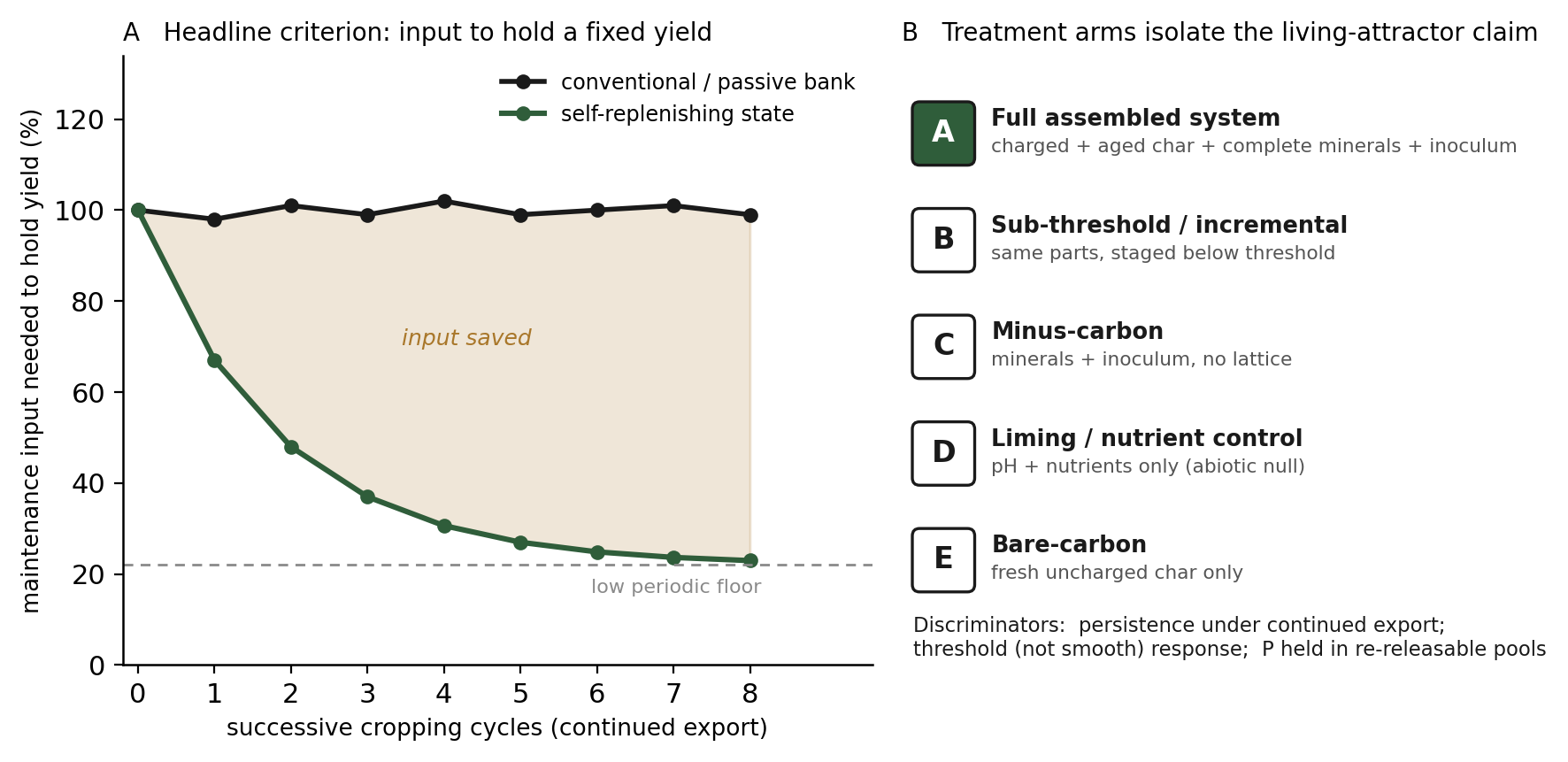
11. Conclusion
Terra preta is best understood not as a fertilized soil but as a soil whose biological community has settled into a different equilibrium, a frame this paper shares with Wilkins (2026), and the proposed mechanism for that equilibrium is a durable, high-surface-area carbon lattice acting as a multifunctional shared substrate. The lattice supplies habitat, exchange capacity, reservoirs, and a class-dependent signal economy through different pore classes and surface chemistries that ripen on different clocks; the resulting density and proximity switch on an efficiency economy governed by quorum sensing and a division of labor whose profitability hinges on proximity, with the Black Queen dynamic of adaptive gene loss compounding that economy across a longer evolutionary clock; the positive feedbacks of that economy are the formal prerequisite for an alternative stable state, a regime that a growing body of evidence indicates soil microbial communities can occupy; and the fungal network integrates the system, mobilizes its minerals, trades reciprocally with its hosts, and primes plant immunity, with the acquisitive and structural functions rising as the mycelial network densifies and the immune and signaling functions riding on its presence. Five independent disciplines describe components of the same architecture, and that convergence is the strongest support presently available, though it motivates the hypothesis rather than demonstrating it; a minimal model of the two loops, run with the literature’s parameters, produces the fold and the hysteresis the claim requires against the maintenance input, and locates them in the efficiency economy and the density the lattice permits rather than in storage.
The honest verdict is that the synthesis is strong, defensible, and testable, that its components are individually well established, and that the integrated outcome (a soil that banks what it is given in accessible form and renews itself from that stock, and behind it an engineered, hysteretic up-transition into a self-stabilizing high-fertility state) is the open experiment that would distinguish a compelling hypothesis from a demonstrated discovery. The calibrated version of the claim is also the more powerful one, because the corrections that this synthesis incorporates (a tipping point rather than a runaway, an efficient route rather than a unique one, asynchronous maturation rather than instant function, measurable rather than conscious fungal signaling) are exactly what make the result survive scrutiny.
The synthesis also names its own place in an applied line of work that has been converging on the same object from the practical side: nitrate captured and delivered by composted char, the organic coating that explains the capture, organo-mineral complexes built deliberately, nutrient-charged placements in the root zone, and low-dose mineral composites built on the char lattice (Kammann et al., 2015; Hagemann et al., 2017; H.-P. Schmidt et al., 2015; Joseph et al., 2010, 2013, 2021). That line pursues low-dose, high-efficiency composites whose response rises with their reactive mineral content; this paper predicts instead a threshold in dose and a falling input over time. What that line still lacks, by its own accounting, is the discriminating comparison, and the experiment of Section 10 is built to be it: the fully specified lattice against the raw char it began as, at matched inputs, read through the form and turnover of the nutrient bank, with the maintenance curve behind it, as the signature that separates a conditioned soil from a fertilized one. Nor is the instrument confined to this paper’s system. Roughly a third of the nitrogen applied to the world’s cereal ground reaches a harvest (Raun and Johnson, 1999), and the redesigned forms, legume-partnered intercrops yielding the same harvest from a fifth less land (Martin-Guay et al., 2018), perennial grains holding annual yields across successive harvests (Zhang et al., 2023), show that direction to be agronomically real while none yet closes the budget at industrial export, which is exactly the boundary this paper draws.
The strength of the case lies where it should: in the convergence of five independent fields on a single, testable architecture, and in the experiment that would convert that architecture from a coherent hypothesis into a demonstrated result. The applied and societal consequences of the mechanism, the deliberate building of such soils and the stakes of doing so, lie beyond the scope of this paper, which ends where the science does, at the threshold of that experiment. The evidentiary status of every claim advanced here is set out in Table 1.
Table 1. Evidentiary status of the principal claims advanced in this paper. Established and well-supported claims are stated plainly; partial claims are flagged; framings to be used sparingly or avoided are marked as such.
| Claim | Status | Principal support | What would strengthen it |
|---|---|---|---|
| Char adds large total surface area to low-surface-area soils | Established | Comparative surface-area data for chars vs. kaolinitic/sandy soils | Direct measurement of the specific char in use |
| Order-of-magnitude surface-area gain | Well supported, conditional | Holds for near-zero baselines such as quartz sand; several-fold for genuinely low-clay soils, fractional on kaolinitic ground | Stating it as conditional on soil and char properties |
| Habitable surface is macropore-limited; gas-adsorption area overstates it | Established | Accessible-fraction and pore-size colonization data | Pore-size distribution of the specific char |
| Macropores shelter cells from protozoan grazing | Contested; the one direct test was null | Pingree et al. (2022) | Colonization is documented; grazing protection is not. State as untested, not as mechanism. |
| Macropore interiors carry dense standing occupancy in the field | Not supported on raw char | Interior colonization very sparse after three field years; activity concentrates in the charosphere; pore-space biomass minor (Lehmann et al., 2011; Quilliam et al., 2013; Pingree et al., 2022) | Cross-sectional imaging of recovered conditioned particles; Section 10 density readouts |
| Surface, CEC, and habitat are partly independent design levers on different clocks | Well supported | Pyrolysis-temperature and aging chemistry; feedstock-morphology control of macropores | Time-course CEC and habitat measurements |
| Density-gated collective switching (quorum sensing) | Established | Miller and Bassler (2001); Waters and Bassler (2005) | Phrasing the threshold as “threshold-like,” not a hard wall |
| Confinement lowers the density required (diffusion and efficiency sensing) | Demonstrated in confined micro-volumes; transfer to char pores is class-dependent (absorbing-wall boundary condition) | Redfield (2002, hypothesis); Hense et al. (2007, unifying framework); Boedicker et al. (2009) and Carnes et al. (2009, single-cell demonstrations); Gao et al. (2016a); Masiello et al. (2013) | Pore-scale confirmation with conditioned, non-consuming walls in a soil-like matrix |
| Fine porosity retains community signals (the switchboard) | Demonstrated in reverse for fresh char at the wall (char can raise quorum behavior elsewhere by aggregation or secretion); predicted for the conditioned class | Masiello et al. (2013); Gao et al. (2016b); Yates et al. (2002); Sheng et al. (2022); Cheng et al. (2024); Yan et al. (2022); Li et al. (2025); Hagemann et al. (2017) | The conditioning-series AHL assay of Section 2 (sorption isotherms, hydrolysis rates, bioreporter recovery) |
| The Black Queen dynamic compounds the proximity economy across an evolutionary clock, deepening the basin, and is not the proximate engine of the transition | Established as evolutionary theory; constructive form modeled | Morris, Lenski, and Zinser (2012); Takeuchi et al. (2024) | An evolutionary-time, partly modeled layer; demonstration in a soil community |
| Inoculated communities are already pervasively auxotrophic and cross-dependent, so the interdependent web is inherited rather than evolved in place | Established | D’Souza et al. (2014); D’Souza and Kost (2016) | None needed |
| Proximity flips division of labor from net cost to net gain | Extension of Tsoi; measured exchange range supports it, threshold does not follow from diffusion | Tsoi et al. (2018); Dal Co et al. (2020); Berg and Purcell (1977) | Labeled as the author’s spatial extension |
| Positive feedback is the prerequisite for an alternative stable state (necessary but not sufficient) | Established | Critical-transition theory (Holling 1973; May 1977; Scheffer et al. 2001); Kéfi, Holmgren and Scheffer (2016) | Showing the feedback is strong enough to fold the response curve |
| Soil microbial communities occupy alternative stable states; transitions show hysteresis | Supported for downward transitions; the full loop not yet traced | Fujita et al. (2025, soil energy landscapes); Todman et al. (2018, soil functional transitions); Amor, Ratzke and Gore (2020, experimental microbial transitions) | A full hysteresis loop traced experimentally in soil, not only inferred |
| Terra preta as an engineered, hysteretic up-transition (framing shared with Wilkins, 2026; constructive bet opposed) | Frontier (open experiment) | Symmetry of the theory; existence of dark earths as a built endpoint | The hysteresis experiment in Section 10 |
| Fungal network integrates the system; its diversity determined plant diversity, stability, and productivity in assembled communities | Demonstrated experimentally; field generality open | van der Heijden et al. (1998); Smith and Read (2008) | Carbon role is balance, not storage only; the organizing role is emergent function, not control |
| Fungal network mobilizes and shuttles minerals to the plant (the principal acquisition organ); reach differs by tier, arbuscular about ten centimeters, ectomycorrhizal decimeters to meters, saprotrophic genets kilometers | Well supported | Smith and Read (2008); Li et al. (1991); Jakobsen et al. (1992); Agerer (2006); Bending and Read (1995); Pérez-Moreno and Read (2000); Ferguson et al. (2003) | Off-plot foraging credited only in ectomycorrhizal perennial systems; never in the wood-wide-web register |
| The hyphal network delivers phosphate-solubilizing bacteria and phosphatases to organic and bound phosphorus and selects accessible over aluminum-bound pools: the biological route by which the bank stays accessible | Well supported as mechanism; magnitude open | Jiang et al. (2021); Wang et al. (2023); Zhang et al. (2018); Sato et al. (2015); Keyes et al. (2022) | Hyphosphere fractionation in Section 10; Keyes et al. (2022) cited for selectivity, not flux, since its uptake estimate is an order of magnitude below prior models |
| Plant-fungus exchange is a reciprocal-reward market with partner choice and sanctions | Well supported | Kiers et al. (2011) | The “negotiation” is discrimination and reward, not deliberation; context-dependent |
| Mycorrhiza-induced resistance (fungi prime plant immunity) | Well supported | Pozo and Azcón-Aguilar (2007); Jung et al. (2012) | Noting context-dependence (Dejana et al. 2022) |
| Plant-fungus molecular dialogue | Established | Akiyama et al. (2005); Maillet et al. (2011) | None needed |
| Interplant defense signaling through fungal networks | Suggestive but contested | Song et al. (2010); Babikova et al. (2013), among the studies the systematic review cautions against | Present as contested, not secure |
| Fungal electrical activity in hyphae | Frontier; not evidence of cognition | Adamatzky (2022) | Real phenomenon; the “language” and intelligence reading is unsupported |
| Conscious, altruistic, forest-scale resource sharing (“wood-wide-web”) | Avoid | Found insufficiently supported and over-cited by Karst, Jones and Hoeksema (2023) | Not applicable; drop the claim |
| The network’s organizing role is emergent function and reciprocal exchange, not intelligence, deliberation, or conscious management | Calibration (limit) | Karst, Jones, and Hoeksema (2023) | State it as integrating tissue and function, never as cognition or a capstone-mind |
| Disease-suppressive soils: general suppression as community-level immunity (non-transferable), specific suppression transferable by inoculation | Well supported | Weller et al. (2002) | Predicting where suppression will occur |
| Dark earth is reproducible beyond Amazonia and made today | Well supported | Solomon et al. (2016), West African Dark Earths; M. J. Schmidt et al. (2023), present-day Amazonian practice | Scaling the documented intentional route from midden to field |
| Pyrogenic carbon persists for centuries but is not permanent | Established | M. W. I. Schmidt et al. (2011); Wang et al. (2016); Kuzyakov et al. (2009) | None needed |
| Persistence alone is not evidence of a living attractor; endurance is over-determined by recalcitrant carbon and passive exchange capacity, and cultivated dark earth depletes | Calibration; concession | This synthesis; M. W. I. Schmidt et al. (2011); M. J. Schmidt et al. (2023); Lima et al. (2002) | Persistence under export is not claimed. The living-state signature is the form and turnover of the nutrient bank, tested in Sections 8 and 10 |
| Dark-earth phosphorus is held in bone-derived calcium and aluminum phosphate particles and on organo-mineral colloids rather than in iron-occluded pools: the archetype’s bank is in accessible form | Established for the archetype | Schaefer et al. (2004); Orozco-Ortiz et al. (2021); Zhang et al. (2021) | The same fractionation and colloid characterization on the conditioned material of Section 10 |
| Dark-earth carbon enrichment is not exclusively pyrogenic; durable carbon plausibly stabilizes co-located non-pyrogenic organic matter | Well supported | Solomon et al. (2016); Slocum et al. (2026); SOM-persistence theory (M. W. I. Schmidt et al., 2011; Lehmann and Kleber, 2015) | Direct demonstration that the lattice causes the co-located stabilization |
| Abiotic chemistry (phosphorus, calcium, exchange capacity, pH, recalcitrant carbon) explains much of dark-earth fertility and persistence | Leading alternative, conceded | Solomon et al. (2016); Jeffery et al. (2017) | The biological claim must be tested against this null, not assumed above it |
| Fresh, uncharged char can reduce yield, while charged or co-composted char improves it | Established | Kammann et al. (2015); Joseph et al. (2018) | None needed |
| The raw-class reversal beyond thirty tonnes per hectare carries a signal-budget component | Hypothesis; candidate mechanism | Masiello et al. (2013); Gao et al. (2016b); Jeffery et al. (2017) | The computed dose budget; the conditioning-series assay ordering recoverable signal |
| Biochar’s average field effect is modest and variable, and concentrated in acidic, sandy, weathered tropical soils | Established | Jeffery et al. (2011, 2017); H.-P. Schmidt et al. (2021) | Liming and publication-bias confounds are real and acknowledged |
| The charging-and-maturation account explains much of the biochar literature’s heterogeneity | Hypothesis (testable, not a blanket dismissal) | This synthesis; Kammann et al. (2015) | The fresh-versus-charged-versus-inoculated comparison, tracked over years against a liming control |
| A thermodynamic floor limits “anything decomposes given time and fuel” | Established | Schink (1997); PFAS recalcitrance | None needed |
| High-function state self-organizes under selection; its endpoint is shaped by founding conditions and local biota (priority effects) | Well supported | Community-assembly and priority-effect theory (Fukami, 2015); inoculum and sequence as determinants (Wubs et al., 2016) | Direction is reliable; exact endpoint is contingent, state as locale-dependent, not deterministic |
| Retention: the conditioned lattice holds water and nutrients against leaching, volatilization and nitrous oxide loss | Well supported (largely abiotic) | Retention functions (Section 2); Kammann et al. (2015); Hagemann et al. (2017) | Loss terms measured at matched input in Section 10 (leachate load, ammonia, nitrous oxide) |
| Acquisition and recycling: the living state mobilizes occluded phosphorus, adds symbiotic nitrogen and turns both over faster per unit of labile stock, so that fertility is banked once and then renews itself | Prediction (the paper’s claim) | Schaefer et al. (2004); Orozco-Ortiz et al. (2021); Zhang et al. (2021); Nelissen et al. (2012); Frossard et al. (2011) | Gross flux per unit labile stock and the phosphorus fractionation time course, read against a lattice conditioned but not alive |
| Free-energy / self-organization framing of the transition (degradation downhill, building uphill; reinforced stability at a higher, metastable state) | Used illustratively (Figure 3A) | Critical-transition theory as the rigorous basis; dissipative-structure language (Prigogine and Nicolis, 1977) by analogy only | Schematic, not evidence, the energetics are qualitative; the quantitative claim remains the experiment (Section 10) |
| Inter-partner loss and leaching loss are one loss, joined by residence time in solution | Author’s synthesis; components standard | Berg and Purcell (1977); Vitousek and Reiners (1975); Raynaud and Nunan (2014) | Direct test of separation as a retention term |
| The proximity feedback crosses a genuine threshold in soil | Asserted, not derived; documented in model and culture systems | Vet, Gelens and Gonze (2020); Larkin et al. (2018) | Section 10 sub-threshold arm distinguishes discontinuity from smooth response |
| The coupled loops open a fold with hysteresis against the maintenance input in the small model at doses of about two percent and above, requiring the cooperation term, the community-built ceiling and the lattice’s density ceiling and not the reversible bank, with storage setting efficiency and the two walls; the fuller model does not reproduce the fold, and the difference is located in the nutrient status of degraded soil against the community’s growth-to-death ratio at the uncooperative efficiency | Conditional; the boundary is derived, the small model sits inside it by a few parts in a hundred, the fuller model outside, and the four deciding quantities are unmeasured (Figure 5, Table 2) | This paper’s models; Kéfi, Holmgren and Scheffer (2016); Vet, Gelens and Gonze (2020); Tsoi et al. (2018); Raynaud and Nunan (2014); Dal Co et al. (2020); Zhou et al. (2017); Liang et al. (2010); Scheffer et al. (2009); Yu et al. (2018) for the field ordering | Measured values of the community’s maximum growth rate and death rate, the uncooperative efficiency, the cooperation threshold and ceiling gain, and the mineral nitrogen and phosphorus status of degraded soil against the community’s half-saturation constants; the down-leg perturbation of Section 10 at half input |
| Nitrogen is retained rather than supplied; the system lowers the replacement rate without closing the loop | Well supported | Immobilization outcompeting nitrification for the ammonium pool; the residence-time argument of Section 3 | Nitrification and immobilization rates measured in the same system |
| A falling maintenance curve requires gross flux to exceed export by a computable multiple; turnover per unit labile stock is a state variable outside the syndrome | Hypothesis; year-one instrument, pre-registered | Nelissen et al. (2012); Frossard et al. (2011) | Year-one arm ordering on turnover predicting the later maintenance ordering |
| The recommended fertilizer rate is a loss-compensation figure, so a falling maintenance input first measures the loss term closing (retention) and only with rising turnover per unit labile stock measures the living state | Calibration (decision rule) | Raun and Johnson (1999); Nelissen et al. (2012); Frossard et al. (2011); Section 9 | The paired readout of Section 10: losses and gross flux read together at matched input |
| Free-living fixation cannot meet harvest export | Established | Measured free-living rates against measured export | None needed; this is why the legume component is required |
| Symbiotic legume fixation is the nitrogen input term of the system | Well supported | Rhizobial symbiosis at rates an order of magnitude above free-living organisms | Crop capture rather than gross fixation is the number that matters |
| Conditioning raises fixation through biomass, not through efficiency, and the gain is bounded | Well supported, bounded | Phosphorus, molybdenum and pH correction on weathered acid soils | State as bounded; the atmospheric fraction is already near its ceiling |
| Reduced nitrous oxide emission is not evidence of retained nitrogen | Calibration (limit) | More complete reduction to dinitrogen | Never cite nitrous oxide reduction within a fertility budget |
| No-till is a boundary condition of the hypothesis, not a recommendation | Well supported | Hyphal severance, aggregate loss, and fragmentation and migration of the lattice (Major et al., 2010a) | Stated explicitly in Section 10 |
| The assembly of no-till, permanent legume cover and conditioned lattice is untested | Frontier (open experiment) | Components individually evidenced; no combined tropical trial exists | The pilot described in Section 10 |
| Char divides into two classes distinguishable by measurement rather than provenance: titratable alkalinity, exchange capacity, surface coating, wettability, nutrient loading, viable community | Definition (operational) | Each axis is a standard laboratory measurement | Reporting all six axes for the Section 10 material |
| At matched inputs char raises yield near fifteen percent over fertilizer alone, post-processing adds a fourteen percent mean gain over unprocessed char, and the advantage of partially conditioned over raw char is modest where measured; the celebrated large contrasts are nutrient-carrying mechanism demonstrations | Established (concession) | Ye et al. (2020); Thomas (2021); Melo et al. (2022) | The fully specified class is what the record has not tested |
| No published field trial has compared a fully specified lattice against the raw char it began as, at matched inputs, in tropical soil; Section 10 is that trial | Frontier (the paper’s contribution) | The syntheses state the gap in their own accounting | Running it |
| Conditional buffering: the conditioned class displaces soil reaction toward the pH 6 to 7 window from either side, base capacity self-gating, acid capacity demand-coupled | Hypothesis (the twin of the central claim) | Every leg separately established: the meta-analytic asymmetry, measured buffering gains, decarboxylation alkalinity, one-material reversals across soils of different starting pH | The reciprocal paired-soil incubation; scoped to non-calcareous ground, calcareous claims converting to microsite mobilization and salinity relief |
| Fungal functions rise with mycelial density along saturating curves | Established for aggregation, phosphorus acquisition, and leaching interception; presence-level for priming | Hyphal length against macroaggregation, r near 0.83 (Wilson et al., 2009; Leifheit et al., 2014); phosphorus inflow fungus-dependent and saturating (Jakobsen et al., 1992); phosphorus leaching cut by more than half (van der Heijden, 2010; Cavagnaro et al., 2015); carbon cost grows with tissue (Johnson et al., 1997) | Density manipulation with per-function dose-response |
| The conditioned lattice raises the community’s potential standing density; the community grows into it along saturating curves | Prediction, scoped to the conditioned class; direction supported at both ends of the record | Raw-char biomass gains of roughly a fifth to a quarter (Zhou et al., 2017; Pokharel et al., 2020); inoculated char outperforms char alone (Ross and Emery, 2025); dark earths carry up to 125 percent more biomass (Liang et al., 2010); trophic proportions scale lawfully (Perkins et al., 2022) | Section 10 sorption-corrected standing-density time series |
| The conditioned lattice and the fungal network are complementary integrators; the system’s response exceeds the sum of component responses | Prediction (conditional on demand-matched phosphorus) | Couplings separately documented (Warnock et al., 2007; Frey-Klett et al., 2007; Bonkowski, 2004); factorial record split by phosphorus (Meng et al., 2024; Sun et al., 2022) | The factorial subtraction on a fungal-network metric with phosphorus as covariate |
Table 2. Parameters of the two-loop model of Section 4 (Figure 5). Central values are used for the figure; ranges are the plausible spans of the cited basis, of which the cooperation threshold and the ceiling term were swept as a grid (reported in the text) and the loop terms were removed one at a time (Figure 5C). The three biological parameters a, K_A and β are order-of-magnitude estimates and are marked as such in the text.
| Symbol | Meaning | Central value | Range | Basis |
|---|---|---|---|---|
| I₀ | background supply (mineralization, deposition) | 0.05 mg N kg⁻¹ d⁻¹ | 0.02–0.1 | about 18 mg N kg⁻¹ yr⁻¹ |
| P, pulses | fertilizer pulse and timing | 25 mg N kg⁻¹, three a year | 10–40 | about 150 kg N ha⁻¹ yr⁻¹ at 1,950 t ha⁻¹ of soil |
| λ | pore-water drainage rate, seasonal | 0.09 d⁻¹ mean, ±60 % | 0.03–0.2 | 1,500 mm yr⁻¹ over 45 mm of pore water in 15 cm |
| Q₀, q | native exchangeable capacity; bank capacity per 1 % dose | 5; 40 mg N kg⁻¹ | 2–20; 20–60 | char at the 25 cmol kg⁻¹ cut value gives 35; coating capture adds (Kammann et al., 2015; Hagemann et al., 2017) |
| kₐ, k_d | sorption, desorption | 0.05 (mg N kg⁻¹)⁻¹ d⁻¹; 0.05 d⁻¹ | k_d 0.02–0.2 | capture within a day, release over weeks (Joseph et al., 2018) |
| k_o | slow fixation of the held pool | 0.0005 d⁻¹ | 0–0.002 | occlusion on a five-year scale; the ceiling wall |
| u_max, K_N | maximal growth; half-saturation | 0.25 d⁻¹; 2 mg N kg⁻¹ | 0.1–0.5; 1–5 | soil microbial growth kinetics in situ |
| m, f, k_m | turnover; prompt return; necromass mineralization | 0.02 d⁻¹; 0.7; 0.001 d⁻¹ | 0.005–0.05; 0.5–0.9 | biomass turnover 20–200 d; necromass about three years |
| a | efficiency of the uncooperative community | 0.35 | 0.2–0.6 | consortium below monoculture until specialization pays (Tsoi et al., 2018) |
| K_A, h | density at which cooperation is half switched on; steepness | 45 mg N kg⁻¹; 3 | 30–80 | mean spacing 12.5 µm entering an 8 µm exchange range: (12.5/8)³ ≈ 3.8 times the degraded biomass (Raynaud and Nunan, 2014; Dal Co et al., 2020) |
| K₀ | biomass ceiling of the degraded soil | 25 mg N kg⁻¹ | 15–40 | biomass carbon 150–250 mg kg⁻¹ in weathered tropical soils |
| κ | rise in the ceiling per 1 % dose | 0.5 | 0.2–1.0 | raw char +20–25 % near 1 % (Zhou et al., 2017; Pokharel et al., 2020); dark earths +125 % (Liang et al., 2010) |
| β | the community’s raising of its own ceiling | 1.0 | 0.5–1.5 | aggregation and water holding with hyphal length (Wilson et al., 2009; Leifheit et al., 2014) |
| u_p | crop root uptake on solution | 0.05 d⁻¹ | 0.02–0.15 | constant, or a 100-day season after each pulse with 10 % demand otherwise |
Declarations
Competing interests. The author is the founder of ProtoTerra LLC, which is developing conditioned biochar-based soil amendments of the kind this paper discusses and is preparing patent filings on their manufacture. The paper claims nothing over any recipe, process or apparatus, and the material specification of Section 8 is stated so that any producer’s material can be classed by measurement.
Funding. This work received no external funding.
Use of AI tools. AI research assistants were used for literature search, reference verification, drafting and revision, and for the coverage arithmetic of Section 2. The author directed the work, verified the sources, and is responsible for all content.
Data and materials availability. No new experimental data are reported. The coverage calculation of Section 2, the two-loop model of Section 4 with its parameter table and the scripts that produced Figure 5, and the pre-registration plan of Section 10 are deposited with the preprint.
Author contributions. Michael Rodriguez conceived the hypothesis, performed the synthesis, and wrote the paper.
References
- Adamatzky, A. (2022). Language of fungi derived from their electrical spiking activity. Royal Society Open Science, 9(4), 211926. https://doi.org/10.1098/rsos.211926
- Agerer, R. (2006). Fungal relationships and structural identity of their ectomycorrhizae. Mycological Progress, 5(2), 67–107. https://doi.org/10.1007/s11557-006-0505-x
- Akiyama, K., Matsuzaki, K., & Hayashi, H. (2005). Plant sesquiterpenes induce hyphal branching in arbuscular mycorrhizal fungi. Nature, 435, 824–827. https://doi.org/10.1038/nature03608
- Amor, D. R., Ratzke, C., & Gore, J. (2020). Transient invaders can induce shifts between alternative stable states of microbial communities. Science Advances, 6(3), eaay8676. https://doi.org/10.1126/sciadv.aay8676
- Anderson, J. B., Bruhn, J. N., Kasimer, D., Wang, H., Rodrigue, N., & Smith, M. L. (2018). Clonal evolution and genome stability in a 2500-year-old fungal individual. Proceedings of the Royal Society B: Biological Sciences, 285(1893), 20182233. https://doi.org/10.1098/rspb.2018.2233
- Arwenyo, B., Varco, J. J., Dygert, A., Brown, S., Pittman, C. U., & Mlsna, T. (2023). Contribution of modified P-enriched biochar on pH buffering capacity of acidic soil. Journal of Environmental Management, 339, 117863. https://doi.org/10.1016/j.jenvman.2023.117863
- Babikova, Z., Gilbert, L., Bruce, T. J. A., Birkett, M., Caulfield, J. C., Woodcock, C., Pickett, J. A., & Johnson, D. (2013). Underground signals carried through common mycelial networks warn neighbouring plants of aphid attack. Ecology Letters, 16(7), 835–843. https://doi.org/10.1111/ele.12115
- Bakshi, S., Aller, D. M., Laird, D. A., & Chintala, R. (2016). Comparison of the physical and chemical properties of laboratory and field-aged biochars. Journal of Environmental Quality, 45(5), 1627–1634. https://doi.org/10.2134/jeq2016.02.0062
- Beisner, B. E., Haydon, D. T., & Cuddington, K. (2003). Alternative stable states in ecology. Frontiers in Ecology and the Environment, 1(7), 376–382. https://doi.org/10.1890/1540-9295(2003)001[0376:assie]2.0.co;2
- Bekchanova, M., Campion, L., Bruns, S., Kuppens, T., Lehmann, J., Jozefczak, M., Cuypers, A., & Malina, R. (2024). Biochar improves the nutrient cycle in sandy-textured soils and increases crop yield: a systematic review. Environmental Evidence, 13, 3. https://doi.org/10.1186/s13750-024-00326-5
- Bending, G. D., & Read, D. J. (1995). The structure and function of the vegetative mycelium of ectomycorrhizal plants. V. Foraging behaviour and translocation of nutrients from exploited litter. New Phytologist, 130(3), 401–409. https://doi.org/10.1111/j.1469-8137.1995.tb01834.x
- Berg, H. C., & Purcell, E. M. (1977). Physics of chemoreception. Biophysical Journal, 20(2), 193–219. https://doi.org/10.1016/s0006-3495(77)85544-6
- Bickel, S., & Or, D. (2023). Aqueous habitats and carbon inputs shape the microscale geography and interaction ranges of soil bacteria. Communications Biology, 6, 322. https://doi.org/10.1038/s42003-023-04703-7
- Billet, L., Devers, M., Rouard, N., Martin-Laurent, F., & Spor, A. (2019). Labour sharing promotes coexistence in atrazine degrading bacterial communities. Scientific Reports, 9(1), 18363. https://doi.org/10.1038/s41598-019-54978-2
- Boedicker, J. Q., Vincent, M. E., & Ismagilov, R. F. (2009). Microfluidic confinement of single cells of bacteria in small volumes initiates high-density behavior of quorum sensing and growth and reveals its variability. Angewandte Chemie International Edition, 48(32), 5908–5911. https://doi.org/10.1002/anie.200901550
- Bonkowski, M. (2004). Protozoa and plant growth: The microbial loop in soil revisited. New Phytologist, 162(3), 617–631. https://doi.org/10.1111/j.1469-8137.2004.01066.x
- Borer, B., Tecon, R., & Or, D. (2018). Spatial organization of bacterial populations in response to oxygen and carbon counter-gradients in pore networks. Nature Communications, 9, 769. https://doi.org/10.1038/s41467-018-03187-y
- Brockhurst, M. A., Buckling, A., Racey, D., & Gardner, A. (2008). Resource supply and the evolution of public-goods cooperation in bacteria. BMC Biology, 6, 20. https://doi.org/10.1186/1741-7007-6-20
- Brown, R. W., Chadwick, D. R., & Jones, D. L. (2026). Clarifying the conflation of biochar carbon stability and its soil co-benefits. Biochar, 8(1), Article 67. https://doi.org/10.1007/s42773-026-00581-4
- Carnes, E. C., Lopez, D. M., Donegan, N. P., Cheung, A., Gresham, H., Timmins, G. S., & Brinker, C. J. (2009). Confinement-induced quorum sensing of individual Staphylococcus aureus bacteria. Nature Chemical Biology, 6(1), 41–45. https://doi.org/10.1038/nchembio.264
- Carpenter, S. R., Cole, J. J., Pace, M. L., Batt, R., Brock, W. A., Cline, T., Coloso, J., Hodgson, J. R., Kitchell, J. F., Seekell, D. A., Smith, L., & Weidel, B. (2011). Early warnings of regime shifts: A whole-ecosystem experiment. Science, 332(6033), 1079–1082. https://doi.org/10.1126/science.1203672
- Cavagnaro, T. R., Bender, S. F., Asghari, H. R., & van der Heijden, M. G. A. (2015). The role of arbuscular mycorrhizas in reducing soil nutrient loss. Trends in Plant Science, 20(5), 283–290. https://doi.org/10.1016/j.tplants.2015.03.004
- Cheiky, M., Jarand, M. L., & Sills, R. A. (2012). Method for enhancing soil growth using bio-char (U.S. Patent No. 8,317,891 B1). U.S. Patent and Trademark Office. https://patents.google.com/patent/US8317891B1
- Cheiky, M. C., & Sills, R. A. (2019). Method for the bioactivation of biochar for use as a soil amendment (U.S. Patent No. 10,273,195 B2). U.S. Patent and Trademark Office. https://patents.google.com/patent/US10273195B2
- Chen, J., Li, S., Liang, C., Xu, Q., Li, Y., Qin, H., & Fuhrmann, J. J. (2017). Response of microbial community structure and function to short-term biochar amendment in an intensively managed bamboo (Phyllostachys praecox) plantation soil: Effect of particle size and addition rate. Science of the Total Environment, 574, 24–33. https://doi.org/10.1016/j.scitotenv.2016.08.190
- Chen, S., Rotaru, A.-E., Shrestha, P. M., Malvankar, N. S., Liu, F., Fan, W., Nevin, K. P., & Lovley, D. R. (2014). Promoting interspecies electron transfer with biochar. Scientific Reports, 4, 5019. https://doi.org/10.1038/srep05019
- Chen, W., Koide, R. T., Adams, T. S., DeForest, J. L., Cheng, L., & Eissenstat, D. M. (2016). Root morphology and mycorrhizal symbioses together shape nutrient foraging strategies of temperate trees. Proceedings of the National Academy of Sciences, 113(31), 8741–8746. https://doi.org/10.1073/pnas.1601006113
- Chen, X., Lewis, S., Heal, K. V., Lin, Q., & Sohi, S. P. (2021). Biochar engineering and ageing influence the spatiotemporal dynamics of soil pH in the charosphere. Geoderma, 386, 114919. https://doi.org/10.1016/j.geoderma.2020.114919
- Cheng, C.-H., Lehmann, J., & Engelhard, M. H. (2008). Natural oxidation of black carbon in soils: Changes in molecular form and surface charge along a climosequence. Geochimica et Cosmochimica Acta, 72(6), 1598–1610. https://doi.org/10.1016/j.gca.2008.01.010
- Cheng, C.-H., Lehmann, J., Thies, J. E., Burton, S. D., & Engelhard, M. H. (2006). Oxidation of black carbon by biotic and abiotic processes. Organic Geochemistry, 37(11), 1477–1488. https://doi.org/10.1016/j.orggeochem.2006.06.022
- Cheng, Y., Lu, K., Chen, Z., Li, N., & Wang, M. (2024). Biochar reduced the risks of human bacterial pathogens in soil via disturbing quorum sensing mediated by persistent free radicals. Environmental Science & Technology, 58(50), 22343–22354. https://doi.org/10.1021/acs.est.4c07668
- Cordero, I., Leizeaga, A., Hicks, L. C., Rousk, J., & Bardgett, R. D. (2023). High intensity perturbations induce an abrupt shift in soil microbial state. The ISME Journal, 17(12), 2190–2199. https://doi.org/10.1038/s41396-023-01512-y
- Cui, Y., Peng, S., Delgado-Baquerizo, M., Rillig, M. C., Terrer, C., Zhu, B., Jing, X., Chen, J., Li, J., Feng, J., He, Y., Fang, L., Moorhead, D. L., Sinsabaugh, R. L., & Peñuelas, J. (2023). Microbial communities in terrestrial surface soils are not widely limited by carbon. Global Change Biology, 29(15), 4412–4429. https://doi.org/10.1111/gcb.16765
- D’Souza, G., & Kost, C. (2016). Experimental evolution of metabolic dependency in bacteria. PLoS Genetics, 12(11), e1006364. https://doi.org/10.1371/journal.pgen.1006364
- D’Souza, G., Waschina, S., Pande, S., Bohl, K., Kaleta, C., & Kost, C. (2014). Less is more: selective advantages can explain the prevalent loss of biosynthetic genes in bacteria. Evolution, 68(9), 2559–2570. https://doi.org/10.1111/evo.12468
- Dal Co, A., van Vliet, S., Kiviet, D. J., Schlegel, S., & Ackermann, M. (2020). Short-range interactions govern the dynamics and functions of microbial communities. Nature Ecology and Evolution, 4, 366–375. https://doi.org/10.1038/s41559-019-1080-2
- Dechesne, A., Or, D., & Smets, B. F. (2008). Limited diffusive fluxes of substrate facilitate coexistence of two competing bacterial strains. FEMS Microbiology Ecology, 64(1), 1–8. https://doi.org/10.1111/j.1574-6941.2008.00446.x
- Dejana, L., Ramírez-Serrano, B., Rivero, J., Gamir, J., López-Ráez, J. A., & Pozo, M. J. (2022). Phosphorus availability drives mycorrhiza-induced resistance in tomato. Frontiers in Plant Science, 13, 1060926. https://doi.org/10.3389/fpls.2022.1060926
- Dhar, D. (1997). On the critical density for continuum percolation of spheres of variable radii. Physica A: Statistical Mechanics and its Applications, 242(3-4), 341–346. https://doi.org/10.1016/S0378-4371(97)00287-2
- Dissanayake, L., Farrar, M. B., Omidvar, N., Joseph, S., Trubenbacher, K., Hosen, M. H., Guo, L., Liu, W., Bai, Y., Xu, Z., & Hosseini Bai, S. (2026). Biochar-based fertilizer is cost-effective, reduces nutrient input and improves nutrient use efficiency without decreasing yield. GCB Bioenergy, 18(2), e70104. https://doi.org/10.1111/gcbb.70104
- Dotterweich, M., & Schreg, R. (2019). Archaeonics – (Geo)archaeological studies in Anthropogenic Dark Earths (ADE) as an example for future-oriented studies of the past. Quaternary International, 502(Part B), 309–318. https://doi.org/10.1016/j.quaint.2018.09.026
- Duan, P., Zhang, X., Zhang, Q., Wu, Z., & Xiong, Z. (2018). Field-aged biochar stimulated N2O production from greenhouse vegetable production soils by nitrification and denitrification. Science of the Total Environment, 642, 1303–1310. https://doi.org/10.1016/j.scitotenv.2018.06.166
- Durenkamp, M., Luo, Y., & Brookes, P. C. (2010). Impact of black carbon addition to soil on the determination of soil microbial biomass by fumigation extraction. Soil Biology and Biochemistry, 42(11), 2026–2029. https://doi.org/10.1016/j.soilbio.2010.07.016
- Elad, Y., David, D. R., Harel, Y. M., Borenshtein, M., Kalifa, H. B., Silber, A., & Graber, E. R. (2010). Induction of systemic resistance in plants by biochar, a soil-applied carbon sequestering agent. Phytopathology, 100(9), 913–921. https://doi.org/10.1094/PHYTO-100-9-0913
- European Biochar Certificate (EBC). (2025). Guidelines for a sustainable production of biochar (Version 10.5E, 14 August 2025). Carbon Standards International (CSI), Frick, Switzerland. https://www.european-biochar.org/media/doc/7/ebc_en_10_5_red.pdf
- Ferguson, B. A., Dreisbach, T. A., Parks, C. G., Filip, G. M., & Schmitt, C. L. (2003). Coarse-scale population structure of pathogenic Armillaria species in a mixed-conifer forest in the Blue Mountains of northeast Oregon. Canadian Journal of Forest Research, 33(4), 612–623. https://doi.org/10.1139/x03-065
- Finn, D. R., App, M., Hertzog, L., & Tebbe, C. C. (2022). Reconciling concepts of black queen and tragedy of the commons in simulated bulk soil and rhizosphere prokaryote communities. Frontiers in Microbiology, 13, 969784. https://doi.org/10.3389/fmicb.2022.969784
- Frey-Klett, P., Garbaye, J., & Tarkka, M. (2007). The mycorrhiza helper bacteria revisited. New Phytologist, 176(1), 22–36. https://doi.org/10.1111/j.1469-8137.2007.02191.x
- Frossard, E., Achat, D. L., Bernasconi, S. M., Bünemann, E. K., Fardeau, J.-C., Jansa, J., Morel, C., Rabeharisoa, L., Randriamanantsoa, L., Sinaj, S., Tamburini, F., & Oberson, A. (2011). The use of tracers to investigate phosphate cycling in soil–plant systems. In E. K. Bünemann, A. Oberson, & E. Frossard (Eds.), Phosphorus in Action (Soil Biology 26). Springer. https://doi.org/10.1007/978-3-642-15271-9_3
- Fujita, H., Yoshida, S., Suzuki, K., & Toju, H. (2025). Alternative stable states of microbiome structure and soil ecosystem functions. Environmental Microbiome, 20, 28. https://doi.org/10.1186/s40793-025-00688-4
- Fukami, T. (2015). Historical contingency in community assembly: integrating niches, species pools, and priority effects. Annual Review of Ecology, Evolution, and Systematics, 46, 1–23. https://doi.org/10.1146/annurev-ecolsys-110411-160340
- Gao, M., Zheng, H., Ren, Y., Lou, R., Wu, F., Yu, W., Liu, X., & Ma, X. (2016a). A crucial role for spatial distribution in bacterial quorum sensing. Scientific Reports, 6(1), 34695. https://doi.org/10.1038/srep34695
- Gao, X., Cheng, H.-Y., Del Valle, I., Liu, S., Masiello, C. A., & Silberg, J. J. (2016b). Charcoal disrupts soil microbial communication through a combination of signal sorption and hydrolysis. ACS Omega, 1(2), 226–233. https://doi.org/10.1021/acsomega.6b00085
- Gao, X., Liu, H., Mei, W., Zhang, W., Dong, H., Fu, X., Xie, M., Han, Y., & Wang, L. (2024). Particle size is an important factor influencing the effects of biochar return to woodland soils: An evaluation from the perspective of sapling growth and soil microbial carbon processes. Journal of Environmental Management, 371, 123272. https://doi.org/10.1016/j.jenvman.2024.123272
- Glaser, B., & Birk, J. J. (2012). State of the scientific knowledge on properties and genesis of Anthropogenic Dark Earths in Central Amazonia (terra preta de Índio). Geochimica et Cosmochimica Acta, 82, 39–51. https://doi.org/10.1016/j.gca.2010.11.029
- Glaser, B., Haumaier, L., Guggenberger, G., & Zech, W. (2001). The ‘Terra Preta’ phenomenon: a model for sustainable agriculture in the humid tropics. Naturwissenschaften, 88(1), 37–41. https://doi.org/10.1007/s001140000193
- Gross, A., Tahery, S., Joseph, S., & Glaser, B. (2025). Towards understanding the long-term fate of biochar in Terra Preta. Carbon Management, 16(1), 2560126. https://doi.org/10.1080/17583004.2025.2560126
- Grossman, J. M., O’Neill, B. E., Tsai, S. M., Liang, B., Neves, E., Lehmann, J., & Thies, J. E. (2010). Amazonian anthrosols support similar microbial communities that differ distinctly from those extant in adjacent, unmodified soils of the same mineralogy. Microbial Ecology, 60(1), 192–205. https://doi.org/10.1007/s00248-010-9689-3
- Hagemann, N., Joseph, S., Schmidt, H.-P., Kammann, C. I., Harter, J., Borch, T., Young, R. B., Varga, K., Taherymoosavi, S., Elliott, K. W., McKenna, A., Albu, M., Mayrhofer, C., Obst, M., Conte, P., Dieguez-Alonso, A., Orsetti, S., Subdiaga, E., Behrens, S., & Kappler, A. (2017). Organic coating on biochar explains its nutrient retention and stimulation of soil fertility. Nature Communications, 8, 1089. https://doi.org/10.1038/s41467-017-01123-0
- Hale, S. E., Nurida, N. L., Jubaedah, Mulder, J., Sørmo, E., Silvani, L., Abiven, S., Joseph, S., Taherymoosavi, S., & Cornelissen, G. (2020). The effect of biochar, lime and ash on maize yield in a long-term field trial in a Ultisol in the humid tropics. Science of the Total Environment, 719, 137455. https://doi.org/10.1016/j.scitotenv.2020.137455
- Harel, Y. M., Elad, Y., Rav-David, D., Borenstein, M., Shulchani, R., Lew, B., & Graber, E. R. (2012). Biochar mediates systemic response of strawberry to foliar fungal pathogens. Plant and Soil, 357(1-2), 245–257. https://doi.org/10.1007/s11104-012-1129-3
- Hart, J. P., & Feranec, R. S. (2020). Using maize δ15N values to assess soil fertility in fifteenth- and sixteenth-century AD Iroquoian agricultural fields. PLOS ONE, 15(4), e0230952. https://doi.org/10.1371/journal.pone.0230952
- Hense, B. A., Kuttler, C., Müller, J., Rothballer, M., Hartmann, A., & Kreft, J.-U. (2007). Does efficiency sensing unify diffusion and quorum sensing? Nature Reviews Microbiology, 5(3), 230–239. https://doi.org/10.1038/nrmicro1600
- Hillebrand, H., Donohue, I., Harpole, W. S., Hodapp, D., Kucera, M., Lewandowska, A. M., Merder, J., Montoya, J. M., & Freund, J. A. (2020). Thresholds for ecological responses to global change do not emerge from empirical data. Nature Ecology & Evolution, 4, 1502–1509. https://doi.org/10.1038/s41559-020-1256-9
- Holling, C. S. (1973). Resilience and stability of ecological systems. Annual Review of Ecology and Systematics, 4, 1–23. https://doi.org/10.1146/annurev.es.04.110173.000245
- Huang, A., Ramesh, D., Nie, Y., Zhao, K., & Wang, M. (2026). Influence of cell-cell distance on the ecology and evolution of microbial communities. The ISME Journal. Advance online publication. https://doi.org/10.1093/ismejo/wrag199
- International Biochar Initiative (IBI). (2015). Standardized product definition and product testing guidelines for biochar that is used in soil (IBI Biochar Standards), Version 2.1. https://biochar-international.org/wp-content/uploads/2023/01/IBI_Biochar_Standards_V2.1_Final2.pdf
- IUSS Working Group WRB. (2022). World Reference Base for Soil Resources: International soil classification system for naming soils and creating legends for soil maps (4th ed.). International Union of Soil Sciences.
- Jakobsen, I., Abbott, L. K., & Robson, A. D. (1992). External hyphae of vesicular-arbuscular mycorrhizal fungi associated with Trifolium subterraneum L. 1. Spread of hyphae and phosphorus inflow into roots. New Phytologist, 120(3), 371–380. https://doi.org/10.1111/j.1469-8137.1992.tb01077.x
- Jeffery, S., Abalos, D., Prodana, M., Bastos, A. C., van Groenigen, J. W., Hungate, B. A., & Verheijen, F. (2017). Biochar boosts tropical but not temperate crop yields. Environmental Research Letters, 12(5), 053001. https://doi.org/10.1088/1748-9326/aa67bd
- Jeffery, S., Verheijen, F. G. A., van der Velde, M., & Bastos, A. C. (2011). A quantitative review of the effects of biochar application to soils on crop productivity using meta-analysis. Agriculture, Ecosystems & Environment, 144(1), 175–187. https://doi.org/10.1016/j.agee.2011.08.015
- Jiang, F., Zhang, L., Zhou, J., George, T. S., & Feng, G. (2021). Arbuscular mycorrhizal fungi enhance mineralisation of organic phosphorus by carrying bacteria along their extraradical hyphae. New Phytologist, 230(1), 304–315. https://doi.org/10.1111/nph.17081
- Johnson, N. C., Graham, J. H., & Smith, F. A. (1997). Functioning of mycorrhizal associations along the mutualism–parasitism continuum. New Phytologist, 135(4), 575–585. https://doi.org/10.1046/j.1469-8137.1997.00729.x
- Johnston, A. E., & Poulton, P. R. (2019). Phosphorus in agriculture: A review of results from 175 years of research at Rothamsted, UK. Journal of Environmental Quality, 48(5), 1133–1144. https://doi.org/10.2134/jeq2019.02.0078
- Johnston, A. M., & Bruulsema, T. W. (2014). 4R nutrient stewardship for improved nutrient use efficiency. Procedia Engineering, 83, 365–370. https://doi.org/10.1016/j.proeng.2014.09.029
- Jones, J. D., & Mallarino, A. P. (2018). Influence of source and particle size on agricultural limestone efficiency at increasing soil pH. Soil Science Society of America Journal, 82(1), 271–282. https://doi.org/10.2136/sssaj2017.06.0207
- Joseph, S., Cowie, A. L., Van Zwieten, L., Bolan, N., Budai, A., Buss, W., Cayuela, M. L., Graber, E. R., Ippolito, J. A., Kuzyakov, Y., Luo, Y., Ok, Y. S., Palansooriya, K. N., Shepherd, J., Stephens, S., Weng, Z., & Lehmann, J. (2021). How biochar works, and when it doesn’t: A review of mechanisms controlling soil and plant responses to biochar. GCB Bioenergy, 13(11), 1731–1764. https://doi.org/10.1111/gcbb.12885
- Joseph, S., Graber, E. R., Chia, C., Munroe, P., Donne, S., Thomas, T., Nielsen, S., Marjo, C., Rutlidge, H., Pan, G. X., Li, L., Taylor, P., Rawal, A., & Hook, J. (2013). Shifting paradigms: development of high-efficiency biochar fertilizers based on nano-structures and soluble components. Carbon Management, 4(3), 323–343. https://doi.org/10.4155/cmt.13.23
- Joseph, S., Kammann, C. I., Shepherd, J. G., Conte, P., Schmidt, H.-P., Hagemann, N., Rich, A. M., Marjo, C. E., Allen, J., Munroe, P., Mitchell, D. R. G., Donne, S., Spokas, K., & Graber, E. R. (2018). Microstructural and associated chemical changes during the composting of a high-temperature biochar: mechanisms for nitrate, phosphate, and other nutrient retention and release. Science of the Total Environment, 618, 1210–1223. https://doi.org/10.1016/j.scitotenv.2017.09.200
- Joseph, S. D., Camps-Arbestain, M., Lin, Y., Munroe, P., Chia, C. H., Hook, J., van Zwieten, L., Kimber, S., Cowie, A., Singh, B. P., Lehmann, J., Foidl, N., & Smernik, R. J. (2010). An investigation into the reactions of biochar in soil. Australian Journal of Soil Research (now Soil Research), 48(7), 501–515. https://doi.org/10.1071/SR10009
- Jung, H., & Meile, C. D. (2020). Numerical investigation of microbial quorum sensing under various flow conditions. PeerJ, 8, e9942. https://doi.org/10.7717/peerj.9942
- Jung, S. C., Martinez-Medina, A., Lopez-Raez, J. A., & Pozo, M. J. (2012). Mycorrhiza-induced resistance and priming of plant defenses. Journal of Chemical Ecology, 38(6), 651–664. https://doi.org/10.1007/s10886-012-0134-6
- Kammann, C. I., Schmidt, H.-P., Messerschmidt, N., Linsel, S., Steffens, D., Müller, C., Koyro, H.-W., Conte, P., & Joseph, S. (2015). Plant growth improvement mediated by nitrate capture in co-composted biochar. Scientific Reports, 5, 11080. https://doi.org/10.1038/srep11080
- Karst, J., Jones, M. D., & Hoeksema, J. D. (2023). Positive citation bias and overinterpreted results lead to misinformation on common mycorrhizal networks in forests. Nature Ecology & Evolution, 7, 501–511. https://doi.org/10.1038/s41559-023-01986-1
- Kätterer, T., Roobroeck, D., Andrén, O., Kimutai, G., Karltun, E., Kirchmann, H., Nyberg, G., Vanlauwe, B., & Röing de Nowina, K. (2019). Biochar addition persistently increased soil fertility and yields in maize–soybean rotations over 10 years in sub-humid regions of Kenya. Field Crops Research, 235, 18–26. https://doi.org/10.1016/j.fcr.2019.02.015
- Kéfi, S., Holmgren, M., & Scheffer, M. (2016). When can positive interactions cause alternative stable states in ecosystems? Functional Ecology, 30(1), 88–97. https://doi.org/10.1111/1365-2435.12601
- Keyes, S. D., van Veelen, A., McKay Fletcher, D., Scotson, C. P., Koebernick, N., Petroselli, C., Williams, K., Ruiz, S., Cooper, L., Mayon, R., Duncan, S., Dumont, M., Jakobsen, I., Oldroyd, G., Tkacz, A., Poole, P., Mosselmans, F., Borca, C., Huthwelker, T., … Roose, T. (2022). Multimodal correlative imaging and modelling of phosphorus uptake from soil by hyphae of mycorrhizal fungi. New Phytologist, 234(2), 688–703. https://doi.org/10.1111/nph.17980
- Kiers, E. T., Duhamel, M., Beesetty, Y., Mensah, J. A., Franken, O., Verbruggen, E., Fellbaum, C. R., Kowalchuk, G. A., Hart, M. M., Bago, A., Palmer, T. M., West, S. A., Vandenkoornhuyse, P., Jansa, J., & Bücking, H. (2011). Reciprocal rewards stabilize cooperation in the mycorrhizal symbiosis. Science, 333(6044), 880–882. https://doi.org/10.1126/science.1208473
- Kim, J.-S., Sparovek, G., Longo, R. M., De Melo, W. J., & Crowley, D. (2007). Bacterial diversity of terra preta and pristine forest soil from the Western Amazon. Soil Biology and Biochemistry, 39(2), 684–690. https://doi.org/10.1016/j.soilbio.2006.08.010
- Krieger, A.-E. (2014). Method for the production of humus- and nutrient-rich and water-storing soils or soil substrates for sustainable land use and development systems (European Patent No. EP 2188230 B1; priority date 2007-08-10; publication/grant date 2014-11-12). European Patent Office. https://patents.google.com/patent/EP2188230B1/en
- Kuzyakov, Y., & Blagodatskaya, E. (2015). Microbial hotspots and hot moments in soil: concept & review. Soil Biology and Biochemistry, 83, 184–199. https://doi.org/10.1016/j.soilbio.2015.01.025
- Kuzyakov, Y., & Zamanian, K. (2019). Reviews and syntheses: Agropedogenesis – humankind as the sixth soil-forming factor and attractors of agricultural soil degradation. Biogeosciences, 16(24), 4783–4803. https://doi.org/10.5194/bg-16-4783-2019
- Kuzyakov, Y., Subbotina, I., Chen, H., Bogomolova, I., & Xu, X. (2009). Black carbon decomposition and incorporation into soil microbial biomass estimated by 14C labeling. Soil Biology and Biochemistry, 41(2), 210–219. https://doi.org/10.1016/j.soilbio.2008.10.016
- Larkin, J. W., Zhai, X., Kikuchi, K., Redford, S. E., Prindle, A., Liu, J., Greenfield, S., Walczak, A. M., Garcia-Ojalvo, J., Mugler, A., & Süel, G. M. (2018). Signal percolation within a bacterial community. Cell Systems, 7(2), 137–145.e3. https://doi.org/10.1016/j.cels.2018.06.005
- Lehmann, J., & Kleber, M. (2015). The contentious nature of soil organic matter. Nature, 528, 60–68. https://doi.org/10.1038/nature16069
- Lehmann, J., Pereira da Silva, J., Steiner, C., Nehls, T., Zech, W., & Glaser, B. (2003). Nutrient availability and leaching in an archaeological Anthrosol and a Ferralsol of the Central Amazon basin: fertilizer, manure and charcoal amendments. Plant and Soil, 249(2), 343–357. https://doi.org/10.1023/A:1022833116184
- Lehmann, J., Rillig, M. C., Thies, J., Masiello, C. A., Hockaday, W. C., & Crowley, D. (2011). Biochar effects on soil biota – A review. Soil Biology and Biochemistry, 43(9), 1812–1836. https://doi.org/10.1016/j.soilbio.2011.04.022
- Lehmann, J. (2009). Terra Preta Nova – Where to from Here? In W. I. Woods, W. G. Teixeira, J. Lehmann, C. Steiner, A. WinklerPrins, & L. Rebellato (Eds.), Amazonian Dark Earths: Wim Sombroek’s Vision (pp. 473–486). Springer. https://doi.org/10.1007/978-1-4020-9031-8_28
- Lehtovirta-Morley, L. E., Stoecker, K., Vilcinskas, A., Prosser, J. I., & Nicol, G. W. (2011). Cultivation of an obligate acidophilic ammonia oxidizer from a nitrifying acid soil. Proceedings of the National Academy of Sciences, 108, 15892–15897. https://doi.org/10.1073/pnas.1107196108
- Leifheit, E. F., Veresoglou, S. D., Lehmann, A., Morris, E. K., & Rillig, M. C. (2014). Multiple factors influence the role of arbuscular mycorrhizal fungi in soil aggregation: A meta-analysis. Plant and Soil, 374, 523–537. https://doi.org/10.1007/s11104-013-1899-2
- Leitão, R., Ferreira, T., Ferreira, N. G. C., Orozco-terWengel, P., Kille, P., Brown, G. G., & Cunha, L. (2026). Compartment-specific responses of soil, root, and earthworm gut microbiomes to Terra Preta de Índio–inspired amendments in a tropical latosol. Applied Soil Ecology, 225, 107278. https://doi.org/10.1016/j.apsoil.2026.107278
- Lenton, T. M., Kohler, T. A., Marquet, P. A., Boyle, R. A., Crucifix, M., Wilkinson, D. M., & Scheffer, M. (2021). Survival of the Systems. Trends in Ecology & Evolution, 36(4), 333–344. https://doi.org/10.1016/j.tree.2020.12.003
- Li, X.-L., George, E., & Marschner, H. (1991). Extension of the phosphorus depletion zone in VA-mycorrhizal white clover in a calcareous soil. Plant and Soil, 136(1), 41–48. https://doi.org/10.1007/BF02465218
- Li, Y., Fan, C., Liu, L., Zhai, X., Zang, B., Li, Y.-Y., & Chen, R. (2025). Biochar-induced quorum sensing enhances methane production by strengthening direct interspecies electron transfer. Bioresource Technology, 434, 132845. https://doi.org/10.1016/j.biortech.2025.132845
- Liang, B., Lehmann, J., Sohi, S. P., Thies, J. E., O’Neill, B., Trujillo, L., Gaunt, J., Solomon, D., Grossman, J., Neves, E. G., & Luizão, F. J. (2010). Black carbon affects the cycling of non-black carbon in soil. Organic Geochemistry, 41(2), 206–213. https://doi.org/10.1016/j.orggeochem.2009.09.007
- Liang, B., Lehmann, J., Solomon, D., Kinyangi, J., Grossman, J., O’Neill, B., Skjemstad, J. O., Thies, J., Luizão, F. J., Petersen, J., & Neves, E. G. (2006). Black carbon increases cation exchange capacity in soils. Soil Science Society of America Journal, 70(5), 1719–1730. https://doi.org/10.2136/sssaj2005.0383
- Lima, H. N., Schaefer, C. E. R., Mello, J. W. V., Gilkes, R. J., & Ker, J. C. (2002). Pedogenesis and pre-Colombian land use of “Terra Preta Anthrosols” (“Indian black earth”) of Western Amazonia. Geoderma, 110(1–2), 1–17. https://doi.org/10.1016/S0016-7061(02)00141-6
- Lin, Z., & Zhuang, H. (2025). Biochar amendment in paddy fields: Non-monotonic dose effects, threshold-driven cascading tipping points from soil properties to microbial functions, and rice yield enhancement mechanisms (preprint, posted 11 September 2025). SSRN. https://doi.org/10.2139/ssrn.5472855
- Liu, S., Cen, B., Yu, Z., Qiu, R., Gao, T., & Long, X. (2025). The key role of biochar in amending acidic soil: reducing soil acidity and improving soil acid buffering capacity. Biochar, 7(1), Article 52. https://doi.org/10.1007/s42773-025-00432-8
- Lombardo, U., Arroyo-Kalin, M., Schmidt, M., Huisman, H., Lima, H. P., de Paula Moraes, C., Neves, E. G., Clement, C. R., Aires da Fonseca, J., de Almeida, F. O., Vieira Alho, C. F. B., Bronk Ramsey, C., Brown, A., Cavallini, M. S., Lima da Costa, M., Cunha, L., dos Anjos, L. H. C., Denevan, W. M., Fausto, C., … Geraldes Teixeira, W. (2022). Evidence confirms an anthropic origin of Amazonian Dark Earths. Nature Communications, 13, 3444. https://doi.org/10.1038/s41467-022-31064-2
- Maillet, F., Poinsot, V., André, O., Puech-Pagès, V., Haouy, A., Gueunier, M., Cromer, L., Giraudet, D., Formey, D., Niebel, A., Martinez, E. A., Driguez, H., Bécard, G., & Dénarié, J. (2011). Fungal lipochitooligosaccharide symbiotic signals in arbuscular mycorrhiza. Nature, 469, 58–63. https://doi.org/10.1038/nature09622
- Major, J., Lehmann, J., Rondon, M., & Goodale, C. (2010a). Fate of soil-applied black carbon: downward migration, leaching and soil respiration. Global Change Biology, 16(4), 1366–1379. https://doi.org/10.1111/j.1365-2486.2009.02044.x
- Major, J., Rondon, M., Molina, D., Riha, S. J., & Lehmann, J. (2010b). Maize yield and nutrition during 4 years after biochar application to a Colombian savanna oxisol. Plant and Soil, 333, 117–128. https://doi.org/10.1007/s11104-010-0327-0
- Martin-Guay, M.-O., Paquette, A., Dupras, J., & Rivest, D. (2018). The new Green Revolution: sustainable intensification of agriculture by intercropping. Science of the Total Environment, 615, 767–772. https://doi.org/10.1016/j.scitotenv.2017.10.024
- Masiello, C. A., Chen, Y., Gao, X., Liu, S., Cheng, H.-Y., Bennett, M. R., Rudgers, J. A., Wagner, D. S., Zygourakis, K., & Silberg, J. J. (2013). Biochar and microbial signaling: Production conditions determine effects on microbial communication. Environmental Science & Technology, 47(20), 11496–11503. https://doi.org/10.1021/es401458s
- Mason, A. R. G., Bicharanloo, B., Salomon, M., Lowe, A., Dijkstra, F. A., & Cavagnaro, T. (2025). Enhanced stabilisation of soil carbon via arbuscular mycorrhizal fungi and biochar. Scientific Reports, 15(1), 39631. https://doi.org/10.1038/s41598-025-23219-0
- May, R. M. (1977). Thresholds and breakpoints in ecosystems with a multiplicity of stable states. Nature, 269, 471–477. https://doi.org/10.1038/269471a0
- Mehari, Z. H., Elad, Y., Rav-David, D., Graber, E. R., & Meller Harel, Y. (2015). Induced systemic resistance in tomato (Solanum lycopersicum) against Botrytis cinerea by biochar amendment involves jasmonic acid signaling. Plant and Soil, 395(1-2), 31–44. https://doi.org/10.1007/s11104-015-2445-1
- Melo, L. C. A., Lehmann, J., Carneiro, J. S. d. S., & Camps-Arbestain, M. (2022). Biochar-based fertilizer effects on crop productivity: A meta-analysis. Plant and Soil, 472, 45–58. https://doi.org/10.1007/s11104-021-05276-2
- Meng, L., Cheng, Z., Wang, Y., Li, S., & Clarke, N. (2024). Arbuscular mycorrhizal fungal interacted with biochar and enhanced phosphate-solubilizing microorganism abundance and phosphorus uptake in maize. Agronomy, 14(8), 1678. https://doi.org/10.3390/agronomy14081678
- Mickan, B. S., Abbott, L. K., Stefanova, K., & Solaiman, Z. M. (2016). Interactions between biochar and mycorrhizal fungi in a water-stressed agricultural soil. Mycorrhiza, 26(6), 565–574. https://doi.org/10.1007/s00572-016-0693-4
- Miller, M. B., & Bassler, B. L. (2001). Quorum sensing in bacteria. Annual Review of Microbiology, 55, 165–199. https://doi.org/10.1146/annurev.micro.55.1.165
- Morris, J. J., Lenski, R. E., & Zinser, E. R. (2012). The Black Queen Hypothesis: evolution of dependencies through adaptive gene loss. mBio, 3(2), e00036-12. https://doi.org/10.1128/mBio.00036-12
- Mt. Pleasant, J., & Burt, R. F. (2010). Estimating productivity of traditional Iroquoian cropping systems from field experiments and historical literature. Journal of Ethnobiology, 30(1), 52–79. https://doi.org/10.2993/0278-0771-30.1.52
- Neina, D., & Glaser, B. (2024). Terra Preta production from Ghanaian and Zambian soils using domestic wastes. Scientific Reports, 14(1), 24197. https://doi.org/10.1038/s41598-024-75521-y
- Nelissen, V., Rütting, T., Huygens, D., Staelens, J., Ruysschaert, G., & Boeckx, P. (2012). Maize biochars accelerate short-term soil nitrogen dynamics in a loamy sand soil. Soil Biology and Biochemistry, 55, 20–27. https://doi.org/10.1016/j.soilbio.2012.05.019
- O’Neill, B., Grossman, J., Tsai, M. T., Gomes, J. E., Lehmann, J., Peterson, J., Neves, E., & Thies, J. E. (2009). Bacterial community composition in Brazilian Anthrosols and adjacent soils characterized using culturing and molecular identification. Microbial Ecology, 58(1), 23–35. https://doi.org/10.1007/s00248-009-9515-y
- Olson, R. A., Anderson, F. N., Frank, K. D., Grabouski, P. H., Rehm, G. W., & Shapiro, C. A. (1987). Soil testing interpretations: Sufficiency vs. build-up and maintenance. In J. R. Brown (Ed.), Soil Testing: Sampling, Correlation, Calibration, and Interpretation (SSSA Special Publication 21, ch. 5, pp. 41–52). Soil Science Society of America. https://doi.org/10.2136/sssaspecpub21.c5
- Oña, L., & Kost, C. (2022). Cooperation increases robustness to ecological disturbance in microbial cross-feeding networks. Ecology Letters, 25(6), 1410–1420. https://doi.org/10.1111/ele.14006
- Orozco-Ortiz, J. M., Peña-Venegas, C. P., Bauke, S. L., Borgemeister, C., Mörchen, R., Lehndorff, E., & Amelung, W. (2021). Terra Preta properties in Northwestern Amazonia (Colombia). Sustainability, 13(13), 7088. https://doi.org/10.3390/su13137088
- Pérez-Moreno, J., & Read, D. J. (2000). Mobilization and transfer of nutrients from litter to tree seedlings via the vegetative mycelium of ectomycorrhizal plants. New Phytologist, 145(2), 301–309. https://doi.org/10.1046/j.1469-8137.2000.00569.x
- Perkins, D. M., Hatton, I. A., Gauzens, B., Barnes, A. D., Ott, D., Rosenbaum, B., Vinagre, C., & Brose, U. (2022). Consistent predator-prey biomass scaling in complex food webs. Nature Communications, 13(1), 4990. https://doi.org/10.1038/s41467-022-32578-5
- Pineda, A., Kaplan, I., Hannula, S. E., Ghanem, W., & Bezemer, T. M. (2020). Conditioning the soil microbiome through plant–soil feedbacks suppresses an aboveground insect pest. New Phytologist, 226(2), 595–608. https://doi.org/10.1111/nph.16385
- Pingree, M. R. A., DeLuca, E. E., Schwartz, D. T., & DeLuca, T. H. (2022). No evidence that conifer biochar impacts soil functioning by serving as microbial refugia in boreal soils. GCB Bioenergy, 14(8), 972–988. https://doi.org/10.1111/gcbb.12978
- Pokharel, P., Ma, Z., & Chang, S. X. (2020). Biochar increases soil microbial biomass with changes in extra- and intracellular enzyme activities: A global meta-analysis. Biochar, 2(1), 65–79. https://doi.org/10.1007/s42773-020-00039-1
- Pozo, M. J., & Azcón-Aguilar, C. (2007). Unraveling mycorrhiza-induced resistance. Current Opinion in Plant Biology, 10(4), 393–398. https://doi.org/10.1016/j.pbi.2007.05.004
- Prigogine, I., & Nicolis, G. (1977). Self-Organization in Nonequilibrium Systems. Wiley.
- Quilliam, R. S., Glanville, H. C., Wade, S. C., & Jones, D. L. (2013). Life in the ‘charosphere’ – Does biochar in agricultural soil provide a significant habitat for microorganisms? Soil Biology and Biochemistry, 65, 287–293. https://doi.org/10.1016/j.soilbio.2013.06.004
- Raaijmakers, J. M., & Mazzola, M. (2016). Soil immune responses. Science, 352(6292), 1392–1393. https://doi.org/10.1126/science.aaf3252
- Ramesh, D., Fara, E., Oschmann, F., Ugolini, G. S., Stocker, R., van Vliet, S., Ackermann, M., & Schubert, O. T. (2025). Limits to the evolution of metabolic dependency in spatially structured microbial communities. bioRxiv. https://doi.org/10.1101/2025.05.09.651753
- Ran, H., Wang, Y., Wei, K., Liu, Y., Wang, G., & Zhu, K. (2023). Spatial and temporal changes of charosphere hotspots with or without nitrogen additions. Biochar, 5, 49. https://doi.org/10.1007/s42773-023-00247-5
- Raun, W. R., & Johnson, G. V. (1999). Improving nitrogen use efficiency for cereal production. Agronomy Journal, 91(3), 357–363. https://doi.org/10.2134/agronj1999.00021962009100030001x
- Raynaud, X., & Nunan, N. (2014). Spatial ecology of bacteria at the microscale in soil. PLOS ONE, 9(1), e87217. https://doi.org/10.1371/journal.pone.0087217
- Redfield, R. J. (2002). Is quorum sensing a side effect of diffusion sensing? Trends in Microbiology, 10(8), 365–370. https://doi.org/10.1016/s0966-842x(02)02400-9
- Rillig, M. C., & Mummey, D. L. (2006). Mycorrhizas and soil structure. New Phytologist, 171(1), 41–53. https://doi.org/10.1111/j.1469-8137.2006.01750.x
- Rintoul, M. D., & Torquato, S. (1997). Precise determination of the critical threshold and exponents in a three-dimensional continuum percolation model. Journal of Physics A: Mathematical and General, 30(16), L585–L592. https://doi.org/10.1088/0305-4470/30/16/005
- Rosenthal, J., & Gunn, K. M. (2025). Arbuscular mycorrhizal fungi in biochar-amended soils: a review. Soil Research, 63(5), Article SR24123. https://doi.org/10.1071/SR24123
- Ross, A. T., & Emery, S. M. (2025). Microbial inocula enhance effects of biochar amendments on crop productivity, soil health, and microbial communities: A meta-analysis. Soil Science Society of America Journal, 89(1), e20792. https://doi.org/10.1002/saj2.20792
- Sato, T., Ezawa, T., Cheng, W., & Tawaraya, K. (2015). Release of acid phosphatase from extraradical hyphae of arbuscular mycorrhizal fungus Rhizophagus clarus. Soil Science and Plant Nutrition, 61(2), 269–274. https://doi.org/10.1080/00380768.2014.993298
- Schaefer, C. E. G. R., Lima, H. N., Gilkes, R. J., & Mello, J. W. V. (2004). Micromorphology and electron microprobe analysis of phosphorus and potassium forms of an Indian Black Earth (IBE) Anthrosol from Western Amazonia. Australian Journal of Soil Research, 42(4), 401–409. https://doi.org/10.1071/SR03106
- Scheffer, M., Bascompte, J., Brock, W. A., Brovkin, V., Carpenter, S. R., Dakos, V., Held, H., van Nes, E. H., Rietkerk, M., & Sugihara, G. (2009). Early-warning signals for critical transitions. Nature, 461(7260), 53–59. https://doi.org/10.1038/nature08227
- Scheffer, M., Carpenter, S., Foley, J. A., Folke, C., & Walker, B. (2001). Catastrophic shifts in ecosystems. Nature, 413, 591–596. https://doi.org/10.1038/35098000
- Schink, B. (1997). Energetics of syntrophic cooperation in methanogenic degradation. Microbiology and Molecular Biology Reviews, 61(2), 262–280. https://doi.org/10.1128/mmbr.61.2.262-280.1997
- Schmidt, H.-P., Kammann, C., Hagemann, N., Leifeld, J., Bucheli, T. D., Sánchez-Monedero, M. A., & Cayuela, M. L. (2021). Biochar in agriculture – A systematic review of 26 global meta-analyses. GCB Bioenergy, 13(11), 1708–1730. https://doi.org/10.1111/gcbb.12889
- Schmidt, H.-P., Pandit, B. H., Martinsen, V., Cornelissen, G., Conte, P., & Kammann, C. I. (2015). Fourfold increase in pumpkin yield in response to low-dosage root zone application of urine-enhanced biochar to a fertile tropical soil. Agriculture, 5(3), 723–741. https://doi.org/10.3390/agriculture5030723
- Schmidt, H.-P. (2011, March 19). Wege zu Terra Preta – Aktivierung von Pflanzenkohle. Ithaka Journal. https://www.ithaka-journal.net/wege-zu-terra-preta-aktivierung-von-biokohle
- Schmidt, M. J., Goldberg, S. L., Heckenberger, M., Fausto, C., Franchetto, B., Watling, J., Lima, H., Moraes, B., Dorshow, W. B., Toney, J., Kuikuro, Y., Waura, K., Kuikuro, H., Kuikuro, T. W., Kuikuro, T., Kuikuro, Y., Kuikuro, A., Teixeira, W., Rocha, B., Honorato, V., Tavares, H., Magalhães, M., Barbosa, C. A., da Fonseca, J. A., Mendes, K., Alleoni, L. R. F., Cerri, C. E. P., Arroyo-Kalin, M., Neves, E., & Perron, J. T. (2023). Intentional creation of carbon-rich dark earth soils in the Amazon. Science Advances, 9(38), eadh8499. https://doi.org/10.1126/sciadv.adh8499
- Schmidt, M. W. I., Torn, M. S., Abiven, S., Dittmar, T., Guggenberger, G., Janssens, I. A., Kleber, M., Kögel-Knabner, I., Lehmann, J., Manning, D. A. C., Nannipieri, P., Rasse, D. P., Weiner, S., & Trumbore, S. E. (2011). Persistence of soil organic matter as an ecosystem property. Nature, 478(7367), 49–56. https://doi.org/10.1038/nature10386
- Shen, M., Liu, S., Jiang, C., Zhang, T., & Chen, W. (2023). Recent advances in stimuli-response mechanisms of nano-enabled controlled-release fertilizers and pesticides. Eco-Environment & Health, 2(3), 161–175. https://doi.org/10.1016/j.eehl.2023.07.005
- Sheng, H., Yin, Y., Xiang, L., Wang, Z., Harindintwali, J. D., Cheng, J., Ge, J., Zhang, L., Jiang, X., Yu, X., & Wang, F. (2022). Sorption of N-acyl homoserine lactones on maize straw derived biochars: Characterization, kinetics and isotherm analysis. Chemosphere, 299, 134446. https://doi.org/10.1016/j.chemosphere.2022.134446
- Shi, R.-Y., Ni, N., Nkoh, J. N., Li, J.-Y., Xu, R.-K., & Qian, W. (2019). Beneficial dual role of biochars in inhibiting soil acidification resulting from nitrification. Chemosphere, 234, 43–51. https://doi.org/10.1016/j.chemosphere.2019.06.030
- Silva, L. C. R., Corrêa, R. S., Wright, J. L., Bomfim, B., Hendricks, L., Gavin, D. G., Muniz, A. W., Martins, G. C., Motta, A. C. V., Barbosa, J. Z., Melo, V. F., Young, S. D., Broadley, M. R., & Santos, R. V. (2021). A new hypothesis for the origin of Amazonian Dark Earths. Nature Communications, 12, 127. https://doi.org/10.1038/s41467-020-20184-2
- Singh, B., Amonette, J. E., Camps-Arbestain, M., & Kookana, R. S. (2024). A biochar classification system and associated test methods. In J. Lehmann & S. Joseph (Eds.), Biochar for Environmental Management: Science, Technology and Implementation (3rd ed., pp. 209–248). Routledge. https://doi.org/10.4324/9781003297673-9
- Slocum, M. P., Barton, R. B., Wagner, S. J., Lehmann, J., Solomon, D., Yeboah, E., & Plante, A. F. (2026). Elevated organic carbon in African Dark Earths is not exclusively attributable to pyrogenic organic matter. Science of the Total Environment, 1016, 181481. https://doi.org/10.1016/j.scitotenv.2026.181481
- Smith, S. E., & Read, D. J. (2008). Mycorrhizal Symbiosis (3rd ed.). Academic Press.
- Solomon, D., Lehmann, J., Fraser, J. A., Leach, M., Amanor, K., Frausin, V., Kristiansen, S. M., Millimouno, D., & Fairhead, J. (2016). Indigenous African soil enrichment as a climate-smart sustainable agriculture alternative. Frontiers in Ecology and the Environment, 14(2), 71–76. https://doi.org/10.1002/fee.1226
- Song, Y. Y., Zeng, R. S., Xu, J. F., Li, J., Shen, X., & Yihdego, W. G. (2010). Interplant communication of tomato plants through underground common mycorrhizal networks. PLoS ONE, 5(10), e13324. https://doi.org/10.1371/journal.pone.0013324
- Steiner, C., Teixeira, W. G., Lehmann, J., Nehls, T., de Macêdo, J. L. V., Blum, W. E. H., & Zech, W. (2007). Long term effects of manure, charcoal and mineral fertilization on crop production and fertility on a highly weathered Central Amazonian upland soil. Plant and Soil, 291(1–2), 275–290. https://doi.org/10.1007/s11104-007-9193-9
- Suding, K. N., & Hobbs, R. J. (2009). Threshold models in restoration and conservation: a developing framework. Trends in Ecology & Evolution, 24(5), 271–279. https://doi.org/10.1016/j.tree.2008.11.012
- Sun, J., Jia, Q., Li, Y., Zhang, T., Chen, J., Ren, Y., Dong, K., Xu, S., Shi, N.-N., & Fu, S. (2022). Effects of arbuscular mycorrhizal fungi and biochar on growth, nutrient absorption, and physiological properties of maize (Zea mays L.). Journal of Fungi, 8(12), 1275. https://doi.org/10.3390/jof8121275
- Takeuchi, N., Fullmer, M. S., Maddock, D. J., & Poole, A. M. (2024). The Constructive Black Queen hypothesis: new functions can evolve under conditions favouring gene loss. The ISME Journal, 18(1), wrae011. https://doi.org/10.1093/ismejo/wrae011
- Tang, C., & Yu, Q. (1999). Impact of chemical composition of legume residues and initial soil pH on pH change of a soil after residue incorporation. Plant and Soil, 215, 29–38. https://doi.org/10.1023/a:1004704018912
- Thomas, S. C. (2021). Post-processing of biochars to enhance plant growth responses: a review and meta-analysis. Biochar, 3(4), 437–455. https://doi.org/10.1007/s42773-021-00115-0
- Todman, L. C., Fraser, F. C., Corstanje, R., Harris, J. A., Pawlett, M., Ritz, K., & Whitmore, A. P. (2018). Evidence for functional state transitions in intensively-managed soil ecosystems. Scientific Reports, 8, 11522. https://doi.org/10.1038/s41598-018-29925-2
- Treseder, K. K. (2004). A meta-analysis of mycorrhizal responses to nitrogen, phosphorus, and atmospheric CO2 in field studies. New Phytologist, 164(2), 347–355. https://doi.org/10.1111/j.1469-8137.2004.01159.x
- Tsoi, R., Wu, F., Zhang, C., Bewick, S., Karig, D., & You, L. (2018). Metabolic division of labor in microbial systems. Proceedings of the National Academy of Sciences, 115(10), 2526–2531. https://doi.org/10.1073/pnas.1716888115
- van der Heijden, M. G. A., Klironomos, J. N., Ursic, M., Moutoglis, P., Streitwolf-Engel, R., Boller, T., Wiemken, A., & Sanders, I. R. (1998). Mycorrhizal fungal diversity determines plant biodiversity, ecosystem variability and productivity. Nature, 396, 69–72. https://doi.org/10.1038/23932
- van der Heijden, M. G. A. (2010). Mycorrhizal fungi reduce nutrient loss from model grassland ecosystems. Ecology, 91(4), 1163–1171. https://doi.org/10.1890/09-0336.1
- Vanek, S. J., Thies, J., Wang, B., Hanley, K., & Lehmann, J. (2016). Pore-size and water activity effects on survival of Rhizobium tropici in biochar inoculant carriers. Journal of Microbial & Biochemical Technology, 8(4), 296–306. https://doi.org/10.4172/1948-5948.1000300
- Vet, S., Gelens, L., & Gonze, D. (2020). Mutualistic cross-feeding in microbial systems generates bistability via an Allee effect. Scientific Reports, 10, 7763. https://doi.org/10.1038/s41598-020-63772-4
- Vitousek, P. M., & Reiners, W. A. (1975). Ecosystem succession and nutrient retention: a hypothesis. BioScience, 25(6), 376–381. https://doi.org/10.2307/1297148
- Wang, G., Jin, Z., George, T. S., Feng, G., & Zhang, L. (2023). Arbuscular mycorrhizal fungi enhance plant phosphorus uptake through stimulating hyphosphere soil microbiome functional profiles for phosphorus turnover. New Phytologist, 238(6), 2578–2593. https://doi.org/10.1111/nph.18772
- Wang, G., van der Putten, W. H., Klironomos, J., Zhang, F., & Zhang, J. (2025). Steering plant-soil feedback for sustainable agriculture. Science, 389(6758), eads2506. https://doi.org/10.1126/science.ads2506
- Wang, J., Xiong, Z., & Kuzyakov, Y. (2016). Biochar stability in soil: meta-analysis of decomposition and priming effects. GCB Bioenergy, 8(3), 512–523. https://doi.org/10.1111/gcbb.12266
- Wang, L., O’Connor, D., Rinklebe, J., Ok, Y. S., Tsang, D. C. W., Shen, Z., & Hou, D. (2020). Biochar aging: Mechanisms, physicochemical changes, assessment, and implications for field applications. Environmental Science & Technology, 54(23), 14797–14814. https://doi.org/10.1021/acs.est.0c04033
- Wang, M., Liu, X., Nie, Y., & Wu, X.-L. (2021). Selfishness driving reductive evolution shapes interdependent patterns in spatially structured microbial communities. The ISME Journal, 15(5), 1387–1401. https://doi.org/10.1038/s41396-020-00858-x
- Warnock, D. D., Lehmann, J., Kuyper, T. W., & Rillig, M. C. (2007). Mycorrhizal responses to biochar in soil: Concepts and mechanisms. Plant and Soil, 300(1–2), 9–20. https://doi.org/10.1007/s11104-007-9391-5
- Warnock, D. D., Mummey, D. L., McBride, B., Major, J., Lehmann, J., & Rillig, M. C. (2010). Influences of non-herbaceous biochar on arbuscular mycorrhizal fungal abundances in roots and soils: Results from growth-chamber and field experiments. Applied Soil Ecology, 46(3), 450–456. https://doi.org/10.1016/j.apsoil.2010.09.002
- Waters, C. M., & Bassler, B. L. (2005). Quorum sensing: cell-to-cell communication in bacteria. Annual Review of Cell and Developmental Biology, 21, 319–346. https://doi.org/10.1146/annurev.cellbio.21.012704.131001
- Weller, D. M., Raaijmakers, J. M., Gardener, B. B. M., & Thomashow, L. S. (2002). Microbial populations responsible for specific soil suppressiveness to plant pathogens. Annual Review of Phytopathology, 40, 309–348. https://doi.org/10.1146/annurev.phyto.40.030402.110010
- Wilkins, S. L. (2026). Terra Preta de Índio as an emergent ecological state: Reclassifying a path-dependent attractor from constructible substrate (Version 5, 6 May 2026). EarthArXiv. https://doi.org/10.31223/X5FN2R
- Wilson, G. W. T., Rice, C. W., Rillig, M. C., Springer, A., & Hartnett, D. C. (2009). Soil aggregation and carbon sequestration are tightly correlated with the abundance of arbuscular mycorrhizal fungi: Results from long-term field experiments. Ecology Letters, 12(5), 452–461. https://doi.org/10.1111/j.1461-0248.2009.01303.x
- Woods, W. I., & McCann, J. M. (1999). The anthropogenic origin and persistence of Amazonian Dark Earths. Yearbook (Conference of Latin Americanist Geographers), 25, 7–14. https://www.jstor.org/stable/25765871
- Wubs, E. R. J., van der Putten, W. H., Bosch, M., & Bezemer, T. M. (2016). Soil inoculation steers restoration of terrestrial ecosystems. Nature Plants, 2, 16107. https://doi.org/10.1038/nplants.2016.107
- Xu, J. M., Tang, C., & Chen, Z. L. (2006). The role of plant residues in pH change of acid soils differing in initial pH. Soil Biology and Biochemistry, 38, 709–719. https://doi.org/10.1016/j.soilbio.2005.06.022
- Xu, R.-K., Zhao, A.-Z., Yuan, J.-H., & Jiang, J. (2012). pH buffering capacity of acid soils from tropical and subtropical regions of China as influenced by incorporation of crop straw biochars. Journal of Soils and Sediments, 12, 494–502. https://doi.org/10.1007/s11368-012-0483-3
- Yan, F., Schubert, S., & Mengel, K. (1996). Soil pH increase due to biological decarboxylation of organic anions. Soil Biology and Biochemistry, 28(4-5), 617–624. https://doi.org/10.1016/0038-0717(95)00180-8
- Yan, H., Liu, C., Yu, W., Zhu, X., & Chen, B. (2022). The aggregate distribution of Pseudomonas aeruginosa on biochar facilitates quorum sensing and biofilm formation. Science of the Total Environment, 856(Pt 1), 159034. https://doi.org/10.1016/j.scitotenv.2022.159034
- Yang, F., Fu, Q., & Antonietti, M. (2023). Anthropogenic, carbon-reinforced soil as a living engineered material. Chemical Reviews, 123(5), 2420–2435. https://doi.org/10.1021/acs.chemrev.2c00399
- Yang, F., Lan, Y., Li, R., Fu, Q., Cheng, K., Liu, Z., & Antonietti, M. (2024). Anthropogenic soil as an environmental material, as exemplified with improved growth of rice seedlings. Carbon Research, 3(1), Article 46. https://doi.org/10.1007/s44246-024-00127-y
- Yao, J., Wang, X., Hong, M., Gao, H., & Zhao, S. (2025). Response of soil pH to biochar application in farmland across China: A meta-analysis. PeerJ, 13, e19400. https://doi.org/10.7717/peerj.19400
- Yates, E. A., Philipp, B., Buckley, C., Atkinson, S., Chhabra, S. R., Sockett, R. E., Goldner, M., Dessaux, Y., Cámara, M., Smith, H., & Williams, P. (2002). N-acylhomoserine lactones undergo lactonolysis in a pH-, temperature-, and acyl chain length-dependent manner during growth of Yersinia pseudotuberculosis and Pseudomonas aeruginosa. Infection and Immunity, 70(10), 5635–5646. https://doi.org/10.1128/IAI.70.10.5635-5646.2002
- Ye, L., Camps-Arbestain, M., Shen, Q., Lehmann, J., Singh, B., & Sabir, M. (2020). Biochar effects on crop yields with and without fertilizer: a meta-analysis of field studies using separate controls. Soil Use and Management, 36(1), 2–18. https://doi.org/10.1111/sum.12546
- Yu, J., Deem, L. M., Crow, S. E., Deenik, J. L., & Penton, C. R. (2018). Biochar application influences microbial assemblage complexity and composition due to soil and bioenergy crop type interactions. Soil Biology and Biochemistry, 117, 97–107. https://doi.org/10.1016/j.soilbio.2017.11.017
- Yu, M., Meng, J., Yu, L., Su, W., Afzal, M., Li, Y., Brookes, P. C., Redmile-Gordon, M., Luo, Y., & Xu, J. (2019). Changes in nitrogen related functional genes along soil pH, C and nutrient gradients in the charosphere. Science of the Total Environment, 650(Pt 1), 626–632. https://doi.org/10.1016/j.scitotenv.2018.08.372
- Zhang, L., Shi, N., Fan, J., Wang, F., George, T. S., & Feng, G. (2018). Arbuscular mycorrhizal fungi stimulate organic phosphate mobilization associated with changing bacterial community structure under field conditions. Environmental Microbiology, 20(7), 2639–2651. https://doi.org/10.1111/1462-2920.14289
- Zhang, N., Xing, J., Wei, L., Liu, C., Zhao, W., Liu, Z., Wang, Y., Liu, E., Ren, X., Jia, Z., Wei, T., Siddique, K. H. M., & Zhang, P. (2025). The potential of biochar to mitigate soil acidification: a global meta-analysis. Biochar, 7, 49. https://doi.org/10.1007/s42773-025-00451-5
- Zhang, Q., Bol, R., Amelung, W., Missong, A., Siemens, J., Mulder, I., Willbold, S., Müller, C., Westphal Muniz, A., & Klumpp, E. (2021). Water dispersible colloids and related nutrient availability in Amazonian Terra Preta soils. Geoderma, 397, 115103. https://doi.org/10.1016/j.geoderma.2021.115103
- Zhang, S., Huang, G., Zhang, Y., Lv, X., Wan, K., Liang, J., Feng, Y., Dao, J., Wu, S., Zhang, L., Yang, X., Lian, X., Huang, L., Shao, L., Zhang, J., Qin, S., Tao, D., Crews, T. E., Sacks, E. J., Lyu, J., Wade, L. J., & Hu, F. (2023). Sustained productivity and agronomic potential of perennial rice. Nature Sustainability, 6, 28–38. https://doi.org/10.1038/s41893-022-00997-3
- Zhao, R., Wu, J., Jiang, C., & Liu, F. (2020). Effects of biochar particle size and concomitant nitrogen fertilization on soil microbial community structure during the maize seedling stage. Environmental Science and Pollution Research, 27(12), 13095–13104. https://doi.org/10.1007/s11356-020-07888-0
- Zhou, H., Zhang, D., Wang, P., Liu, X., Cheng, K., Li, L., Zheng, J., Zhang, X., Zheng, J., Crowley, D., van Zwieten, L., & Pan, G. (2017). Changes in microbial biomass and the metabolic quotient with biochar addition to agricultural soils: A meta-analysis. Agriculture, Ecosystems & Environment, 239, 80–89. https://doi.org/10.1016/j.agee.2017.01.006
About this companion
This is the plain-language companion to the technical paper of the same name. It follows that paper section by section and, as far as it can, paragraph by paragraph, in the same order, so the two can be read side by side. It can be read on its own as well. One thing to hold onto from the start: this paper proposes an explanation, it does not claim to have proven one. It gathers a great deal of established science to show why the explanation is worth taking seriously, and it is careful, throughout, to mark the line between what is known and the one big experiment that has not yet been run. This plain version keeps that line exactly where the technical paper draws it. The scientific sources are all in the technical paper.
Abstract (the whole argument in short)
Amazonian dark earth, terra preta, is richer, more alive, and longer-lasting than the worn tropical ground it sits on, and it holds its fertility for centuries after people stop tending it. This paper advances one idea about how, together with the established science that motivates it: that a durable, sponge-like skeleton of charcoal acts as a shared home for soil life, and that, supplied with a full set of minerals and a starter culture of microbes, it lets ordinary soil organize itself, under selection, into a different kind of working order, one whose endpoint is shaped by how it was started and by the local life on hand rather than fixed in advance.
The argument has four parts. First, the skeleton supplies living space, the ability to grip nutrients, stores of water and food, and, once the charcoal is conditioned, the predicted holding of the community’s chemical messages, through pore sizes and surface chemistries that ripen on different clocks. Second, the resulting density and closeness switch on a crowd economy run by chemical signaling and a division of labor; on a slower clock, the Black Queen dynamic, in which organisms shed genes for work their neighbors already do, compounds it and deepens dependence and stability alike. Third, those self-reinforcing loops are the formal requirement for an alternative stable state, which soil communities are increasingly thought to occupy: the rigorous form of an ecological “escape velocity.” Fourth, fungi tie the system together, unlocking minerals, trading reciprocally with plants, and priming their defenses, the mineral and structural jobs growing with how much fungal thread there is and the immune ones riding on the network simply being present.
Staying power is then two mechanisms of unlike kind: a charcoal scaffold that endures on its own, and a living community that holds fertility only while it is fed. The same organization predicts tight internal recycling, a water economy built on retention, and, where what leaves the field stays within reach of biological replacement, a falling need for upkeep under cropping. Every component is independently established across five disciplines, and their convergence on one architecture is what makes the hypothesis worth testing, though convergence on paper is not assembly in soil. What would turn it into a discovery is one experiment: a deliberate up-transition in real soil that then sticks, meaning that undoing the push does not undo the new state.
1. Introduction: a soil that runs itself
Amazonian dark earth has long carried a reputation bordering on the magical: a black soil that turns barren tropical ground productive and holds it that way for generations. This paper argues that the “magic” resolves into mechanism, and that among the dynamics deepening it is a named evolutionary one, the Black Queen. The reputation is earned; the explanation is ordinary science.
The real puzzle of terra preta is not that it is fertile. Plenty of soils are fertile while you keep feeding them. The puzzle is that terra preta stayed fertile, alive, and structurally distinct for centuries to thousands of years after people stopped adding anything to it, sitting in the middle of a landscape of heavily leached, nutrient-poor soils that do not behave that way. A soil that holds a high-functioning state without upkeep is behaving, subject to a distinction drawn later between merely enduring and actively persisting, less like a fertilized field and more like a system that has settled into a different equilibrium.
The idea put forward here is that this difference is produced, and then maintained, by a physical object: a stable, sponge-like skeleton of charcoal. Supplied alongside a complete mineral profile (the major nutrients plus a full complement of trace elements) and a starter culture of microbes, it adds an enormous quantity of structured habitat and reactive surface. That lifts the number of microbes and, more importantly, how close together they are, until the community is no longer held back by lack of space, by shared resources drifting away before a partner can use them, or by the loss of metabolic partners. Past a threshold, with nothing left limiting, the system crosses into a different regime of organization, one that can both assemble itself and stay assembled.
The claim can be stated as one proposition: the conditioned charcoal skeleton is the keystone variable of the terra preta pattern. One material, charcoal in sufficient quantity, matured until it grips nutrients strongly, loaded with minerals and inoculated, is the controlling input from which the soil’s other properties follow, rather than a list of traits each installed by hand. Those properties arrive as two dividends on two clocks. The first is immediate and physical: openness and tilth, water retention, and resistance to leaching, conferred the moment such a material enters the ground, needing no biology and no ripening. The second is slower and biological: self-replenishing fertility under cropping, suppression of disease, and organized microbial complexity, emerging as ordinary soil physics and biology work on that material over time. The strong form of the proposition is that this second dividend is genuinely emergent, the outcome of feedbacks running on a suitable material rather than separately engineered functions, and therefore reproducible in principle by conditioning charcoal to the same specification, which turns the common view that terra preta cannot be deliberately reproduced into a tractable question about conditioning. It is bounded in one respect: the biological dividend is reliably emergent given adequate inoculation and time, not instantaneous and not indifferent to how the soil was started, because who arrives first matters.
Three points of precision are worth stating at the outset, because they separate a defensible claim from an overstated one.
First, the transition is best described as a tipping point into an alternative basin, not a literal escape to an unbounded state. The community does not run away; it settles into a higher, self-reinforcing equilibrium that resists being knocked out of place. That framing is what makes terra preta’s persistence a feature of the mechanism rather than a coincidence.
Second, the skeleton is proposed as an unusually efficient and durable route to structured habitat with a great deal of surface, not as the only possible route. Deep black prairie soils, and soils built up over years of composting, reach high density and complexity with very little charcoal in them. What distinguishes charcoal is the durability of its structure and the breadth of jobs its surface does at once. Within the Amazonian comparison, though, it is the keystone difference: terra preta differs from its neighbors in minerals and biology too, but those can be added to ordinary soils that then lose them again. Keystone means the element whose removal would collapse the lasting result, not the only element present.
Third, the claim is grounded in mechanism but has not yet been demonstrated as a controlled shift of regime in real soil. Every component the mechanism requires is independently well established. The integrated outcome, a deliberate up-transition into a self-stabilizing, high-fertility state, remains the open experiment, and the paper is explicit about where that boundary lies.
One further point bears on what this paper claims as its own. The reframing of terra preta’s persistence as an attractor, a state the soil settles into and returns to, tested by how it resists disturbance, by its “stickiness,” and by whether the order of arrival matters, rather than inferred from what the soil is made of, was stated independently by another researcher, writing independently and at about the same time, who reached the same picture from the time pattern of the charcoal record and treats black carbon as necessary infrastructure inside a broader system of feedbacks. This paper converges on that frame from the mechanism side and claims no priority on it. Where the two part company is the constructive question. He treats the reproducible founding of a self-sustaining state by manipulating what the soil is made of, including by assembling microbial mixtures to order, as the test that would refute the framework, while allowing that such mixtures might sustain themselves if embedded in an equivalent long-term feedback structure. This paper specifies that structure, argues it can be supplied deliberately as a single input above the threshold, and designs the experiment that decides between the two bets. Attractor reasoning has earlier precedent in soil science too; what this paper adds is the mechanism, the two-class specification of the material, and a test based on what leaves the field, not the vocabulary.
2. The charcoal skeleton as a multi-purpose shared home
Start with arithmetic. Charcoal can present an enormous internal surface, twenty to several hundred square meters in a single gram. The soils this matters for have very little: sand near zero, silt about one square meter per gram, the tropical clay of the Amazonian comparison ten to thirty. At one to three percent by weight, a charcoal of two hundred square meters per gram adds two to six square meters per gram of soil, transformative for a quartz sand and only a fraction of what that tropical clay already has. But the blend average is the wrong lens: amended soil is ordinary ground studded with separate particles, each carrying its full surface into its own neighborhood, so what counts is what a root meets at a particle.
That lens invites its own arithmetic, and stating it commits the paper to whatever the numbers return. Mixed into the top fifteen centimeters, one to three percent by weight is roughly twenty to sixty tonnes per hectare, and the upper half of that range sits at and beyond the thirty tonnes where raw-charcoal yield trials in temperate soils are known to reverse. The window this mechanism needs is one raw charcoal exits badly, which is why the raw-versus-conditioned distinction carries weight at the hinge of the argument and not only in its defense. Large reviews likewise find no short-term gain above ten tonnes per hectare. A recent single-season trial, so far only a preliminary report that has not been through review, peaked at two percent by weight and declined at three, which its authors put down to alkalinity and clogged pores; but that peak is one season’s high point, without geometry or persistence, and is not the onset computed here.
How much soil that window places within reach of a particle is computable. The affected zone around a particle measures about three millimeters for shifts in which microbes are present and six for acidity and available nitrogen, while imaging of acidity halos returns one to one and a half millimeters, so the halo width is bracketed rather than known. The figures below use three millimeters; at the smaller radius the same doses return roughly ninety, twenty and seven percent, so the finer grind keeps the conclusion inside the bracket. The calculation asks what fraction of the soil lies inside somebody’s halo when particles of a given size are scattered at random, handling overlaps rather than ignoring them.
The arithmetic rewards fineness overwhelmingly (Figure 1). At one percent by weight, millimeter-scale particles place essentially the whole soil volume inside a halo, three-millimeter granules somewhat over half, and centimeter-scale chips little more than a tenth: the same mass, nearly a tenfold range of coverage on grind alone. Grind is therefore a first-class variable, on equal footing with dose, and one the big yield reviews do not report, though direct trials confirm that finer charcoal raises microbial biomass at the same mass applied. Two limits attach to the numbers rather than the logic: the halo widths come from measurements across the edge of a charcoal layer, not around scattered particles, and a halo may change width with particle size, so they are the best current inputs rather than settled constants. And the calculation contains no threshold: coverage rises smoothly. Where it passes roughly twenty-nine percent, at which randomly placed spheres first link into one connected structure, the halos merge into a soil-spanning network, a remark about geometry and not a mechanism.
The important refinement is that “surface area,” as gas adsorption measures it, is not habitable space for a living cell. Most of it lies in pores far too small to occupy. The pores that house microbes are the larger ones, a few up to about twenty micrometers, or thousandths of a millimeter, matching cells of one to five micrometers and the larger pores fungal threads colonize. A surface-area figure therefore overstates colonizable habitat, often several times over. This sharpens the thesis into a two-channel picture: one material doing different jobs through different pore sizes (Figure 2).
Housing. The larger pores are where cells and fungal threads can live, and the honest field record on raw charcoal says how far that goes. Direct measurement finds the insides of field-aged charcoal very sparsely colonized after three years, with activity concentrating in the halo of soil around the particle rather than in the charcoal, and the one direct test of whether a pore shelters cells from the tiny predators that graze on them found no protection. The housing channel is therefore claimed as colonizable space, documented as capacity rather than tenants counted, and not as a demonstrated refuge: call it the real estate claim, since what is asserted is the property, not the tenancy. The economy built here needs no address inside the pore; it needs density and closeness, which those measurements relocate rather than remove. For conditioned charcoal the question changes, because the community arrives already in residence.
Larder and switchboard. The finer surface, the bulk of the measured area, does two jobs the paper must keep apart. The larder is established: it takes up and holds water, dissolved organic matter, gases and mineral nutrients against the water draining downward. The switchboard, the holding of the community’s diffusible signals, cannot be claimed the same way, because for fresh charcoal the evidence runs the other way. Charcoal takes up the signal molecules bacteria use to sense one another, strongly, and its alkaline surface then destroys them by breaking open the ring they are built around; measured directly, charcoals disrupt communication rather than preserving it. A fresh surface is, for any signal reaching its wall, a sink and, at native alkalinity, an incinerator. Reports of charcoal raising signal-driven behavior elsewhere do not contradict this: those gains come through density and conduction, not the wall. Long-lived reactive fragments on the surface degrade signal in soil as well, and loading and coating do not obviously quench that route, so the bench test measures it separately rather than assuming conditioning removes it.
The raw-versus-conditioned distinction predicts where that verdict ends, from machinery the paper already carries. The hold on those signal molecules rides on bare, water-repelling surface, which conditioning buries, so the sticking route should saturate; the destructive route runs on a reserve of alkalinity that conditioning spends and binds by design, so the breakdown should slow in proportion. Conditioned charcoal is therefore predicted, not asserted, to hold free signal where its raw parent destroys it. The two functions should not trade against each other, riding different sites: the larder on charged surface, the signal sink on bare carbon. A bench comparison of raw charcoal, an alkalinity-neutralized raw control, and a loaded and coated charcoal settles it, and if the conditioned material destroys or locks away signal like its raw parent, the switchboard is deleted from the specification rather than reframed.
That second channel is the physical basis for the crowd economy of the next section, and the coupling of the two channels through one piece of material is the heart of the multi-purpose home.
A further point, frequently misstated, concerns the ability to grip nutrients. It does not scale with bare surface area; it comes from oxygen-bearing groups on the carbon surface, and because making charcoal hot builds surface while burning those groups off, surface area and fresh grip move in opposite directions with temperature. That looks like a problem for any claim that more surface means more function, but two considerations resolve it. The first is that habitat, surface and grip are set by three different variables, and so are partly independent levers: habitable pores come from the plant’s preserved cell structure, measured surface from carbonizing hot, grip from cool chemistry and from surface chemistry that develops with age. Since dose is a further free lever, there is no forced trade: more of a cooler, better-gripping charcoal supplies both, at the cost of material rather than lost function.
The second consideration is about time, and it is the more interesting one. The physical channel is fixed the moment the charcoal is made, whereas much of the surface chemistry, and therefore much of the grip and much of the biological function, develops as the charcoal weathers and its surface takes on oxygen and negative charge. The housing is ready on day one; the nutrient-gripping economy ripens over months to years. This staggered ripening is the mechanistic reason terra preta is grown rather than mixed: if everything switched on at once on application, there would be nothing to wait for.
One consequence of the holding capacity is that nutrients stop leaching away, and it matters most where terra preta arose. Under high rainfall over low-charge clay soils, soluble nutrients are flushed below the root zone before anything takes them up, and the charged, sticky skeleton intercepts and holds them against that flush. The same holding extends to water on two levels: the pore structure holds water, most noticeably in coarse soils, and the dense community the skeleton supports secretes sugary polymers and mucilage and builds crumb structure that slows drying, a second reservoir on the first. That biological water sits in the secreted matrix and the improved structure, not inside the cells, whose own volume is negligible.
These retention properties carry a corollary easy to miss. A fresh, unloaded charcoal is not yet any of these things: its holding sites are empty, so on entering a soil it first draws nutrients and water out of solution and keeps them, behaving for a time as a net sink rather than a source. Only once those sites are loaded, the surface aged, and the biology established does it become a net contributor. That shift is why the manner and timing of preparation, not the bare presence of charcoal, decide whether the skeleton helps or harms in its first seasons, and it is the likeliest reason short trials of fresh, uninoculated charcoal report such inconsistent results.
The honest boundary of this section is that what is well established is the very large total surface, that only the larger pores are habitable, that those pores match the dimensions of cells and fungal threads, the holding of nutrients and water by the finer porosity against leaching, the uptake and destruction of signal molecules by fresh charcoal, and the initial net-sink behavior of an unloaded skeleton. What is inferred, and taken up next, is that these properties together drive a discrete change in how the community is organized.
3. The crowd economy: density, division of labor, and dependence
If the charcoal skeleton raises how many microbes there are and how closely they sit, the question becomes what changes when a microbial community gets dense and tightly packed. Microbial ecology answers with several named, well-supported mechanisms that together describe a self-reinforcing economy.
What changes when the crowd gets big enough
Quorum sensing is the classic case of a community switching behavior once it is dense enough. Cells release signaling molecules whose concentration rises with population, and above a threshold the population turns on collective functions such as building biofilms and coordinating metabolism. That past a certain density the system enters a new mode is not speculation; it is a central idea in the study of bacterial social life. One calibration is warranted: how sharp the threshold is remains contested, and single-cell studies suggest the switch can be gradual. The defensible phrasing is a threshold-like transition into a new regime.
Confinement lowers the density required. The same systems respond to being boxed in: a cell may really be measuring whether its own secretions stay put, and the readings were unified into one measurement combining density, escape rate and clustering. The prediction has been demonstrated directly, as few as one to three cells in a small enough space switching on their collective programs because their signals have nowhere to go. A cell in a small pore therefore behaves as though in a dense crowd, so structured habitat does not merely hold more cells; it lowers the density needed to trigger collective behavior at all.
One boundary condition disciplines the transfer. That experiment works because its wall gives back what it receives, neither consuming the signal nor destroying it, and a fresh charcoal pore wall does the opposite. The confinement gain is therefore claimed only for conditioned charcoal, and claimed as a prediction the bench test prices. For raw charcoal the pore is a signal sink, and the argument is withdrawn for that class rather than defended.
Splitting the work between specialists
Spreading a long chain of metabolic steps across specialists lightens the load each cell carries, and modeling predicts this can raise a community’s output and let more species coexist on the same resources. The crucial result, most often left out, is that a division of labor is not automatically more efficient. Splitting a chain imposes a transport cost, because the half-finished products must travel, and a careful analysis shows a two-strain partnership produces less biomass than an equivalent single organism unless specializing raises per-step efficiency enough to overcome that penalty.
Closeness, time in transit, and where a threshold could come from
The model behind that result is well mixed by construction and carries no notion of space, so what it establishes is that the penalty exists and that rates govern it. The extension that follows is this paper’s own step, stated separately for that reason.
The traded intermediate must cross the gap between the cell releasing it and the cell taking it up, so the fraction arriving depends on that gap: for an absorbing target, the chance of capture falls off in inverse proportion to distance. The distances are known and small: a few micrometers in directly imaged cross-feeding pairs, about twelve and a half on average between cells in real soil. Closeness at this scale is a measurable quantity operating over the same range as the exchange it governs, not a metaphor. It carries a cost side too: crowded neighbors drain the limited pool a leaky partner releases, so closeness past a point starves rather than feeds.
This is where the paper’s two principal claims converge: the closeness supplied by the charcoal skeleton is the variable that flips a division of labor from a net cost into a net gain. The real estate claim and the efficiency claim are one mechanism, not two assertions. One consequence of the physics bounds what can be claimed, though: the falloff of captured fraction with distance is smooth and steady, so molecules wandering through water produce no critical distance and no collapse, and any threshold must arrive from somewhere else.
What happens to the fraction not captured is where the two halves of the retention argument meet. The previous section described the skeleton intercepting nutrients against the water draining downward; this one has described intermediates lost in transit. They are one problem at two scales, joined by how long something spends dissolved. Every trip from one cell to the next is an interval in which a nutrient atom is mobile and exposed to the downward flow through a profile whose bottom is open. A soil biome has no floor: what passes below the rooting zone is lost, not relocated. Shorter gaps mean fewer and briefer intervals in solution, so the same atom passes between organisms more times before it escapes. Tight internal recycling and low leaching are one quantity measured in two places.
The ratio is not itself new: the race between biological uptake and removal by moving water is a standard comparison, and the dependence of retention on how fast biology accumulates nutrients is older still. What is proposed here is the distance between cells as a term in that ratio, and therefore the claim that a material shortening that distance acts on nutrient retention system-wide and not only on local efficiency. The skeleton acts on the ratio twice, shortening the gaps and taking up the dissolved material while it is in solution anyway. The second is far better evidenced, since the skeleton’s taking up of nutrients, and the loss that prevents, is measured and reproducible, whereas the claim that living in pores raises local density rests on inference.
The threshold, then, is not in the movement of molecules but in the feedback. Retention raises density, density shortens the average gap, shorter gaps raise the fraction captured, and the captured fraction raises retention again. A smooth response curve becomes a threshold when a loop of this kind pushes on it hard enough, the condition developed next, which the theory states as necessary but not sufficient. That such loops do produce thresholds in cooperating microbial systems is documented rather than hoped for: partnerships in which neither cell can live without the other’s leavings generate the two-valley picture, with a density below which the partnership cannot sustain itself, though in a well-mixed model rather than a spatial one.
Those results establish that the mechanism is real in systems of this kind. They do not establish it here. This paper asserts that a conditioned skeleton, supplied at sufficient dose with complete minerals and a starter culture, drives the same loop across the same threshold in soil, and it does not derive that from the work it cites. It is the central claim of the paper, offered to be measured rather than treated as shown. The below-threshold arm of the proposed experiment exists so that a smooth dose response can be told apart from the discontinuity claimed here.
The claim carries an operating envelope, both walls labeled by class. Closeness past a point delivers competitors as readily as partners, a limit on density rather than on the skeleton, whose rigid pores keep the air path open as packing tightens. Holding past a point turns retention into clogging, the signature pathology of unconditioned charcoal, returning for conditioned material only where dose outruns loading. The field reversal beyond thirty tonnes per hectare bounds raw charcoal. One candidate explanation, registered as a candidate and not a claim, is that each raw particle is a signal sink whose summed strength scales with dose and fineness exactly as coverage does, so past some dose the amendment begins to silence the economy it was meant to house.
Whether conditioned charcoal has any interior optimum at all is a different question, and soil classification has moved partway toward it, now recognizing a distinct dark-earth horizon and giving soils built mostly from human-made materials their own category. So the limiting case is stated as a hypothesis: a growing medium built entirely on conditioned charcoal, its minerals and community delivered with the particle and its energy supplied as mulch. Plants already grow in charcoal-dominated media, so the question is whether such ground organizes itself and holds as the full soil economy described here, which no field trial has tested. Laid over native ground it remains a topsoil, the fungal reach extending into the subsoil beneath.
The Black Queen: a second clock, running on evolution
The mechanisms above act on the timescale of ordinary physiology and need no genetic change. A further dynamic acts on an evolutionary clock that changes which genes organisms carry, and rather than competing with the closeness economy it compounds on top of it. The Black Queen Hypothesis holds that losing a function costly to run and leaky in its benefits is favored for the individual, and that the loss proceeds until the shared good is just barely supplied for the community. An organism gains by not making what its neighbors already supply, which strips genomes down and produces obligate interdependence. Because this needs selection across generations, it is not what establishes the high-functioning state within a season; it enters from two directions instead.
First, the organisms that inoculate a soil are already dependent on one another, because shedding the genes for making one’s own building blocks is favored and widespread in nature, and the difficulty of growing most soil microbes in isolation reflects that directly. The closeness economy draws on that ready-made web from the first day, and the skeleton supplies the habitat in which it can be expressed. Second, gene loss continues inside the established community, fast counted in generations but paced in real time by the slow growth of most soil cells, so it unfolds over the soil’s long life. As it proceeds, shared goods are reliably supplied, selection on the redundant private copies relaxes, dependence tightens, and the basin deepens.
The dynamic does not establish the high-functioning state on its own; it makes a state already established by closeness harder to dislodge. A modeled extension indicates the process can be creative as well as reductive, relaxed selection on redundant genes allowing new functions to be explored. Two ceilings bound it: in simulation, loss of function piling up in bulk soil can tip a community into a tragedy of the commons where the shared good is no longer replenished, and spatial structure can hinder the dynamic as readily as help it. Gene loss compounds only where the shared pool is kept topped up, which is precisely the argument for the conditioned skeleton. The honest boundary is that this second clock, especially its creative form, is an evolutionary argument and in part a modeled one, offered as a compounding reinforcement and not as the immediate engine of the transition.
Multiplying rather than adding
The closeness terms are not independent perks to be summed: the section has assembled two feedback loops, not one. The first is biological, density enabling specialization, specialization lowering the cost each cell carries, lower cost supporting higher density. The second is physical, retention holding nutrients in place, held nutrients supporting density, density shortening the gaps over which capture must win, and efficient capture returning to retention what would otherwise leach away. They are distinct circuits sharing one hub, the standing density of life in the soil, so each turn of either wheel speeds the other, and coupled circuits sharing a hub compound rather than add. This is the flywheel; beneath it the Black Queen clock turns across generations, so a state established by the fast loops is deepened by the slow one.
The boundary of this section is that all of the above is established as mechanism, supported by theory and by laboratory and built-to-order community experiments. What it does not by itself demonstrate is that a real soil crosses into a discrete, higher-order community state. It shows that every gear the flywheel requires is real.
4. Crossing the threshold: tipping points and the two-valley picture
The everyday notion of an ecological “escape velocity,” a hump the community must clear before a higher order of organization becomes self-sustaining, has a rigorous form in ecology: a tipping point crossed into an alternative stable state.
An ecosystem can sit in two or more stable states under the same outside conditions. Pushed past a critical threshold, its response is fast and out of scale with the push, and it settles into the other. The “stays assembled” half is “stickiness”: once crossed, restoring the driving condition does not restore the former state. The picture is a ball on a landscape (Figure 3A): the worn-out state the deeper valley, the high-functioning state a shallower one higher up, held by the feedbacks of the previous section, with the fold in the response curve where the “stickiness” lives (Figure 3B). An “escape velocity” is the push that gets the ball over a ridge into the next valley, not a runaway into the unbounded; once there, knocks roll back toward it.
Two features make this more than an analogy. First, a self-reinforcing loop is necessary but not sufficient for alternative stable states at community scale: whether a positive feedback opens a second valley depends on its form and strength, not merely its presence. The efficiency economy and the multi-purpose surface described earlier are the loops without which a second valley cannot exist.
Second, the evidence increasingly locates such transitions in microbial communities, and in soil, not only lakes and forests. A landscape analysis of more than fifteen hundred farmed soil samples infers several alternative stable states of bacterial and fungal community structure, separated by tipping points and differing in how much crop disease accompanies them. In controlled communities a passing disturbance, including a temporary shift in acidity, has induced a lasting switch that held after it was removed; soil function shows the same signature under drying stress, an intense disturbance leaving the community in another working state where a mild one does not. Persistence after the cause is removed is the field-scale form of the regime the hypothesis posits. The soil work so far indicates that such states exist and that transitions occur; tracing a full loop of “stickiness” in soil, rather than inferring the tipping points, remains the harder and still-open measurement.
The most relevant home for the argument is restoration ecology, where the road back is not the mirror image of the road down: feedbacks trap degraded systems, so reversing the original driver is not enough to restore function. The same researchers warn that threshold ideas have been taken up in restoration faster than the evidence for them has been evaluated; this paper takes that warning as the standard its proposed experiment must meet. In the field’s own terms, a depleted soil is not merely low on inputs but held in a low-fertility valley by its own feedbacks, and cannot be coaxed out a little at a time. Hence one comprehensive, simultaneous intervention, the charcoal skeleton, complete minerals and a starter culture delivered together as a single push past the threshold: half-measures relax back, whereas a threshold-crossing input can reorganize the system into the higher valley, where it holds.
The clearest way to state what that intervention must be, kept as an analogy and not as evidence, is that such a community behaves like an engine rather than a pile of ingredients. Its parts, the durable charcoal habitat, the complete mineral charge and the living starter culture, must reach a minimum working complexity together before the feedback runs at all, just as an engine will not carry itself below a minimum of compression, fuel, air and ignition acting together; only above that minimum does the flywheel take over, and a warmed engine keeps running under conditions that could never have started it, which is “stickiness” in the mechanic’s language. Whether the biological start is truly all-or-nothing, or instead a steep climb between two branches, the analogy assumes rather than establishes, and it is what the “stickiness” comparison in the proposed experiment is built to tell apart.
The synthesis unifying the paper is that the charcoal skeleton is the durable non-living anchor of the stabilizing feedback, alternative stable states being typically driven by feedbacks between living and non-living parts. While it persists it holds the water, nutrients, habitat and, in the conditioned class, the chemical messages that sustain the dense, interdependent community, which maintains the crumb structure and organic-mineral binding holding the system in the high-fertility valley. The roles must not be merged: the carbon makes the state durable, keeping the feedback supplied and the valley from wearing away, while the valley and its “stickiness” are made by the self-reinforcing biology the material supports. The nearest published framing treats carbon-reinforced human-made soil as a self-organized living engineered material whose stimulated microbial community is the key, with artificial black soils made to function within weeks: self-organization without the two valleys, the manufacturing pole against which the claim that this state is grown is set.
These are two kinds of persistence, and conflating them obscures the claim. The carbon’s durability is passive: diamond sits above graphite in energy, graphite being carbon’s settled form at the earth’s surface, yet diamond persists indefinitely because reverting would mean dismantling an ordered network of bonds, a barrier so high the rate is negligible. Charcoal carbon is locked the same way, though its ring structures are stacked untidily, nearer disordered graphite than diamond, so the principle is borrowed and not the literal form. But a diamond does nothing to stay a diamond: it is trapped, not maintained. High fertility is active persistence, held by a living community that builds the conditions favoring itself and lasting only while energy flows through it. Terra preta couples the two, which is why one soil endures for centuries and shrugs off drought through the inert scaffold yet falls to repeated tillage and to biocides, which dismantle the living community and displace rather than destroy the carbon.
That terra preta persisted for centuries after abandonment fits this picture but is not by itself evidence of a living attractor, since durable carbon and a passive ability to grip nutrients would endure that long with no self-reinforcing biology at all. What distinguishes a self-stabilizing biological state from a durable but passive store is not that the soil lasts but how it lasts: a passive store is drawn down as harvests carry nutrients off the field, whereas a self-replenishing community would maintain fertility under continued cropping. That signature, persistence under export rather than persistence as such, is the discriminating test taken up later.
Three boundaries must be stated honestly. An abrupt response alone does not prove two stable states, since abrupt responses can follow abrupt changes in outside conditions; demonstrating one requires showing “stickiness,” two states under the same conditions. The documented soil transitions run predominantly downward, the clearest being a drought-driven shift whose transformed community persisted after the soil was returned to its former moisture. The deliberate up-transition into a high-fertility valley is strongly plausible by the symmetry of the theory, and is supported by dark earths as a built high-fertility endpoint, but it has not been demonstrated as a controlled experiment. And a real feedback is necessary but not sufficient: the loops must be strong enough to fold the response curve and open a second valley, and showing that they are is the work that remains.
The work has a desk stage as well as a field stage, entered as a commitment because it can kill the claim cheaply. The two loops of the previous section are built from published, measurable pieces, so the coupled system can be written as a small model whose numbers are fixed from the literature before any field trial is priced. A fold with “stickiness” inside the measured ranges, requiring both loops with neither sufficient alone, is the quantitative form of everything this section claims; numbers that open no fold there are the claim’s cheapest honest refutation, to be reported as such rather than adjusted away. The model also prices the operating window, which should lie between a ceiling past which holding becomes clogging and a floor below which supply arrives too much in pulses for the cross-feeding economy to hold. The floor is the weaker wall, since cross-feeding under fluctuating supply has been explored chiefly in simulation while classic experiments on shared goods show cooperation rising with resources, so it is scoped to supply that stands in for partners rather than enrichment in general, and priced rather than assumed. Element differences become a prediction, nitrate being gripped weakly by most charcoals and so having the narrowest window, measurable on stand-in conditioned materials before it is ever asked of a field.
5. The fungal layer: the soil’s connective tissue, not its mind
Of the components of the proposed system the fungal network has the widest reach, and the right approach is to state its role at full strength and then, with equal clarity, where the evidence for it ends. Five functions follow, of differing evidential weight. The first four are well supported; the fifth is supported in part and carries one widely publicized overstatement that must be set aside.
Integrate the system (well supported). The fungal network is the closest thing the soil has to an integrating organ. Fungi, partnered with roots or living on dead matter, govern large parts of the soil economy at once: nutrient cycling, which microbes are present, the suppression of soil-borne disease, and the binding of mineral particles and organic matter into the crumbs that give soil its structure, while their dead tissue and the carbon they receive from plants enter the stable organic-matter pool. The role can be measured at the level of the whole system, not merely inferred: in assembled plant communities, the diversity of root-partner fungi below ground determined the diversity, steadiness and productivity of the plants above. How far that generalizes is its own open question, but altering the fungal layer reorganized the output of the whole, the strongest sense in which the network organizes a system: function spread through every layer, the connective and conductive tissue of the soil rather than a controller atop a hierarchy. The carbon role runs both ways, since dead fungal tissue stabilizes organic matter while root-partner activity can speed its turnover, so the defensible statement is that fungi govern the carbon balance, not that they only store carbon.
Mobilize and shuttle minerals (well supported). The network is the plant’s principal organ for acquiring the mineral elements in shortest supply. Fungal threads extend a root system’s reach by orders of magnitude and acquire phosphorus, nitrogen, water and trace elements the root cannot reach, including elements prised off mineral surfaces by fungal activity. On a durable, strongly gripping carbon habitat, this network is how mineral stock enters biological circulation, the same reach turned downward, mining the substrate in place.
Run a two-way market with plant partners (well supported). The exchange between plant and fungus is not a passive leak but a regulated, reciprocal trade. Plants detect, discriminate between and reward the fungal partners delivering the most phosphorus, by allocating them more carbon, and the fungi direct more nutrient to the roots supplying the most carbon, so cooperation is stabilized and cheating penalized on both sides. That is a market with partner choice and sanctions, the rigorous content of the intuition that the system negotiates: discrimination and reciprocal reward, not deliberation. The reward mechanism is real but context-dependent, varying with the host’s demand and the supply on offer rather than fixed.
Mobilize the plant’s immune system (well supported, and a literal immune function). In a named, repeatedly reproduced phenomenon, colonization by root-partner fungi mildly activates the plant’s immune system, locally and throughout, leaving it “primed” so that defenses come on faster and harder when an attacker arrives, centered on one defense pathway, and demonstrated across a broad range of diseases and plant-eating pests in many crops. The effect is context-dependent: where phosphorus is plentiful the priming can be weakened or reversed, so the defensible phrasing is that fungi prime plant immunity under most conditions. Charcoal itself sets off the same whole-plant resistance with no fungal partner measured, through the same pathway, so the network-gated priming claimed here must be separated from the charcoal-direct route by an experimental arm with the fungal partner left out, or by measuring fungal thread alongside any immune readout.
Signal and communicate (graded, with one overstatement to set aside). The communication claims must be separated by strength. The molecular dialogue is settled science: under phosphorus stress the plant releases compounds that make fungal spores germinate and their threads branch, and the fungus replies with molecules plant receptors recognize, switching on the shared partnership program. Beyond that the evidence weakens. Individual experiments report that plants joined by a shared network pass on defense cues, receivers showing raised disease resistance or defensive scents when a donor is attacked; these are among the single-study findings a systematic review found over-cited and not robustly established, and are presented here as contested rather than secure. Electrical activity resembling nerve impulses has been recorded in fungal threads; the phenomenon is real, but reading it as a language is unsupported speculation and no evidence of thinking, an open frontier at most. The romantic synthesis, that forests are fungal internets through which mature trees consciously share resources and warnings with their kin, was formally challenged by a systematic review finding the claims of widespread networks, of reliable transfer benefiting recipients, and of favoring one’s own offspring insufficiently supported, the last without peer-reviewed evidence at all. That narrative is set aside; the molecular dialogue, the immune priming, and a contested plant-to-plant signaling are retained.
What ties this layer to the rest of the paper is the relation between fungal function and how much thread there is, stated at its measured strength rather than borrowed from the literature just set aside. The physically carried functions rise with the amount of fungal thread, along curves that flatten rather than lines running on forever: thread length in field soils tracks closely with how well crumbs hold together in water; phosphorus uptake climbs as thread proliferates, though delivery per unit of thread differs more than twentyfold between fungi; and a denser mesh intercepts more of what moves, cutting the phosphorus washed out of the soil by more than half in model grasslands, a protection heavy fertilizing measurably erodes. The informational functions differ: priming switches on with the network’s presence rather than climbing with density, and the protection from an established network occupying habitat and root ahead of pathogens is expected to track density but has not been measured. A denser network is never free, since its carbon cost grows with its tissue until, in phosphorus-rich ground, the partnership can slide from trade toward tax.
What the conditioned charcoal contributes is a raised ceiling, not a push, and the claim needs care: the prevailing account holds that standing microbial life is limited by carbon and energy before space, so bare habitat should raise nothing, though global surveys now find carbon limitation far from universal. The conditioned class relieves several constraints at once, habitat surface, water and nutrient holding, a buffered exchange window, and minerals and food metered out with the community itself; it is the combination, not habitat alone, that can raise how much life a soil carries. Raw charcoal alone lifts standing microbial biomass by roughly a fifth to a quarter, most strongly in acidic field soils; charcoal carrying its own biology beats charcoal without it, the gains concentrated in locally sourced and research-grade starter cultures rather than off-the-shelf products, a quality bar the proposed experiment inherits; and the dark earths, this ceiling filled, hold up to one hundred and twenty-five percent more microbial biomass than neighboring soils of the same minerals, on less maintenance energy. Trials crossing charcoal with fungi bound the prediction: gains under water stress but not with ample water, colonization unchanged while the fungal carbon route dominated, no straight line at high dose. The community should then grow into that ceiling along the flattening curves and settle at a higher plateau, its predator-to-prey balance following the less-than-proportional scaling documented across ecosystems, a regulation expected rather than demonstrated, since the nearest evidence, enrichment held in check by structure, comes from water-tank experiments and never yet from soil. Whether standing density rises is measured, not assumed, with a method corrected for charcoal’s interference, since charcoal soaks up the cell contents the standard measurement releases and uncorrected estimates read low exactly where the ceiling matters. The fungal layer rides the same surface-and-density flywheel, and the real estate claim predicts the very variable observed to control it.
Stated plainly, the evidence supports a fungal network that integrates the system, mobilizes its minerals, trades reciprocally with its plant partners and primes their immunity, the acquisitive and structural functions intensifying as the network densifies and the immune and signaling ones riding on its presence. That is a commanding organizing role, and the paper rests on it. What the evidence does not support, and this paper does not claim, is that the network is intelligent, that it deliberates, or that it consciously manages the system from above. Its organization is the emergent product of distributed function and reciprocal exchange, the integrating tissue of the soil rather than its mind, and stating the role at exactly that strength is what keeps it defensible.
One further claim follows, entered as a prediction so it can be lost rather than admired. The network is the living integrator of this economy, and its couplings are documented: bacteria that help fungi establish and function, grazing by single-celled predators that liberates nitrogen and redirects plant carbon underground, and charcoal reaching fungi indirectly through the rest of the biology. Integration is nearly the whole of fungal function rather than a bonus on it, since a fungus given only one partner is a starving fungus. The conditioned charcoal is proposed as a second integrator of unlike kind, physical where the network is biological, and the two should compound rather than overlap, each supplying what the other cannot: the scaffold permanence and a metered mineral reserve, the network foraging, transport and response. The prediction is that the system’s response to the conditioned charcoal exceeds the sum of its component responses, part of the excess appearing as amplification of the fungal coupling itself. It holds only where phosphorus is matched to what the plant needs, since the clearest failure mode on record is a charcoal that oversupplies phosphorus and induces the plant to stop paying its partners, collapsing the coupling the amendment was meant to ride. The paired trials show both outcomes are real. The test is a subtraction, conditioned response minus charcoal alone minus biology alone plus untreated control, read on a network measure such as thread length outside the root, with phosphorus recorded alongside; a zero or negative interaction at matched phosphorus falsifies the prediction outright, while a negative one coinciding with a phosphorus spike identifies the documented severing mechanism and requires the matched retest.
6. Five fields, one blueprint
The strongest support this synthesis can offer is not any individual source but a pattern of convergence. Five disciplines that do not generally cite one another each describe a component of the same architecture: dense, structured, well-supplied communities crossing feedback-driven thresholds into self-stabilizing, high-functioning states. When independent fields, studying different systems, each recover a piece of one architecture, that is good evidence that the components are real and that the architecture is assembled from established parts. It is not, by itself, evidence that those parts assemble into the integrated outcome in a soil, which is the step the proposed experiment isolates. What the convergence establishes is that the hypothesis is built from accomplished science rather than speculation, and that is what makes it worth the test.
Disease-suppressive soils (microbiology). A suppressive soil is one in which a soil-borne disease fails to develop despite a virulent pathogen, a susceptible host and favorable conditions, because of the microbial community; it has been studied for decades and framed as a soil immune response. It comes in two forms whose properties map onto this paper’s claims. General suppression is driven by the total amount of microbial life, is inherent to the soil, and cannot be transferred: that is the density claim, expressed as immunity belonging to the whole community. Specific suppression is attributable to particular microbes, can be transferred by mixing a small fraction of a suppressive soil into a susceptible one, and can be destroyed by heat: very nearly a demonstration of transferring a state by inoculation, which is the intervention model. The calibration is that general suppression is correlative rather than a state that can be switched on, and that where suppressive soils occur is often difficult to predict.
Coexistence at the scale of pores (soil physics). Experiments in artificial pore networks built to mimic soil crumbs show two bacterial species, one that must have oxygen and one that can do without, sorting into preferred regions along opposing gradients of carbon and oxygen and coexisting persistently in structured space, as they cannot in a well-stirred culture. Structured space sustains a coexistence that homogeneous mixing destroys, shown here directly and anticipated in models where limited movement of dissolved matter alone lets competing strains coexist. Consistent with that, soil organizes itself into hotspots of locally intense microbial activity, around roots, around decaying matter, in channels and on crumb surfaces, their size set by how far food and signals diffuse through the pore structure. That fuses the surface argument made earlier with the crowd economy.
Who arrives first (community ecology). The order and timing of species arrival make community structure contingent on history, and can produce alternative stable states, because early arrivals take the niches and modify them. Which valley a community lands in can therefore depend on who arrives first, which sharpens the intervention model: it may not be enough to add resources and organisms; the desired community may need to be established first and fast, so that it takes the niches before the degraded community reasserts itself. The honest crack is the live debate over how much of assembly is determined and how much is chance, and the fact that some disturbed systems do recover toward their reference state, so a new state must be genuinely self-stabilizing rather than merely different for a while.
Plants and soil conditioning each other (agroecology). Plants condition the soil and the soil conditions the plants that follow, a feedback loop now being developed deliberately as a tool. A proof of concept showed that steering the soil community through this loop can induce resistance to an insect pest in a crop’s above-ground parts, and a recent synthesis argues for applying the principle to restore soil function in agriculture. This connects suppressive soils, the order of arrival and the present thesis: conditioning produces a suppressive or immune community, and that community can be steered by inoculation. The crack is that the feedback can be negative as well as positive, and that how to steer soil communities toward their beneficial functions remains largely unknown.
Dark earths elsewhere (the science of human-made soils). Terra preta is not unique to Amazonia and, critically, the method is not entirely lost. West African communities produce carbon-rich, high-fertility African dark earths today, analogous to Amazonian terra preta, by building up ash, charcoal, bone and household organic waste in kitchen gardens and waste heaps. These soils hold substantially more organic and charcoal carbon, more available phosphorus, and a greater ability to grip nutrients than the soils beside them. The honest crack is the debate over intent, which recent ethnography has narrowed without closing: present-day Amazonian villagers do create dark earth deliberately, and the ancient soils carry the same signatures, yet whether ancient practice amounted to engineering for fertility across whole landscapes remains contested. The intentional, engineered-at-scale version is still the thing to be demonstrated, which is again the open experiment.
The unifying observation is the convergence itself. Microbiology, soil physics, community ecology, agroecology and the science of human-made soils each describe, in their own systems, a piece of one transition, driven by density and feedback, into a self-stabilizing, high-functioning state. That convergence is what makes the hypothesis credible and worth testing, independent of any single source. What it does not do is stand in for the integrated demonstration, which remains the open experiment.
7. The carbon question: how long it lasts, and the limits of “forever”
The mechanism set out in the previous sections depends on the charcoal skeleton lasting long enough to anchor the feedback that stabilizes the soil. That raises two questions at once: how durable the skeleton actually is, and whether anything in soil is truly permanent.
The modern understanding of why soil organic matter lasts supports the way this paper frames the question. The field has largely given up the idea that certain molecules are intrinsically indestructible. Persistence is now understood as a property of the setting rather than of the molecule: matter lasts because it is physically out of reach, because it is bound to mineral surfaces, because the right organisms or enzymes are locally absent, or because of the oxygen and moisture conditions where it sits. Charcoal carbon fits that picture as an unusually durable but still finite material. Tracing and incubation studies split it into a small easily-consumed fraction that burns off within months and a dominant stubborn fraction whose average residence time runs to centuries, with relatively little carbon released over multi-year tracing studies. The densely packed aromatic core is that durable backbone.
There are three distinct fates for the charcoal, and only one of them, the productive oxidation of its surface, resembles simple reordering. The easily-consumed fraction is genuinely oxidized to carbon dioxide and lost, and it is larger in charcoals made at lower temperatures. The surface is also oxidized, but productively, forming the oxygen-bearing groups that build the grip on nutrients over time. The condensed core largely persists, slowly, for centuries. For the purpose of building a high-fertility soil, the early loss is modest and much of what looks like breakdown is the maturing itself: particles fragment and expose fresh surface, the surface oxidizes and builds grip, the easily-consumed carbon feeds the early microbial bloom, and condensed fragments become bound up with minerals. For carbon-permanence accounting the ledger reads the other way, and the cost of a lower-temperature charcoal is real, because permanence rewards the most stubborn material. One local note: charcoal carbon may turn over faster in deeply weathered tropical soils than global averages suggest, which would mean faster maturing but shorter permanence there.
Part of the skeleton’s contribution to durable carbon is indirect. A substantial share of the organic carbon stored in the human-made dark earths is not charcoal at all, and recent work separating out the carbon finds that their enrichment cannot be put down to charcoal alone. Consistent with the view that persistence is a property of the setting, the durable carbon and the mineral surfaces it helps organize plausibly stabilize the ordinary humified organic matter sitting alongside it, extending its residence beyond what those molecules would manage on their own. The skeleton’s role in durable carbon is therefore partly its own stubbornness and partly the protection it lends the non-charcoal carbon around it. That also means a complete soil-building input includes the humifiable organic matter that pool is built from, which is what the cover and residue carried by every arm of the proposed experiment supply, and not the skeleton alone.
On the broader proposition that nothing is permanent given enough time and enough fuel, the honest position is more right than wrong, but the absolute version overshoots, and where it breaks is instructive. Time erodes the barriers that merely make a reaction slow, so slow reactions do eventually proceed. Time does nothing to the barriers that make a reaction uphill. A transformation that runs uphill in energy terms under ordinary conditions will not proceed by microbial action however long you wait, or however much unrelated energy lies nearby, unless coupled to a partner reaction running downhill hard enough to carry it. There is also a floor: a minimum quantum of usable energy a cell can capture, on the order of twenty kilojoules per mole, below which no organism can make a living from the reaction and therefore no enzyme evolves to run it. That is why “given enough fuel” misframes the problem: the organism must earn its energy from the target transformation itself or from its coupled partner, not from arbitrary calories nearby. Fully oxidized minerals offer nothing left to oxidize, and the carbon-fluorine bond in a family of modern industrial compounds is a clean example of a material that resists biological breakdown for want of an energetic handle. The most condensed carbon, including the aromatic core of the charcoal, offers few reachable edges or flaws to attack, which is precisely why that fraction is the most persistent.
The useful synthesis is the one the field itself has adopted: “permanent versus breakable” is the wrong pair of boxes, and “rate of decomposition under these specific conditions” is the right question. Read that way, the philosophical point holds, since almost nothing is infinitely permanent, while the absolute claim does not, since a few things are effectively inert for want of energy or a handle, and thermodynamics is a wall that time does not sand down. The practical payoff is that soil-carbon residence times span many orders of magnitude, and that spread is the entire value proposition. A skeleton that persists for centuries while slowly feeding the system is what makes the mechanism work in a field, and it is exactly the caveat that must attach to any carbon claim built on permanence. The craft is not making the charcoal permanent, nor breaking it, but tuning its rate.
One consequence of that durability belongs to the argument that follows and is best stated plainly here. Precisely because the charcoal and the passive grip it carries endure on their own for centuries, the mere endurance of a dark earth cannot serve as evidence that a living, self-reinforcing community is holding it in place. The carbon explains the longevity with no help from biology at all. The biological claim of this paper therefore does not rest on persistence as such. It rests on how a soil persists, the distinction the next section develops and the proposed experiment is built to read.
8. The competing explanation, and the messy charcoal record
A hypothesis of this kind earns its place by facing the most economical rival explanation and the mixed record honestly, not by collecting confirmations. Both exist here, and both, read carefully, narrow the claim rather than defeat it.
The rival is chemical, and the simplest account: dark earth is fertile and durable through chemistry, not through any change in biological organization. Large stores of phosphorus and calcium from bone, ash and waste; a high ability to grip nutrients; a raised and steadied acidity; a stubborn carbon skeleton lasting centuries. The formation history cuts both ways: the record traces Amazonian dark earth to residues piled around settlements over long periods, and finds villagers today making it deliberately, with refuse-heap soils enriching within decades. The first reading is the chemical account at its strongest, a long subsidy rather than one engineered event; the second sits closer to this paper’s founding claim, and must be measured against the subsidy reading rather than assumed past it. The formation record no longer belongs to the chemical account alone.
The record’s sharpest modern half is this: dark-earth sites under recent cultivation carry less organic carbon and phosphorus than forested ones. Whether that is a bank drawn down under export, as the chemical account predicts, or the ordinary carbon cost of clearing forest, is the ambiguity the proposed experiment exists to resolve, and the strongest evidence that persistence under export cannot be assumed for cultivated dark earth. African dark earths read the same way, carrying several to many times more available phosphorus, more grip and a more favorable acidity than their neighbors, and the large reviews put much of charcoal’s yield effect down to the simple correction of acidity. The account is real, and may explain a large share, perhaps the majority, of dark earth’s fertility and durability. A responsible hypothesis does not deny it; it states what it adds.
It adds answers to two things chemistry alone does not explain. First, self-maintenance under export: a nutrient bank is a stock, drawn down as harvests carry nutrients off, so passive chemistry predicts slow depletion, not fertility maintained under use. A living community that fixes nitrogen, frees phosphorus and rebuilds organic matter could replenish a soil rather than merely stock it, and self-replenishment, not storage, would distinguish it from a rich but finite bank. Second, the shape of the response: additive chemistry predicts benefit scaling smoothly with input and reversing when it stops, where the threshold claim predicts a threshold, a disproportionate response once crossed, and persistence afterwards. Terra preta also hosts distinct, persistent microbial communities unlike its neighbors’, consistent with a distinct biological state, though that alone cannot show biology is cause rather than consequence. The two are separated by measurement: whether the state persists under export, whether it shows a threshold and “stickiness” rather than smooth reversibility, and whether phosphorus sits in pools biology can release again rather than passively stuck or locked away.
The charcoal record must be read just as honestly, because at first glance it looks unfavorable. Across the large reviews the average yield effect is modest, near ten percent, and highly variable, many results showing nothing and some showing harm. The most comprehensive summary, twenty-six reviews together, still concludes an overall benefit, so what wants explaining is the structure of the variation. Restricted to field studies with proper separate controls, the yield effect of charcoal alone disappears, surviving only where charcoal is combined with fertilizer. Publication bias is real but selective: correcting for it leaves most responses intact, while one headline benefit, the gain in working grip on nutrients, reverses from a thirty-six percent increase to a thirty-four percent decrease. None of this is set aside here.
But the same record carries a pattern that is the opposite of discouraging. The benefit is concentrated in acidic, sandy, weathered soils with little grip of their own, in tropical climates, with large gains where starting acidity is high and little or no effect in neutral, fertile, temperate ground. That is not random scatter. It is the dark-earth setting itself, where the proposed mechanism should matter most.
The remaining spread is largely an artifact of how charcoal has been tested, where the earlier preparation argument becomes decisive. Most trials apply fresh charcoal, uncharged and without a starter culture, over one or two seasons: by the sink-to-source argument, exactly the material and the interval in which charcoal should perform worst, since an uncharged skeleton first draws nutrients and water out of solution before returning them. The prediction is borne out. In a controlled comparison untreated charcoal cut plant growth to sixty percent of the unamended control, while the same charcoal, composted and loaded with nutrients beforehand, raised growth by up to three hundred percent in the same poor soil, through captured nitrate and phosphate released slowly. Fresh and charged charcoal are two different materials, and a literature that tested the first is no verdict on the second.
The deliberate recreation of dark earth has been an openly stated research program since it was first framed, and one of its poles is well populated. Black carbon was identified as the key factor behind sustainable fertility two decades ago; compositions of this kind have been patented by others, repeatedly; a nine-month incubation finds charcoal alone no route to terra-preta-like chemistry, one ingredient among several; and terra-preta-inspired amendments continue to be tested. This paper claims nothing over that recipe; the applied composite work beside it is placed in the conclusion. The researcher who framed it doubted so complex a mixture could yield a useful management suggestion and narrowed the program to charcoal alone, so the field has two poles: recipe and single ingredient. This paper’s claim is that the recipe’s outcome, where it succeeds, is a grown state with a threshold, and that the two-class specification makes it measurable rather than asserted.
The two classes are told apart by measurement rather than history. Membership is a specification with six axes: a reserve of alkalinity read as the quantity of acid the material can actually neutralize, by titration rather than as the acidity a meter reports; a grip on nutrients already developed rather than promised; surfaces that take up water rather than repel it; an organic coating of the kind composting is known to lay down; nutrients loaded onto the particle; and a living community already in residence. Each is a number a laboratory can return, so a trial’s material can be classed without knowing how it was made, and a result from one class says nothing of the other.
The specification is stricter than the field’s instruments. The certification standards test the raw material, leave charging, composting and inoculation to a separate scope, and return meter acidity rather than a titrated reserve, with no measure of grip, coating or community. The classification scheme built on them sorts charcoals by carbon-storage, fertilizer, liming and particle-size value: agronomic value, not the response the two classes predict. The post-processing literature likewise excludes co-composting and inoculation, reporting only a fourteen percent average gain, and the tradition that first named activation stated the sink behavior of untreated charcoal plainly. Conditioning is no improvement in every direction either: aged charcoal has raised nitrous oxide emission even as aging raises grip, and surface chemistry trades against stability at manufacture. Hence six numbers rather than a process history. Even the archetype is read that way, two-thousand-year-old dark-earth charcoal being classed by what its surface has become, its coatings reaching into the interior and its oxidation confined to the surface, particles from two sites differing sharply.
The celebrated contrasts are demonstrations of mechanism, not of matched superiority, since the charged material carries nutrients the raw material does not. Where inputs have been matched, charcoal raises yield near fifteen percent over fertilizer alone; the advantage of conditioned charcoals so far tested over raw is modest where measured; and nearly every conditioning tested is partial. The specification cuts both ways: in strongly acid, aluminum-burdened ground the raw alkalinity is the operative benefit, not a defect, and stripping it out without replacement has cost a third of the yield response in the field. What that falsifies is removal, not reformatting. In the conditioned class the reserve is dosed to the soil’s measured demand and never quietly reduced, spent in conditioning where demand is low and carried deliberately where it is high, a qualification this paper’s predictions about chemical signals and about ammonia inherit. Conditioning re-times every function it touches and replaces every function it removes, or it does not deserve the name.
The specification carries one further implication, stated as a formal hypothesis rather than a demonstrated property, and it is the fraternal twin of the central claim. Where the central hypothesis has the loaded skeleton and its biology settling a soil into a stable high-fertility state, the twin has the same material settling the soil’s acidity, toward the neutral to slightly acid window, roughly six to seven on the standard scale, from either side. Call it conditional buffering: the class carries opposing capacities, and the environment selects which expresses. The alkaline capacity gates itself by thermodynamics, carbonate dissolving against acid and inert past the ceiling where it dissolves no further, and part of the reserve riding as calcium and magnesium salts of organic acids, which regenerate alkalinity in place as microbes respire the acid away. The acid capacity is biological and demand-coupled: organic acids given off where nutrient shortage calls for them, and the conversion of ammonium to nitrate making acid where nitrogen flows. That side gates only loosely, its pressure easing as acidity rises without vanishing, since acid-tolerant nitrifiers are well documented.
Each leg is separately established. Even raw charcoal measurably raises a soil’s resistance to changes in acidity; the large reviews show the asymmetry, charcoal lifting acid soils strongly while doing little in alkaline ones and lowering them under some circumstances; single materials have reversed direction across soils of different starting acidity, and different materials reverse it within one soil; conditioned charcoals raise buffering far beyond raw ones; and charcoal outbuffers a lime control at matched acidity while suppressing the conversion of ammonium to nitrate, a suppression running against the acid leg that the paired-soil test must reconcile. Re-acidification through that conversion is the durability problem of liming, which a demand-coupled acid leg is meant to absorb. What has never been demonstrated is the assembled claim, one material converging soils on the window from both directions; the hypothesis extends a documented reversal into unexamined territory rather than asserting a new chemistry.
The scoping follows one distinction: what the material expresses in place, gated by its environment, against what must be specified when it is made, dosed by the soil test. Both halves have precedent the paper claims no credit for: dosing against measured demand is the settled practice of lime requirement testing, and release triggered by the soil environment is the program of the controlled-release fertilizer field. The difference is mechanism and direction, since that field gates release through engineered coatings answering to single triggers, where the conditioned skeleton expresses opposing capacities through mineral dissolution and demand-coupled biology. Only the union is proposed: opposing capacities dosed to measured demand, direction selected in place.
Conditional buffering is staked for soils from strongly acid through mildly alkaline and free of solid carbonate. Carbonate-rich ground defeats bulk convergence on arithmetic alone, its carbonate stock outweighing any practical delivery of acid by an order of magnitude or more, so there the claim converts to the particle scale: locally acidified microsites freeing up phosphorus, iron, zinc and manganese while bulk acidity stands where the carbonate holds it, with relief of salt problems rather than alkalinity. One asymmetry is stated plainly: an acid-side reserve does not switch itself off the way a base reserve does, because the organisms that release it stay active far below the target window, so that reserve is set by the specification rather than left to regulate itself, dosed to alkaline ground and never carried universally. The falsifying test is simple: incubate one material in paired soils, one strongly acid and one mildly alkaline without free carbonate, a carbonate-rich soil alongside to map the boundary without claiming it, and read whether the acidity trajectories converge on the window from both sides. A material that fails to lift the acid member, or to hold or lower the alkaline one, falsifies the twin without touching the central claim.
The engine image is the clearest way to read this record. Most charcoal trials are not weak tests of the assembled system but of a disassembled one: a bare skeleton, or a skeleton plus a correction of acidity, run a season or two, is an engine turned over with no fuel and no spark, and its failure to start is no verdict on the engine. The claim is not that assembly guarantees ignition, which the proposed experiment is built to find out, but that a record of incomplete assemblies cannot settle a hypothesis about the complete one.
This argument must not be allowed to become unfalsifiable, and it is not. It does not claim that every null result reflects improper preparation; some soils are already fertile and buffered and have little to gain, as the reviews show plainly. The claim is narrower and testable: charged, aged and inoculated charcoal will outperform fresh charcoal, the gap will widen over years rather than seasons, and the comparison that would settle the matter, fresh against charged against charged-and-inoculated, tracked over time against an explicit acidity-correction control, has rarely been run. No published field trial has yet set a fully specified skeleton against the raw charcoal it began as, at matched inputs, in the tropical soils where the difference should be largest, and the syntheses state that gap themselves. That comparison is what separates the biological claim from the chemical one. The mixed record is not evidence against the hypothesis. It is evidence that the decisive experiment has not yet been done.
9. Running lean: the thrift that falls out of the mechanism
The mechanism predicts more than persistence. It predicts a distinctive thrift with resources, emerging as one property of the organization rather than a set of separately engineered benefits. A community that has crossed into the self-reinforcing valley is, by construction, one that retains, recycles and mobilizes the limiting resources rather than losing them, and that retention holds the valley. Efficiency is the mechanism’s expected signature, not an add-on. Each dimension below is a prediction whose size the proposed experiment is meant to quantify; none is demonstrated.
Water thrift follows from the retention functions described earlier. The charcoal and the crumb structure it supports raise how much water the soil holds and intercept the water draining downward, cutting evaporation and drainage losses and carrying the community through dry spells. The floor is the transpiration the crop must run to fix carbon, not the soil, so the predicted gain is largest in coarse, low-clay soils. Nutrient thrift follows from the same surface: microbes lock nutrients into their bodies and fungi carry them about, while the charged charcoal holds mineral nitrogen and other ions against leaching and loss to the air. The prediction is a reduced rate of external replacement, not a closed loop, since what the harvest exports must still be supplied; the difference between a tightly recycling system and a passive store is the persistence-under-export signature of the previous section.
Two further efficiencies are properly biological, and the first is retention rather than manufacture. Free-living fixation offsets only a minority of what a harvest removes, so nitrogen is not supplied by the system and stays on the list to be replaced. What a dense, carbon-fed community on conditioned charcoal can do is shorten the interval during which nitrogen exists as a mobile mineral form at all. Ammonium taken into microbial bodies is neither food for the organisms that make nitrate nor in solution to be washed away, so the loss rate is a race between uptake and that conversion for the same pool, and where uptake wins the leachable form is never made. What limits the race is easily-used carbon and energy, not nitrogen in the air. Again the prediction is a reduced replacement rate, not a closed loop.
The gaseous side is treated more cautiously: a fall in nitrous oxide may mean fuller reduction to ordinary nitrogen rather than nitrogen retained, and the shift away from acidity that accompanies most charcoals can drive ammonia loss upward rather than down. That risk attaches to the raw material, not the class: conditioning spends and binds the reserve raw charcoal would otherwise deliver beside the season’s fertilizer, leaving a controlled release rather than a pulse. The distinction is one of reserve alkalinity, not the acidity a meter reads, and it is a prediction rather than an exemption: at matched nitrogen, conditioned charcoal should lose materially less ammonia than the raw charcoal it began as. Metabolic efficiency rises separately, as a complete mineral supply restores the trace-element cofactors of the photosynthetic and respiratory machinery, moving the limiting efficiencies toward ceilings that depleted ground runs far below. These efficiencies create no resources; they convert and conserve them, and the measure is the falling upkeep curve of the experiment that follows.
Where nitrogen is genuinely added rather than held, the input is symbiotic. A permanent leguminous ground cover, and a perennial legume in the canopy where the planting allows, fix nitrogen through their root-nodule partnership an order of magnitude faster than free-living organisms, and this term decides whether the external requirement can fall substantially. The accounting must be done on what the crop captures, not what is fixed, because nitrogen in living legume tissue reaches a companion crop only through root turnover, exudates and decaying litter, the fraction recovered being a minority even in well-managed systems. Conditioning raises this input, since nodulation in weathered tropical ground is held back by phosphorus, molybdenum, boron and acidity rather than the partnership itself, which a complete mineral loading with its base reserve supplies. The gain is bounded, and arrives through biomass rather than efficiency: the share a legume already draws from the air has little room to rise, whereas the quantity a corrected soil will carry has a great deal.
10. The one experiment that would settle it
Every component the proposed mechanism requires is independently established, and five disciplines converge on its architecture. What that does not show is the integrated outcome: that a real soil can be driven across a threshold into a self-stabilizing state of the terra preta kind. The synthesis is the groundwork; the demonstration would be the discovery. The design below is built to separate this paper’s claim from the strongest rival account, because it is not enough to show that a matured soil holds high function once inputs are withdrawn. A passive bank of carbon and grip, the chemical account conceded earlier, predicts exactly that: stubborn carbon does not decay and gripping sites do not empty. The living-state claim predicts something stronger and different, and the experiment has to isolate it.
The variable that separates them is not withdrawal of inputs but continued export, what the harvest carries off the field. A passive bank, however large, is drawn down by repeated cropping: each harvest removes nutrients, and with nothing coming back the store declines on a schedule set by its size. A soil whose fertility is maintained by a self-replenishing community predicts the opposite, high function sustained across repeated harvest cycles, because the community keeps weathering minerals, holding mobile nutrients and rebuilding the pools faster than a passive store allows. The decisive contrast is therefore performance under sustained cropping with inputs withheld, run long enough for a passive bank to draw down visibly, which on realistic store sizes means five to ten years rather than a season or two. Persistence under export, not under rest, is the signature of a living state.
That schedule is at present an assertion, and the design converts it into a computation registered in advance. The bank is large by construction, since every arm receives the same total mineral loading. How much each crop carries off, set against those loadings and their availability, slowed by the gripping chemistry conceded to the rival account, yields the trajectory the passive-bank account predicts for the full treatment, element by element; the living-state claim predicts a departure. The honest form is a two-trajectory computation whose output is the expected gap between the full treatment and the conventional control, built only from the flows that can genuinely separate them: less leaching and less loss to the air, conversion between pools, and a bounded credit for minerals the fungal network mines from deeper down. At matched yield the export term is identical in every arm, and biology creates neither phosphorus nor potassium, so a simple ratio of stock to export flatters the contrast and is not used. The computation is checked against data it was not built from, and its settings are then frozen with the rest of the plan.
Three things follow. The dose becomes a dial with two constraints, high enough to found the state and small enough that the drawdown shows within the trial’s lifetime, and that window must be shown non-empty, element by element, before this contrast counts as an instrument; phosphorus on phosphorus-fixing ground and potassium set different windows, stated rather than averaged away. Replication is sized against the expected gap rather than by convention, because thresholds asserted against unmeasured field noise are exactly the claims the record fails to support. And the computation may return the unwelcome answer. A decade of undiminished benefit from even raw charcoal sits in the field record, so if every above-threshold dose implies a drawdown slower than the trial can watch, or a gap smaller than field noise at feasible replication, this contrast is conceded unable to decide, and the deciding weight moves, by the plan rather than after the fact, to the upkeep curve and to a bounded push back down that reads the “stickiness” without waiting for a bank to empty. The design thereby settles a question a recent independent account leaves open, the spectrum between a soil that sustains itself when its residues are returned and one that sustains itself under harvest removal. Withdrawal without cropping is never the variable, since a state that merely survives rest is what the chemical account predicts anyway.
A second and more legible reading of the same signature runs alongside the persistence arms, and it is the one most useful as a headline result. Instead of withholding inputs entirely, a parallel split of each arm is held at fixed yield by just enough added input, while its partner half runs with inputs withheld, and the measurement is how much that top-up must be, cycle after cycle. A passive bank, and equally a conventionally fertilized control, needs a roughly constant input to hold yield, because what leaves in the harvest must be replaced in full each time. Soil-test practice already reads that way, and the program that first set out to recreate dark earth assumed the same, charcoal being a conditioner that does not replace the nutrients exported each season. A soil that has crossed into a self-replenishing state predicts a different curve: the upkeep needed to hold the same yield falls over successive cycles toward a low, periodic floor (Figure 4A), as the installed grip and the living community take over the holding and recycling of nutrients, leaving the exported elements, nitrogen and potassium and then phosphorus, topped up against the harvest. Every element a crop exports must eventually be replaced, so the curve measures how many times the system cycles an atom before losing it; it does not claim inputs cease. A falling upkeep at constant yield is the affirmative signature of a founding charge that then largely sustains itself; a flat or rising one refutes it. The reduced-input results in the record are levels, not slopes; the curve is what tells a one-step substitution apart from a falling requirement.
How steeply that curve falls should depend on how much the harvest exports rather than on which crop it is, so the claim is bounded by the budget rather than the botany: it is made wherever biological input can approach what the harvest removes, meaning perennial and orchard systems and low-export mixed plantings, and not for high-export production, where the gap is structural rather than a matter of conditioning. That boundary is not a statement that annual grains cannot live inside this form, because the Three Sisters planting held maize inside an untilled, legume-partnered, ground-covered system for centuries at export intensities its biology demonstrably replaced. It is a statement that modern export intensities exceed what any biology can replace, whatever the crop. A system whose export permanently exceeds biological replacement is a dependent system by construction, and the upkeep curve measures the dependence. It is also the cleanest single result the program can put before a prospective research partner, because it states the whole claim, that fertility can be founded once and then mostly holds itself, in directly measured form.
The design is a single side-by-side trial on degraded ground, low in carbon and low in grip, where the mechanism is most relevant, with a real terra preta sample as a reference endpoint where one is available. Two conditions are held across every arm, and they are boundary conditions of the hypothesis rather than variables under test. The ground is not tilled, because tillage severs the fungal network and dismantles the crumb structure the state depends on, and because it breaks up the skeleton itself, which field tracing shows moving below the amended layer within a single year in oxide-rich tropical soils. And a permanent leguminous cover is established in every arm, because nitrogen input is a property of the system rather than an effect of the treatment. Every arm receives the same total mineral loading and is brought to the same acidity and the same stock of exchangeable calcium, magnesium and potassium, so that the carbon skeleton and the biology, not nutrients or acidity, are the variables under test.
The arms are these. (A) The full treatment: conditioned charcoal matured to a high ability to grip nutrients and loaded with minerals, plus a defined starter culture augmented from local sources, at a dose above the threshold. (A-prime) The same conditioned, mineral-loaded skeleton without the augmented starter culture, run as a split of arm A so that conditioning and inoculation can be told apart, the middle term of the fresh against charged against charged-and-inoculated comparison. (B) The same package at a dose below the threshold, particle size held to arm A’s specification so that dose and grind are not confounded, with the halo coverage of both arms computed against the crossing point named earlier. (C) A minus-charcoal arm receiving the identical minerals and starter culture with no carbon skeleton, optionally with an inert high-surface filler, noted plainly as an imperfect control, since no filler reproduces the skeleton’s charge chemistry, pore architecture or electron shuttling; it tests whether minerals and biology suffice without the skeleton, not which property does the work. (D) A correction control brought to the same acidity and the same stock of exchangeable calcium, magnesium and potassium by liming and the same nutrient status by soluble fertilizer, without skeleton or starter culture, standing for conventional practice at matched inputs. (E) A bare-charcoal arm receiving fresh, unconditioned charcoal from the same parent material as arm A, its share of the common mineral loading applied to the soil rather than to the particle, and no starter culture: the class most of the field literature has measured, so that the contrast between arms A and E carries the two-class comparison this paper’s argument turns on (Figure 4B). An untreated degraded-soil baseline completes the set.
The readout is the whole terra preta pattern, not yield alone, because the proposition is that the biological properties emerge as a set from one substrate rather than being installed one at a time. Across the cropping cycles each arm is scored for crop performance; for how much microbial life it carries, counted by a method corrected for the charcoal’s habit of soaking up what the standard measurement releases; for community diversity and network complexity; for the length of fungal thread outside the root and how far the root-partner fungi have colonized it; for disease suppression and primed plant immunity, read against a subplot in each arm with the root-partner fungi left out and with thread length and available phosphorus alongside; and for crumb stability, tilth, water held and nutrients retained. Ammonia loss after a nitrogen application is measured directly beside these, because every arm is equalized in bulk acidity while the reserve alkalinity of raw charcoal acts at the particle scale, so a loss difference surviving that equalization is exactly the signature the previous section predicts. The suite appearing together in the full arm, over time and out of substrate and starter culture rather than function by function, is the positive signature of emergence; if the properties appear only when installed individually, that part of the claim fails.
The contrasts decide the question. If the full arm sustains high function under continued harvest while the below-threshold arm relaxes toward baseline, the result is a threshold in the founding input, the discontinuity a smooth dose-response would not produce; “stickiness” proper, two outcomes under the same end conditions, is read instead from a bounded push back down on the full arm, which returns the driver toward the below-threshold value and asks whether the state returns with it. If the full arm holds while the minus-charcoal arm fails to establish or to sustain the biological dividend, carbon is the keystone variable rather than one contributor among equals. If the full arm holds under harvest while the correction control decays as its soluble store is cropped away, the outcome is more than a correction of acidity and nutrients, the ground on which the chemical account was granted its force. If the full arm outperforms the bare-charcoal arm, the mineral loading and biological charging of the skeleton matter, consistent with the fresh against co-composted contrast in the literature. The physical dividend, by contrast, is expected in every charcoal-bearing arm straight away; it is not what the experiment is testing.
The cross-disciplinary sweep also sharpens how to attempt the transition, not only how to test it. Suppressive-soil transfer indicates the target community can be moved as a starter culture, whole-soil inoculation has steered restoration in the field, and the arrival-order work makes timing decisive: the wanted community must be established early and densely enough to take the niches first. That traditional practice in West Africa and Amazonia has produced high-fertility dark earth repeatedly is an existence proof for the endpoint, though not for the engineered route, which has never been demonstrated with the internal controls above.
Supporting measurements convert specific mechanistic claims into numbers inside the same design. Separating the soil’s phosphorus into its pools over time, from the readily available fraction to the fraction locked away, would show whether the system parks phosphorus where it can be released again or loses it, and a column test would put the anti-leaching claim directly to the question. Varying the weathered-clay content across otherwise identical full-treatment plots would locate the point at which an oxide surface flips from a rechargeable phosphorus buffer into a net sink, the knife-edge deciding whether a phosphorus-fixing soil is an asset or a liability.
A further measurement can veto or license the long tail within the first season. A falling replacement requirement at constant yield is impossible unless gross flow through the biological pools exceeds export by a computable multiple, so measuring that flow per unit of readily available stock, by tracer dilution for nitrogen and tracer exchange for phosphorus, reads in year one whether any arm is even a candidate. Nitrogen should pass slackly, so phosphorus is the binding case. The reading is a strong falsifier and a weak confirmer, since early flows are disturbed by the amendment itself and non-biological exchange can imitate biological throughput, so it is followed over time rather than sampled once. An arm whose turnover cannot support a falling curve is excused from the decade before the decade is spent, and the year-one ranking of arms becomes a prediction, fixed in advance, that the later upkeep measurements must match.
The design is falsifiable in each of its claims, which is its purpose. A full arm that decays under continued harvest at the rate of the correction control would refute the living-state claim and vindicate the passive bank. A minus-charcoal arm that matches the full treatment would refute the keystone claim. An above-threshold arm no better than the below-threshold arm would refute the minimum-complexity claim itself, collapsing the prediction back into the smooth dose-response most amendment trials report. A correction control that reproduces the whole suite and holds it under cropping would show that lime and fertilizer suffice. The one outcome the design does not permit is a free pass for a null result: because the controls are internal, a failure of the full arm cannot be set aside as poor charcoal or a weak starter culture without that explanation being tested against the other charcoal-bearing arms. Each verdict is bound to a number before the first season, since the computation registered in advance and the measured spread of field noise convert every named refutation into a rejection rule with stated power.
Feasibility is stated as plainly as the predictions. The readouts arrive on different horizons: co-emergence, early crop performance, microbial density and the upkeep curve all begin reading within the first cropping cycles, while the decisive persistence contrast needs the tail the sized rival account sets, five to ten years at the loadings this design contemplates and longer wherever the computation says the bank outlasts the watch, and no shorter run can settle it. The full set of arms at adequate replication is likewise beyond one site, so the design is offered as a common protocol for a small network of sites, any single site serving as the pilot that reads the early signature and the upkeep curve while the network carries the long tail and the statistical power. The experiment is proposed, not promised, and its cost in years and plots is part of the proposal. Deliberately driven regime shifts with early-warning readouts have been run at whole-ecosystem scale, so the genre has precedent even where the soil instance does not.
11. Conclusion
Terra preta is best understood not as a fertilized soil but as a soil whose biological community has settled into a different equilibrium, a frame this paper shares with a recent independent account, and the mechanism proposed for that equilibrium is a durable, sponge-like carbon skeleton acting as a shared, multi-purpose home. The skeleton supplies habitat, the ability to grip nutrients, reservoirs, and a signal economy that depends on which class of material it is, through different pore sizes and surface chemistries that ripen on different clocks. The resulting density and closeness switch on an economy of efficiency governed by density-triggered collective behavior and by a division of labor whose profitability hinges on closeness, with the Black Queen dynamic of adaptive gene loss compounding that economy across a much longer evolutionary clock. The positive feedbacks of that economy are the formal prerequisite for an alternative stable state, a regime a growing body of evidence indicates soil microbial communities can occupy. And the fungal network integrates the system, mobilizes its minerals, trades reciprocally with its plant partners and primes their immunity, its acquisitive and structural functions rising as the network densifies and its immune and signaling functions riding on its presence. Five independent disciplines describe components of the same architecture, and that convergence is the strongest support presently available, though it motivates the hypothesis rather than demonstrating it.
The honest verdict is that the synthesis is strong, defensible and testable, that its components are individually well established, and that the integrated outcome, an engineered transition up into a self-stabilizing high-fertility state that then sticks, is the open experiment that would distinguish a compelling hypothesis from a demonstrated discovery. The calibrated version of the claim is also the more powerful one, because the corrections this synthesis takes on board, a tipping point rather than a runaway, an efficient route rather than a unique one, functions maturing on different clocks rather than arriving at once, and fungal signaling that is measurable rather than conscious, are exactly what make the result survive scrutiny.
The synthesis also names its own place in an applied line of work that has been converging on the same object from the practical side: nitrate captured by composted charcoal and delivered to plants, the organic coating that explains the capture, organo-mineral materials built deliberately, nutrient-charged placements in the root zone, and low-dose mineral composites built on the charcoal skeleton. That line pursues low-dose, high-efficiency composites whose response rises with their reactive mineral content; this paper predicts instead a threshold in dose and an input that falls over time. What that line still lacks, by its own accounting, is the discriminating comparison, and the experiment described above is built to be it: the fully specified skeleton against the raw charcoal it began as, at matched inputs, read through the upkeep curve, with persistence under continued harvest as the signature that separates a conditioned soil from a fertilized one. Nor is the instrument confined to this paper’s system. Roughly a third of the nitrogen applied to the world’s cereal ground reaches a harvest, and the redesigned forms, legume-partnered intercrops yielding the same harvest from a fifth less land, perennial grains holding annual yields across successive harvests, show that direction to be agronomically real, while none yet closes the budget at industrial rates of export, which is exactly the boundary this paper draws.
The strength of the case lies where it should: in the convergence of five independent fields on a single, testable architecture, and in the experiment that would convert that architecture from a coherent hypothesis into a demonstrated result. The applied and societal consequences of the mechanism, the deliberate building of such soils and the stakes of doing so, lie beyond the scope of this paper, which ends where the science does, at the threshold of that experiment. The evidentiary status of every claim it advances is set out in a table there, and summarized in plain terms below.
A short note on what is solid and what is proposed
Most of the parts are established science: charcoal adds much surface to soils that have little; its habitable space lies in the larger pores; microbes switch behavior collectively once dense enough; positive feedback is the prerequisite for an alternative stable state; root-partner fungi mobilize minerals, trade reciprocally with plants and prime their immunity; dark earth was made by people and is still made today; charcoal carbon persists for centuries without being permanent; and fresh charcoal can cut yield where charged charcoal raises it.
What is proposed rather than proven is the assembly: that a soil can be driven across a threshold into a self-renewing high-fertility state and stay there. The threshold in soil is asserted, not derived. The falling upkeep curve, the settling of acidity toward the neutral window from either side, the raised ceiling on microbial density and the compounding of skeleton with fungal network are predictions. The ball-on-a-landscape picture is analogy only, and the closeness step in the division-of-labor argument is the paper’s own.
Two things are deliberately not claimed. The fungal network is not intelligent and does not communicate as popular accounts suggest; it is integrating tissue, not a mind. And the centuries-long survival of dark earth is not by itself proof of a living, self-renewing state, since stubborn carbon and passive grip already account for endurance. The one experiment that would settle it is the side-by-side test in section 10 above, whose deciding measure is whether high fertility holds up under continued harvest.
This is the plain-language companion to the technical paper “Biochar: the Black ‘Magic’ of Terra Preta.” For the scientific sources behind every claim above, and for the precise wording of the calibrated claims, see the technical paper.